
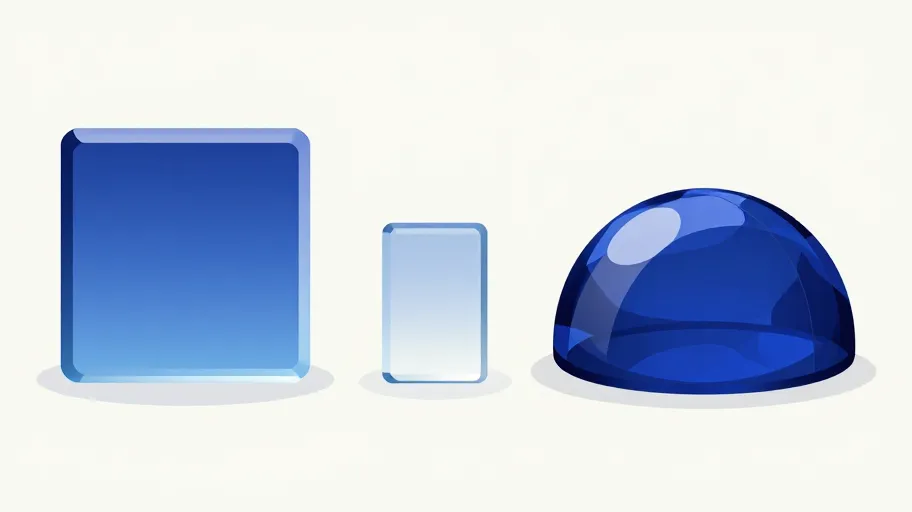
Selecting the correct profile is the foundational step in watch specification development. Flat sapphire offers superior legibility and a modern, thin profile, making it ideal for dress watches. Box-type crystals provide vintage aesthetic height and distinct light play, while domed sapphire maximizes water resistance depth and visual fluidity for tool watches. The choice depends entirely on your brand’s design language versus the required utility of the timepiece.
The Geometry-Aesthetics-Utility (GAU) Matrix
For product developers and sourcing managers, selecting sapphire watch glass types is rarely a matter of taste alone; it is an engineering compromise. To streamline your selection process, utilize the Geometry-Aesthetics-Utility (GAU) Matrix. This framework evaluates the three primary geometries against three critical vectors: Visual Distortion (how the crystal refracts the dial), Structural Height (impact on case profile and movement clearance), and Seal Integrity (ease of gasket alignment).
By mapping your project requirements against this matrix, you can quickly eliminate unsuitable geometries. For instance, if the design brief requires a razor-thin case profile, a high-dome geometry creates unnecessary internal volume and potential clearance issues with the hands. Conversely, if the brand identity relies on a vintage 1960s aesthetic, a flat crystal may appear stylistically incongruent regardless of its technical merits.
Flat Sapphire: The Standard of Legibility
Flat sapphire glass remains the industry standard for a reason: it provides the most accurate representation of the dial. From a sourcing perspective, flat crystals are generally the most straightforward to manufacture and inspect. They offer a uniform thickness that simplifies the calculation of case back clearances and hand heights.
Design Implications: The primary advantage is the elimination of parallax error and visual distortion. For chronographs or dive watches requiring precise reading of small sub-dials, a flat profile ensures that the indices remain sharp and true to their scale.
Sourcing Considerations: When specifying flat glass, the critical variables are the edge finish (beveled or flat) and the thickness relative to the diameter. As the diameter increases, the flat glass requires greater thickness to resist pressure, which adds weight. Sourcing managers must ask: Does the increased thickness of a large, flat crystal conflict with the desired overall weight of the watch?
Box-Type (Box-Dombed): Vintage Architecture
Box-type sapphire, often referred to as "box glass," features a distinctly high vertical side and a gentle, or sometimes sharp, curve at the top. This geometry is not merely about aesthetics; it is a nod to historical watchmaking where acrylic crystals were the norm.
Design Implications: The defining characteristic of the box crystal is its "tall" presence. It adds physical presence to the watch without necessarily increasing the case diameter significantly. This geometry creates a unique magnification effect that can make dial elements pop, appealing strongly to the retro-modern market segment. However, the tall internal dome requires significant clearance between the dial and the crystal. If your movement has high-hands or a protruding date wheel, a box crystal may cause mechanical interference.
Sourcing Considerations: Manufacturing box-type sapphire requires precise control over the verticality of the sides. Unlike a pure dome, the apex of a box crystal is smaller, which changes the stress distribution during polishing. When vetting a supplier, verify their ability to maintain a consistent radius on the apex without creating a "flattened" look, which ruins the vintage effect.
Domed Sapphire: The Fluid Profile
Domed sapphire crystals are categorized into two sub-types: single domes and double domes (spherical). A single dome curves from edge to center, while a double dome mimics a section of a sphere, offering a more pronounced "bubble" look often found in high-end diver watches.
Design Implications: The primary benefit of a domed crystal is fluidity; it softens the transition between the case and the wrist, often improving comfort. In diver watches, a dome aids in pressure resistance by distributing external force more evenly across the surface. However, domes introduce significant refraction. The "lens effect" can make dial edges look blurry or can magnify the dial unevenly if the dome is too high relative to the diameter.
Sourcing Considerations: This is the most complex geometry to source. The thickness of the crystal varies from the center (thinnest point) to the edges (thickest point). This variable thickness requires specialized grinding equipment to ensure the crystal does not become a "lens" that distorts the time. For AR coatings, domes present a challenge; ensuring uniform coating thickness on a curved surface requires advanced vacuum deposition techniques.
Decision Table: Sapphire Watch Glass Types
| Feature | Flat Sapphire | Box-Type Sapphire | Domed Sapphire |
|---|---|---|---|
| Visual Distortion | None. High fidelity. | Moderate magnification at edges. | High refraction; "fishbowl" effect possible. |
| Case Profile | Slim, modern. | Tall, vintage presence. | Can be slim (low dome) or tall (high dome). |
| Internal Clearance | Low demand. Saves vertical space. | High demand. Risks hand interference. | Moderate to High demand. |
| Water Resistance | Excellent with proper thickness. | Good, but gasket alignment is critical. | Superior; geometry deflects force. |
| Ideal Application | Dress watches, Chronographs, Pilot watches. | Vintage re-issues, Military style. | Diver watches, Contemporary dress pieces. |
Sourcing and Verification Checklist
Before releasing a purchase order for prototypes, use this checklist to verify your technical drawings against the supplier's capabilities. Do not assume standard tolerances apply to custom geometries.
- Clearance Verification: Have you provided the supplier with the maximum height of your hands (hour/minute/second) and the height of any dial markers (e.g., applied indices) to ensure they do not strike the crystal?
- Gasket Fit: Does the geometry provide a sufficiently flat seating surface for the gasket? Box-type crystals often have vertical sides; ensure the gasket seat is machined into the case wall, not the crystal.
- Coating Specification: If ordering domed glass, have you specified if the AR coating is internal only, external only, or double-sided? (Note: External coatings on domes are more prone to wear).
- Dimensional Tolerances: What are the agreed-upon tolerances for the overall height (AOH) and the base diameter? Variations in AOH affect water resistance ratings.
FAQ
What is the difference between a single dome and a double dome sapphire crystal? A single dome is generated by a single radius curve, much like a section of a circle. A double dome is generated by a spherical radius, creating a profile that looks like a distinct bubble. Double domes generally offer better magnification control but require thicker material at the edges.
Does a thicker sapphire crystal always mean better durability? Not necessarily. While thickness contributes to impact resistance, the hardness of sapphire (9 on the Mohs scale) means it is highly resistant to scratches regardless of thickness. Impact resistance (shatter resistance) is more closely related to the quality of the polishing and the heat treatment of the material. Always request specific impact test data for your geometry.
Can I use a box-type crystal on a modern movement? Yes, provided the movement height and hand stack are low enough. The primary issue is vertical clearance. If the hands are too high, they will scrape the apex of the box crystal. You may need to specify a "low-dome box" or use a spacer ring to lift the crystal, though this affects water resistance.
How does geometry affect the cost of tooling? Complex geometries, specifically high-domes and sharp-edged box types, require more sophisticated grinding wheels and longer polishing cycles. Flat crystals are the most cost-effective to prototype and produce. However, the economies of scale apply; once the tooling is set, the per-unit cost difference decreases significantly.
Is AR coating necessary for domed crystals? It is highly recommended. Because domed crystals act as lenses, they can reflect a significant amount of light, making the dial difficult to read. An internal AR coating helps cancel out these reflections, preserving the legibility of the watch without exposing the coating to external wear.
Compare crystal geometries Contact JadeZone Sapphire to review your technical drawings
Download your Sourcing Checklist PDF: Custom Crystal Specifications