
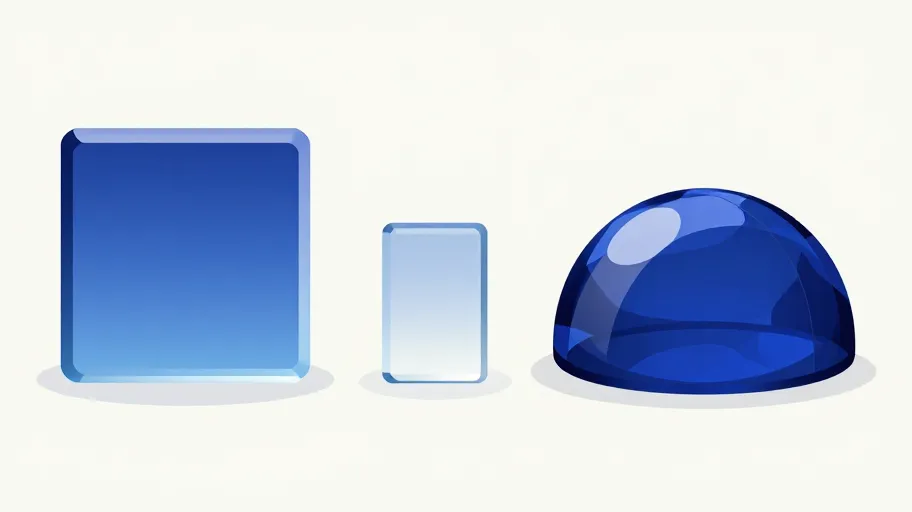
Selecting the correct geometry is a foundational decision in watch development that dictates both the aesthetic personality of the timepiece and the rigor of its engineering requirements. For watch designers and private-label brands, the choice between flat, box-type, and domed sapphire watch glass types balances the desire for visual depth against the practical constraints of water resistance, dial clearance, and shock absorption. While flat crystals offer superior structural stability and dial legibility, domed geometries provide a classic vintage allure but require precise calculation of height and refraction. Box-type crystals serve as a stylistic bridge, offering verticality without the extreme curvature of a high dome. To mitigate the risk of costly re-tooling or assembly failures, sourcing managers must evaluate these options not just by appearance, but by how their specific geometry interacts with the case architecture and movement height.
The Optical-Structural Trade-off Model
To navigate the selection process effectively, we utilize the Optical-Structural Trade-off Model. This framework requires the product developer to weigh three competing variables:
- Visual Depth: How much the crystal contributes to the wrist presence and perceived height of the watch.
- Legibility & Distortion: The degree to which the curvature alters the appearance of the dial indices and hands.
- Case Integration: The mechanical feasibility of sealing the crystal against the case and maintaining water resistance without excessive bulk.
By prioritizing two of these three variables, the third often becomes a constraint. For instance, prioritizing extreme Visual Depth (high dome) inherently increases the risk of optical Distortion and complicates Case Integration. Understanding this model helps define the technical brief before approaching a supplier.
Flat Sapphire Watch Glass
Flat sapphire crystals are the standard for modern tool watches, dive watches, and field watches due to their structural robustness and functional neutrality. From a sourcing perspective, flat glass is generally the most straightforward geometry to manufacture and install.
Technical Implications The primary advantage of flat glass is its uniform thickness. This consistency simplifies the engineering of the case back and crystal gasket, ensuring an even compression seal. Because there is no curvature to refract light, the dial remains perfectly legible from all angles, which is a critical requirement for instrument-style watches.
However, the lack of curvature can make the watch appear thinner and less refined on the wrist. To counter this, designers often specify a flat crystal with a pronounced "bezel" or a distinct edge treatment, such as a flat polished bevel, to catch the light.
Sourcing Considerations When specifying flat glass, the key verification points are the parallelism of the surfaces and the quality of the edge finish. Any deviation in parallelism can create visual distortion, despite the flat profile. Furthermore, because the crystal sits flush or slightly recessed, the clearance between the tallest dial element (usually the hour hand or a complication) and the inner surface of the crystal must be strictly measured to prevent collision during movement.
Box-Type Sapphire Watch Glass
Box-type crystals—often referred to as "box sapphire"—are characterized by their straight, vertical sides and a slightly curved or flat top. This geometry is heavily inspired by mid-20th-century acrylic crystals and is essential for brands targeting a vintage aesthetic without sacrificing the scratch resistance of sapphire.
Technical Implications The defining feature of a box crystal is its height. The vertical sides allow the crystal to rise significantly above the case, giving the watch a pronounced, vintage presence. This geometry requires a specific case design with a corresponding step or ledge to support the vertical sides of the crystal.
The complexity in sourcing box-type glass lies in the internal corner radius. Achieving a sharp internal corner at the transition from the vertical side to the top surface is difficult with sapphire due to the material's hardness; it typically requires a small radius. This radius must be accounted for in the case design to ensure the gasket seats correctly.
Sourcing Considerations Sourcing managers must pay close attention to the wall thickness of the vertical sides. If the walls are too thin, the crystal becomes brittle and prone to chipping during installation. If too thick, it may require an oversized case, disrupting the intended design proportions. It is crucial to confirm with the manufacturer that the specified height does not compromise the overall structural integrity of the thin sapphire walls.
Domed Sapphire Watch Glass
Domed crystals are the choice for dress watches and heritage re-issues, offering a smooth, pebble-like transition from the case to the crystal. They are generally categorized into "double dome" (spherical curvature on both sides) and "single dome" (curved on the outside, flat on the inside).
Technical Implications
- Double Dome: Offers the maximum magnification and vintage "bubble" look. However, because both sides are curved, the crystal acts as a lens. This can magnify the dial, which is desirable for some, but it can also cause significant refraction errors if the dial is not perfectly parallel to the crystal. The thickness at the center is also greater than at the edges, requiring the movement to be seated lower or the case back to be deeper to accommodate the extra height.
- Single Dome: Provides the external aesthetic of a dome while maintaining a flat inner surface. This simplifies dial legibility and reduces the risk of the hands rubbing against the glass. It is often a preferred compromise for modern sports watches with a vintage flair.
Sourcing Considerations The primary challenge with domed crystals is the "fitment" within the case. As the dome height increases, the effective diameter of the crystal footprint decreases. A high-dome crystal designed for a 40mm case might have a contact ring (the part that actually sits on the gasket) of only 38mm. Sourcing managers must verify the seating diameter versus the overall diameter to ensure a watertight seal.
Decision Matrix: Selecting the Right Geometry
To assist in the selection process, the following table outlines the trade-offs inherent in each sapphire watch glass type.
| Feature | Flat Sapphire | Box-Type Sapphire | Domed Sapphire (Double) |
|---|---|---|---|
| Primary Aesthetic | Modern, utilitarian, instrumental | Vintage, prominent, architectural | Classic, elegant, magnified |
| Dial Legibility | High (No distortion) | High (Vertical sides, flat/slight top) | Moderate to Low (Lens effect) |
| Case Complexity | Low (Standard gasket groove) | High (Requires stepped ledge/seat) | Moderate (Depth accommodation) |
| Shock Resistance | High (Even thickness distribution) | Moderate (Thin vertical walls are a risk) | Moderate (Center is thick, edges thin) |
| Water Resistance | Easiest to seal reliably | Requires precise edge machining | Dependent on precise dome radius |
| Ideal Application | Dive watches, Pilot watches, Field watches | Dress watches, Vintage re-issues | Vintage-inspired dress watches |
Strategic Sourcing and Verification
Once the geometry is selected, the focus shifts to the specifications that ensure manufacturability. Since sapphire is a rigid, brittle material, the transition from the crystal to the case must be managed with precision.
Thickness and Height Ratios For domed and box-type crystals, the relationship between the base thickness and the total height is critical. A dome that is too high relative to its base thickness may flex under pressure or crack during the press-fit installation. It is advisable to consult with the manufacturer to determine the minimum safe thickness for a given dome height and diameter.
Edge Treatments The finish of the crystal’s edge affects both the look and the seal.
- Flat Ground: Standard for most installations; sits flush on the gasket.
- Chamfered/Beveled: Aesthetic finish that reflects light; must be measured to ensure it does not interfere with the case wall.
- Polished: Often used for box crystals where the edge is visible.
Anti-Reflective (AR) Coatings Curved surfaces present a challenge for AR coating application. The coating thickness must be uniform across the curve to prevent color shifting or "rainbow" effects on the edges. Sourcing managers should ask the manufacturer how they manage coating consistency on high-dome geometries.
Approval Checklist for Production
Before approving the technical drawings for mass production, verify the following points with your supplier:
- Dimensional Verification: Does the seating diameter match the case gasket groove exactly, accounting for compression?
- Clearance Check: Has the total internal height of the crystal been measured against the tallest hand or dial marker to confirm adequate clearance?
- Edge Integrity: For box-type crystals, is the wall thickness sufficient to withstand pressure testing without chipping?
- Coating Specification: If AR coating is specified, is the application method suitable for the selected curvature (e.g., dip coating vs. spray)?
- Tolerance Confirmation: Are the dimensional tolerances for the diameter and flatness within the limits required for your specific water resistance rating?
Frequently Asked Questions
Does a domed crystal affect water resistance? A domed crystal itself does not inherently prevent water resistance, but it changes the mechanics of the seal. Because the crystal curves away from the case, the surface area contacting the gasket is smaller than a flat crystal. This requires a highly precise fit between the crystal diameter and the case seat to maintain pressure.
Can I replace a flat acrylic crystal with a domed sapphire crystal? Not directly. The case dimensions are designed for a specific geometry. A sapphire crystal is generally thicker than acrylic, and a domed profile may require a different case back depth to accommodate the movement. It usually requires a redesign of the case architecture or a custom-made crystal that mimics the outer profile while fitting the existing case opening.
What is the difference between a "double dome" and a "single dome"? A double dome is curved on both the exterior and the interior, creating a lens effect that magnifies the dial. A single dome is curved on the exterior but flat on the inside. Single domes are often preferred when the designer wants the domed aesthetic without the distortion or reduced hand clearance caused by an internal curve.
Why are box-type crystals more expensive? Box-type crystals typically require more raw material (due to their height) and more complex machining to achieve the vertical sides and crisp internal corners. The rejection rate during manufacturing can also be higher due to the stress points at the sharp internal transitions.
How does thickness impact the cost of sapphire glass? Sapphire cost is largely determined by the volume of the raw material and the time required for grinding and polishing. Thicker crystals and those with complex geometries (like high domes) take longer to polish to optical clarity, increasing production time and cost.