
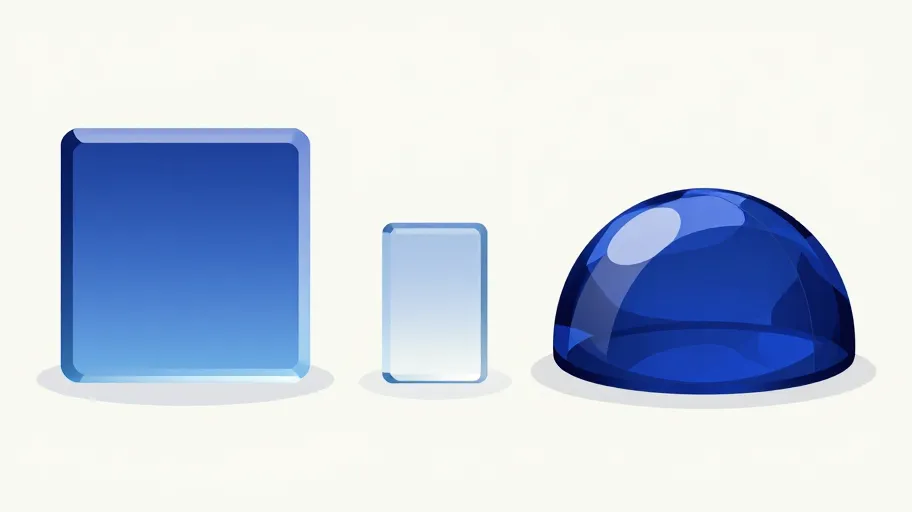
Selecting the correct geometry is a foundational decision in watch specification that dictates both the visual identity of the timepiece and the complexity of the case engineering. For most modern applications, flat sapphire offers superior sealing and ease of anti-reflective coating application. However, box-type sapphire is essential for vintage re-issues requiring a distinct vertical step, while domed sapphire remains the choice for maximizing dial depth and refractive allure in dress watches.
Navigating the SAPPHIRE-Select Framework
To streamline the selection process, sourcing managers and product developers should utilize the SAPPHIRE-Select Framework. This approach moves beyond simple aesthetics to evaluate the interplay between the crystal profile and the watch’s mechanical requirements.
- Surface Profile: The visual curvature (flat, angled, or spherical).
- Application Fit: Compatibility with the intended use case (diver, dress, pilot).
- Production Complexity: CNC grinding and polishing difficulty relative to the geometry.
- Protection Level: Structural integrity and resistance to point impact.
- Hardness Interaction: How the angle affects the perceived thickness and edge vulnerability.
- Internal Clearance: The LIG (Lift Inside Glass) required to accommodate movement height.
- Refraction Control: The degree of magnification or distortion introduced by the curve.
- Economics: Tooling setup costs and yield rates for the specific shape.
Flat Sapphire Watch Glass
Flat crystals are the benchmark for tool watches and contemporary sports models. From a manufacturing perspective, flat sapphire is the most predictable of the sapphire watch glass types. It allows for efficient utilization of raw sapphire boules and maximizes yield during the slicing process.
For the designer, the primary advantage is the control over optics. A flat surface introduces zero magnification, ensuring that dial elements and indices are viewed exactly as designed. This is critical for field watches or dive watches where legibility is paramount. Furthermore, flat surfaces are ideal for applying double-sided anti-reflective coatings. The coating process, often involving vacuum deposition, adheres more uniformly to a planar surface compared to a tight radius, reducing the risk of coating stress or crazing over time.
However, the "hard truth" of flat sapphire is its visual solidity. Without the light-play of a curve, a flat crystal can appear utilitarian. To mitigate this, designers often opt for a pronounced bevel on the underside (a chamfer) to catch the light, though this adds an extra step to the CNC grinding process.
Box-Type Sapphire (Stepped)
Box-type crystals are a specialized subset of sapphire watch glass types designed to emulate the look of high-dome acrylic crystals found on mid-20th-century timepieces. Unlike a simple dome, a box-type crystal features a vertical "step" or distinct angle before transitioning to the main surface.
This geometry is technically demanding to produce. It requires specialized tooling to grind the vertical step and the interior angle without inducing micro-fractures in the sapphire. The complexity lies in maintaining optical clarity across the transition point where the vertical wall meets the sloped interior.
For brands focusing on heritage or retro aesthetics, the box-type sapphire is non-negotiable. It provides the "bubble" appearance vintage collectors crave while offering the scratch resistance of modern synthetic sapphire. When sourcing this geometry, the critical factor is the radius of the top corner. A sharper corner mimics older acrylic crystals more closely but is more susceptible to chipping during assembly. A rounded corner radius increases durability but slightly alters the vintage profile.
Domed Sapphire
Domed sapphire serves the luxury and dress watch segments. The geometry is defined by its spherical curvature, which can be specified as a "single dome" (curved on the outside, flat inside) or a "double dome" (curved on both sides).
The double dome is particularly significant because it allows for a thicker crystal at the center (the apex of the dome) without adding excessive visual thickness. This maintains a low profile while increasing structural integrity. However, sourcing managers must be aware of the "magnification effect." A double dome acts as a lens, magnifying the dial. While this is often a desired effect, adding perceived value and depth, it can cause distortion if the dial printing is not positioned perfectly relative to the focal point of the curve.
From a production standpoint, high-dome sapphire requires more raw material waste than flat glass, as the crystal must be ground from a thicker blank to achieve the apex height. Additionally, the tighter the radius (the higher the dome), the more difficult it is to apply uniform coatings.
Decision Table: Sapphire Watch Glass Types
| Feature | Flat Sapphire | Box-Type (Stepped) | Domed Sapphire |
|---|---|---|---|
| Primary Aesthetic | Utilitarian, Modern, Tool | Vintage, Retro, Mid-Century | Elegant, Deep, Classic |
| Optical Distortion | None (True to dial) | Moderate (Edge refraction) | High (Magnification effect) |
| AR Coating Feasibility | Excellent (High uniformity) | Moderate (Step transition challenge) | Good (Requires specialized fixtures) |
| Case Sealing | Easiest (Uniform gasket compression) | Complex (Step requires specific gasket design) | Moderate (Risk of rocking if tolerance is loose) |
| Impact Resistance | High (Direct force dispersion) | Medium (Step is a potential stress point) | High (Curved structure deflects impact) |
| LIG (Lift Inside Glass) | Low / Minimal | Medium / High | High (Accommodates taller movements) |
Sourcing Approval Checklist
Before approving the technical drawings for production, verify the following points with your manufacturer:
- [ ] Profile Tolerance: Have you confirmed the acceptable deviation in the dome radius or step height? Tight tolerances on complex curves increase scrap rates.
- [ ] Edge Finish: Is the edge polished (transparent) or matte (frosted)? A polished edge on a box-type crystal adds significant assembly time but looks premium.
- [ ] Interior Clearance: Does the specified LIG provide enough clearance for the hands and the top of the movement bridge throughout the full rotation of the hands?
- [ ] Coating Coverage: If the crystal is domed, has the supplier confirmed the coating coverage percentage? High domes may have thinner coating at the apex.
- [ ] Gasket Compatibility: Has the gasket groove in the case been machined to match the specific geometry of the crystal's edge?
Technical FAQ
Q: Does a thicker sapphire crystal always mean better durability? Not necessarily. While thickness contributes to impact resistance, the geometry plays a larger role. A well-engineered domed crystal can deflect impact better than a poorly supported thick flat crystal. However, thickness does increase resistance to flexing, which is vital for water resistance in dive watches.
Q: Can box-type sapphire be treated with anti-reflective coating? Yes, but it is technically challenging. The transition point between the vertical step and the dome can cause "shadowing" during the vacuum deposition process. It is essential to ask the supplier how they fix the crystals during the coating cycle to ensure even coverage on the vertical surfaces.
Q: What is the difference between "Spherical" and "Cylindrical" doming? Most watch crystals are spherical (like a section of a ball). Cylindrical doming curves along one axis (like a section of a tube) and remains flat along the perpendicular axis. This is rare for the main crystal but sometimes used for exhibition casebacks.
Q: How does the dome height affect water resistance? A higher dome increases the LIG. If the case back and movement height remain constant, a higher dome raises the overall height of the watch. More importantly, a very high dome can put lateral stress on the gasket if the crystal rocks slightly. A "tension ring" or acrylic insert is sometimes used to stabilize high-dome crystals.
Q: Why are double domed crystals more expensive? Double domed crystals require grinding and polishing on both the exterior and interior concave surfaces. This doubles the machining time and requires more sophisticated tooling to hold the piece during the internal shaping process.
Conclusion
The choice between flat, box-type, and domed sapphire watch glass types is rarely purely aesthetic; it is a calculation of brand identity against manufacturing reality. Flat glass offers the safest route for robust tooling and legibility. Box-type sapphire unlocks the vintage market but demands precision engineering to execute the step without fragility. Domed sapphire offers visual prestige but requires careful management of magnification and coating application. By applying the SAPPHIRE-Select framework and validating the technical specs with the approval checklist, sourcing managers can ensure the final component aligns with both the design vision and production capabilities.
[CTA Primary] Compare crystal geometries
Contact our engineering team to review your technical drawings and select the optimal geometry for your next production run.
[CTA Secondary] Download Sourcing Checklist
Get the full PDF checklist for verifying sapphire crystal specs before mass production.