
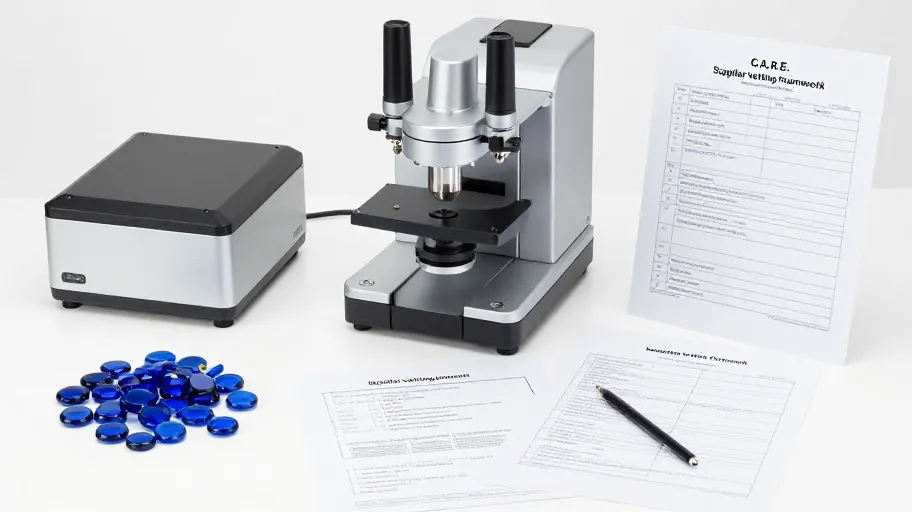
Before committing to sapphire glass production, document your exact dimensional requirements, optical specifications, and quality acceptance criteria. You must verify the manufacturer's technical capacity for your specific geometry and coatings. Prepare a structured list of questions regarding production capabilities, material sourcing, and inspection protocols to approve your supplier choice.
The C.A.R.E. Supplier Vetting Framework
Sourcing custom sapphire crystals requires precise communication. The C.A.R.E. framework helps watch brands and sourcing managers organize their documentation before requesting a quotation or committing to production.
Clarify: Define your exact part specifications. Document the required dimensions, edge treatments, and optical coatings. Undefined variables at this stage lead to unmet expectations later.
Assess: Evaluate the manufacturer's technical ability to produce your specific design. Inquire about their equipment for slicing, grinding, polishing, and coating sapphire.
Request: Ask for evidence of their quality control processes. Document what inspection reports, measurement data, or tolerance adherence proofs they provide.
Evaluate: Compare the documented responses against your project requirements. Ensure all technical and logistical questions are answered before granting approval.
Technical specification decision table
Use this table to map your project requirements before approaching a manufacturer for sapphire glass production.
| Specification category | Questions to document for the supplier | Buyer preparation action |
|---|---|---|
| Geometry and dimensions | What are the exact diameter, thickness, and profile requirements? | Draft a technical drawing with exact measurements. |
| Coating and optical clarity | Is an anti-reflective coating required on one side or both sides? | Specify the desired light transmission percentage. |
| Edge treatment | What type of edge finishing does the watch case require? | Define the bevel, chamfer, or flat polish details. |
| Material verification | How is the sapphire substrate verified for purity? | Request documentation of the raw material grade. |
| Quality acceptance | What defect tolerance is acceptable under magnification? | Define the inspection standard and magnification level. |
Concrete approval questions for sapphire glass production
Present these questions to your prospective manufacturer. Require specific, documented answers rather than general statements.
- What specific equipment does your facility use for slicing and polishing sapphire crystals?
- What measurement tools do you utilize to verify dimensional adherence?
- How do you document the adhesion and performance of anti-reflective coatings?
- What is your procedure for managing deviations during the prototyping phase?
- How do you handle batch consistency during mass production?
- Confirm the current policy directly regarding sample provisions, associated fees, and transit arrangements.
- Confirm the current policy directly regarding production lead times, order minimums, and maximum capacity limits.
- Confirm the current policy directly regarding quality assurance protocols, defect management, and compliance certifications.
Frequently asked questions
What variables must be defined before requesting a sapphire crystal quote? Define the exact geometry, thickness, edge treatment, and coating requirements. Provide a complete technical drawing. Confirm the current policy directly regarding the manufacturer's ability to prototype specific designs.
How do buyers verify a manufacturer's production capability? Request detailed information about their slicing, grinding, and polishing machinery. Ask for evidence of previous projects with similar geometric complexities. Confirm the current policy directly regarding factory audits or site visit arrangements.
What documentation should accompany a production batch? Request dimensional inspection reports, coating performance data, and material purity verification. Ensure the documentation matches your specified acceptance criteria. Confirm the current policy directly regarding the specific testing certificates provided.
How are component tolerances communicated and verified? Tolerances must be explicitly stated on the technical drawing. The manufacturer must explain their measurement methodology to prove adherence. Confirm the current policy directly regarding acceptable tolerance deviations for custom sapphire geometries.
What steps are involved in approving a custom sapphire prototype? The buyer must evaluate the prototype against the submitted technical drawings. Document any dimensional or optical deviations. Confirm the current policy directly regarding the procedure for implementing revisions after the initial prototype evaluation.
Download the checklist
Organize your sourcing data and verify supplier capabilities systematically. Download our comprehensive checklist to guide your documentation process.
JadeZone Sapphire is a Shenzhen and Hong Kong B2B manufacturer of custom sapphire watch crystals and precision sapphire components. We assist watch brands, product developers, and sourcing managers in documenting their custom sapphire glass production requirements.