
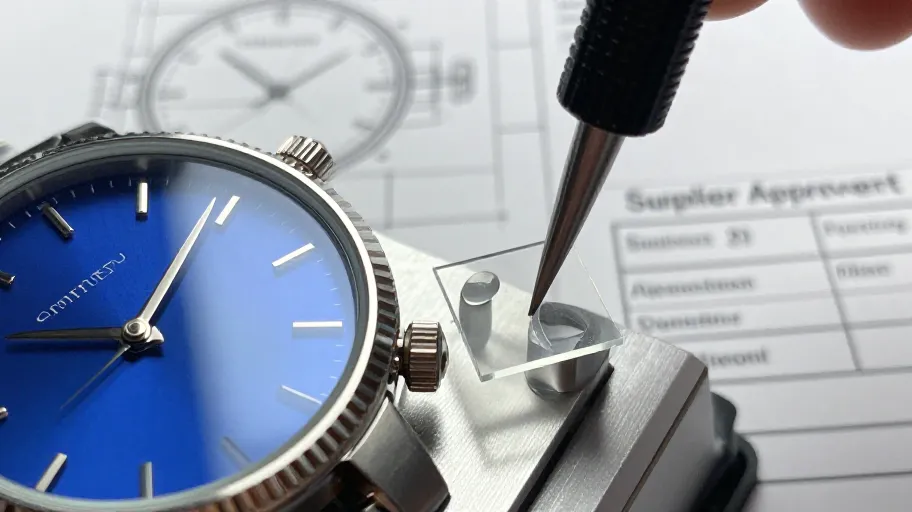
Is a sapphire crystal watch worth it? For a watch brand, the answer is commercial, not sentimental: sapphire is worth specifying when its scratch resistance, optical clarity and warranty exposure profile fit your price tier, positioning and service commitments — and only a verified sample approval process proves a supplier can deliver to your drawings.
Reframing "worth it" for brands, not consumers
Most content answering this question is written for a consumer deciding between two finished watches. You are deciding something different: whether to specify sapphire across a product line, at what cost and risk profile, and with what approval process before mass production. That shifts the question in three ways:
- Value is positional. A sapphire crystal supports a brand promise of durability and longevity. Whether that promise matters depends on your positioning, channel and price architecture — decisions you own, not the supplier.
- Risk is aggregated. A single consumer weighs one watch. You weigh a production run. A crystal specification error propagates across every unit, every warranty claim and every aftermarket service event.
- "Worth it" must be verified, not assumed. The material category has well-understood properties, but your project outcome depends on this supplier's execution of this drawing — which is what samples and sign-off exist to prove.
A disciplined way to structure this decision is the SPEC–SAMPLE–SIGN-OFF framework:
- SPEC — define the technical requirement completely before contacting suppliers, so every quotation answers the same drawing.
- SAMPLE — evaluate a physical sample against that drawing with measurable acceptance criteria, not visual impressions.
- SIGN-OFF — document what was approved, by whom, and what constitutes a deviation, so production and the sample are contractually linked.
Skipping any of the three stages converts a specification decision into a gamble.
The specification domains that decide whether sapphire pays off
A crystal is not a single choice but a set of interlocking specifications. The table below maps the four domains you should have answers for before requesting quotations. Use it as a decision table: for each row, record your requirement, the open question for the supplier, and the evidence you will accept.
| Specification domain | What it covers | Questions to define internally | What to ask the supplier to confirm |
|---|---|---|---|
| Optical | Transparency, clarity, internal quality, coatings | Do we need an anti-reflective coating, and on how many faces? How will optical quality be judged? | What coating options are offered for this geometry, and how is coating performance characterised for this project? |
| Mechanical | Fit, case integration, gasket interface, water-resistance role | How does the crystal participate in the case seal? What assembly forces apply? | How is the gasket seating surface machined and inspected on this design? |
| Dimensional | Diameter, thickness, bevel geometry, features | What drawing tolerances does our case design actually require? | What dimensional tolerances can you hold and verify for this specific part, and with what measurement method? |
| Material and finishing | Grade, polish quality, edge treatment, markers or print | What surface finish and edge treatment does our design call for? | What finishing processes are available, and how are they inspected? |
Treat every cell in the right-hand column as a project-specific confirmation, not an assumption. Any supplier who cannot answer with reference to your drawing has not yet earned the order.
Sample evaluation: turning "worth it" into evidence
A sample is only useful if it is evaluated against pre-agreed criteria. Before requesting samples, write a one-page acceptance sheet covering:
- Dimensional verification. Which features are measured, with which instruments, and against which drawing tolerances you have agreed with the supplier.
- Optical inspection. How clarity, coating presence and visual defects are judged — under what lighting, at what magnification, and with a pass/fail definition.
- Functional fit. Trial assembly with your actual case and gasket, documented with photos and measurements.
- Deviation handling. What happens if the sample deviates from the drawing — who decides, and what evidence supports the decision.
What you must not do is accept a sample as a promise. Confirm with the supplier, in writing and before evaluation begins: the current sample policy, whether samples are charged and on what terms, who bears shipping, what the sample represents relative to production, and the current policy on re-sampling if deviations are found. These policies vary by project and change over time — the only safe answer is the one the supplier confirms to you directly for this enquiry.
Approval questions to put to any supplier
Bring these to your first technical review. The quality of the answers tells you as much as the answers themselves.
- Can you review our drawing and flag any feature that affects manufacturability, cost or reliability before we fix the specification?
- What measurement and inspection methods will you use for the dimensional and optical criteria we have defined, and can inspection evidence accompany delivery?
- How do you link the approved sample to production — what documented reference governs what a conforming part is?
- What is your process when a delivered lot deviates from the approved reference, and how is that resolved?
- What information do you need from us — case drawings, gasket specification, assembly method — to quote accurately?
- What project-specific terms apply to samples, MOQ, lead time and changes to the drawing after approval? (Ask for each in writing as current policy, not as a general rule.)
The sign-off checklist
Approval is a documented act. Before releasing a design to production, complete this checklist:
SPEC–SAMPLE–SIGN-OFF checklist
- Drawing finalised, revision-numbered, and shared with the supplier
- All four specification domains (optical, mechanical, dimensional, finishing) documented
- Acceptance criteria written before sample evaluation begins
- Sample policy, terms and shipping arrangements confirmed in writing for this project
- Dimensional measurements recorded against drawing tolerances
- Optical inspection completed against the agreed pass/fail definition
- Trial assembly with production case and gasket completed and photographed
- Deviations (if any) documented and dispositioned
- Approved sample labelled, retained and referenced in the purchase agreement
- Change-control path agreed for any post-approval drawing revision
Download or copy this checklist and attach it to your RFQ file — it converts a supplier conversation into an auditable decision. (Low-friction checklist CTA: copy this checklist into your next supplier enquiry.)
FAQ
Does sapphire make sense for an entry-level line? That depends on your warranty exposure and brand promise, not on a general rule. A brand whose positioning leans on durability may find sapphire justified even at a lower price point; a fashion-led line may not. Model your expected service and return events, then decide.
How do I compare sapphire against mineral or hybrid crystals for a specific model? Compare on the criteria that drive your costs: scratch-related service events, optical presentation, gasket design implications and the tooling implications of each option. Ask each supplier to quote against the same drawing set so the comparison is like-for-like.
What should a crystal RFQ contain to get an accurate quotation? A revision-controlled drawing, the case and gasket context, your dimensional and optical acceptance criteria, the finishing specification, target volumes and any certification or documentation requirements you have — with each open item flagged as a question rather than an assumption.
How many sample rounds should we plan for? There is no safe universal number. Plan instead for a defined loop: sample, measure against agreed criteria, disposition deviations, re-sample if required — with the supplier's current re-sampling policy confirmed in writing before you start.
What single document protects us most in a custom crystal project? The approved, retained reference sample, tied contractually to your drawing revision. It is the only artefact that links what you evaluated to what you will receive.
Next step: 获取采购 Brief
Ready to evaluate sapphire for your next model? 获取采购 Brief — a structured enquiry document covering specification domains, approval questions and the sample evaluation criteria from this guide, prepared for B2B buyers working with JadeZone Sapphire on custom or OEM sapphire watch crystals. Request it and start your next crystal project with the specification, not the negotiation.