
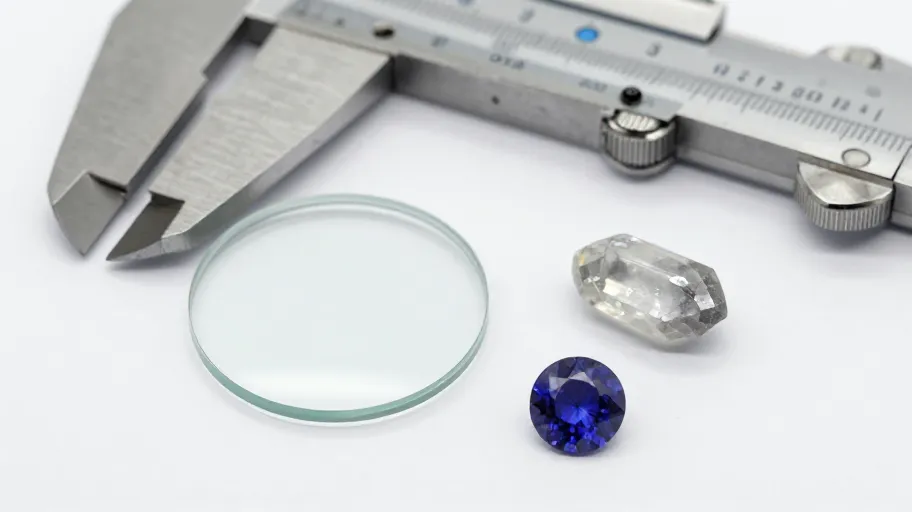
Yes — in watchmaking, "sapphire crystal" means real crystalline aluminium oxide, grown synthetically rather than mined. It is chemically the same substance as natural sapphire, excluding trace impurities that give gemstones colour. The commercial risk is not the material name but substitution: glass or spinel sold under a loose "sapphire" label. Verification, not trust, closes that gap.
What "Sapphire Crystal" Actually Means
Synthetic sapphire for watch crystals is grown as a boule of single-crystal aluminium oxide (Al₂O₃), then sliced, ground and polished into the finished crystal. It is real sapphire in the crystallographic sense: the same lattice structure, the same chemical composition, the same hardness characteristics as the natural gemstone. The lab-grown process exists because natural sapphire with the required optical clarity and orientation is scarce and inconsistent for industrial use.
The procurement problem sits in the space between that definition and supplier wording. "Sapphire crystal" appears on spec sheets that describe glass, coated glass, or synthetic spinel (MgAl₂O₄). None of these are aluminium oxide single crystal. A buyer who treats the phrase as self-evident is outsourcing material authentication to the seller.
That is why the question "is sapphire crystal real sapphire?" deserves a process, not just an answer.
The VERIFY Framework for Crystal Approval
Use VERIFY to structure every crystal qualification, from first enquiry to mass-production approval:
- V — Verify composition. Ask the supplier to state the crystal material in writing: single-crystal aluminium oxide, and whether it is grown by the method they claim. Ask which plane orientation is cut for the watch face and whether it matters for your design.
- E — Expose coatings. Clarify whether the crystal carries an anti-reflective (AR) coating, on one side or both, and how the coating is described in the spec sheet. Coating behaviour is a separate approval item from the substrate.
- R — Refuse assumptions. Do not accept "sapphire" as a complete material claim. Request the full specification: material, coating, dimensional callouts, surface finish and inspection criteria, each confirmed in writing.
- I — Identify tests. Ask which tests the supplier performs and can document — hardness, composition, optical transmission, coating adhesion — and whether reports are batch-specific or one-time.
- F — File evidence. Keep a dated approval file: quoted specs, drawings, sample inspection records, test reports and correspondence. This file is your reference when production parts arrive.
- Y — Yield approval. Approve the supplier only when the documented sample matches the documented specification and your own inspection results. Approval is a document, not a feeling.
Decision Table: Specification Attributes and Approval Questions
| Spec attribute | What the buyer should ask | Evidence to request | Risk if skipped |
|---|---|---|---|
| Substrate material | "Confirm in writing that the crystal is single-crystal aluminium oxide." | Material specification sheet with composition statement | Substitution with glass or spinel at sapphire pricing |
| Crystal growth method and orientation | "Which growth process is used, and what plane orientation is supplied?" | Supplier technical data or process description | Orientation-related optical or durability surprises |
| AR coating | "Is AR coating applied, to which surfaces, and how is it specified?" | Coating specification; ask which coating tests are performed | Coating defects or expectations mismatch after assembly |
| Dimensions and fit | "How are dimensional callouts defined and inspected for my drawing?" | Dimensional inspection method against your approved drawing | Fit and sealing problems at assembly |
| Surface quality | "What inspection criteria apply to polish, edges and inclusions?" | Inspection criteria document; your own sample inspection | Visible defects reaching finished watches |
| Batch consistency | "How do you confirm that mass production matches the approved sample?" | Batch control or traceability description | Sample-to-production drift |
| Test documentation | "Which test reports can accompany each batch?" | Sample of report format, batch-referenced | No objective basis for acceptance or claims |
Every row above is a project-specific question. Sample policies, fees, shipping arrangements, lead times and tolerances were not supplied for this article and must be confirmed directly with the supplier in each case.
Sample Approval Without Guesswork
Sample approval is where the keyword question becomes commercial. Three practices make the difference:
- Approve against a frozen specification. Before samples ship, the drawing and spec sheet should be agreed in writing. A sample without a specification is an opinion.
- Inspect independently. Where your volumes justify it, use a third-party lab or your own instruments to confirm material identity and coating behaviour. Ask the supplier which tests they expect you to repeat and why.
- Document the reference sample. Retain the approved sample, labelled and dated, as the acceptance reference for production. When production parts differ, the comparison is to the reference, not to memory.
Approval Questions to Send Before You Commit
Add these to your supplier qualification email:
- Please confirm the crystal material in writing, including growth method and orientation.
- Please state which surfaces carry AR coating and how the coating is specified and tested.
- Please describe how dimensional and surface inspection is performed for custom drawings.
- Please confirm which reports accompany samples and production batches.
- Please state your current sample policy, any associated fees and shipping arrangements — confirmed directly, in writing, before ordering.
- Please describe how mass production is verified against the approved reference sample.
FAQ
Is sapphire crystal the same as natural sapphire? Chemically and crystallographically, yes — synthetic sapphire is aluminium oxide single crystal, identical in structure to natural sapphire minus the trace elements that colour gems. For watch use it is produced synthetically to achieve consistent clarity and orientation.
Can I tell real sapphire crystal from glass without lab equipment? Field checks exist — hardness behaviour and certain optical cues — but they are screening aids, not proof. For a B2B purchase decision, rely on written material confirmation, documented test reports and, where warranted, independent third-party verification.
What is synthetic spinel, and why does it matter? Synthetic spinel is a different crystal (magnesium aluminium oxide) that has been used as a lower-cost watch-crystal material. It is not sapphire. If a spec sheet says "sapphire crystal" but the material is spinel, the specification — and the price — do not match the claim. Ask for the composition in writing.
Does AR coating change whether the crystal is real sapphire? No. The coating is a thin applied layer; the substrate beneath must still be verified as aluminium oxide single crystal. Treat substrate and coating as two separate approval items with separate evidence.
How do I keep production consistent with the approved sample? Freeze the specification, retain the approved reference sample, and agree in advance how the supplier verifies batch-to-batch consistency. Ask directly what documentation accompanies each batch, and confirm current policies with the supplier before you commit.
Next Step
获取采购 Brief — request the procurement Brief from JadeZone Sapphire and use it to structure your enquiry, specification freeze and sample approval in one documented workflow.
Prefer to start smaller? Download the low-friction sapphire crystal approval checklist and run it against your next sample before you sign off.