
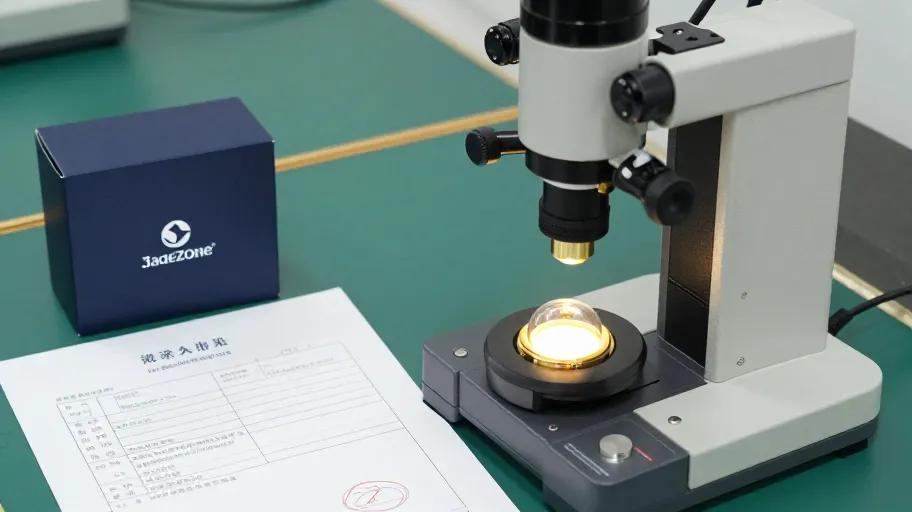
Specifying a domed sapphire crystal for a women's heritage watch comes down to three controlled steps: write the geometry and optical specification before quoting, sample against that specification rather than against photos or descriptions, and approve through a documented gate — golden sample plus written acceptance criteria — before releasing production. JadeZone Sapphire, a Shenzhen and Hong Kong B2B manufacturer of custom sapphire watch crystals and precision sapphire components, supports this workflow. The buyer's job is to arrive with the spec; the supplier's job is to prove conformity.
Why a women's domed crystal is a sourcing problem, not just a part number
A domed sapphire crystal on a small women's case concentrates several engineering tensions into a small area. The dome that gives a heritage watch its vintage character also changes magnification, refraction at the edge, and the distance between the crystal underside and the hands. A profile that reads beautifully on a larger men's case can distort a small dial, clip a handset, or fight with a rehaut. And because heritage designs lean on proportion — boxy domes, tall curves, polished edges — the crystal is not a commodity purchase; it is a component whose geometry defines how the whole watch is perceived.
That is why this guide treats the purchase as a specification and approval project, not a catalogue selection.
The SPEC–SAMPLE–SIGN framework
Use this three-stage framework to control the sourcing process:
- SPEC — Specify before you quote. Convert the heritage design intent into a written, dimensioned specification. Nothing should be quoted from a mood board or reference photo alone.
- SAMPLE — Sample against the spec. Request samples evaluated against controlled drawings and measurable criteria, not against visual impressions.
- SIGN — Approve through a documented gate. Lock a golden sample, record acceptance criteria, and sign the delivery gate before mass production begins.
Skipping any stage transfers risk downstream, where it becomes more expensive to correct.
SPEC: what your specification must define
Bring the following to your first technical conversation with any supplier, including JadeZone Sapphire:
Geometry and profile
- Dome form: spherical, box-dome, double-domed, or a custom revolved profile — supplied as a drawing, not a verbal description.
- Dome height and radius of curvature relative to case size.
- Overall thickness and thickness at the apex versus the edge.
- Edge treatment: polished, bevelled, or stepped; bevel angle documented.
- Diameter and any non-round geometry with dimensions stated on a controlled drawing.
Fit and interface
- Gasket or bezel interface: flatness and seating surface requirements.
- How the crystal is retained — friction fit, adhesive, bezel clamp — and what the crystal must tolerate in that assembly.
- Hand-to-crystal clearance for the specific handset, including sweep-hand rise.
Material and optical requirements
- Sapphire (single-crystal alumina) with the orientation and surface finish stated in the specification.
- Anti-reflective coating: which surfaces, how coating performance will be verified, and what evidence the supplier will provide. Do not accept coating claims without a stated verification method.
- Legibility acceptance criteria: how magnification and edge distortion will be judged on the actual dial and handset, and by whom.
Documentation
- Drawing revision control, so every sample and batch is traceable to one spec version.
- A stated dimensional-inspection plan: which dimensions get measured, with what method, on what share of parts.
Because no tolerance values, MOQs, lead times, costs, certifications or sample policies are supplied in this brief, each of those must be confirmed in writing with the supplier as project-specific terms. Ask for the numbers relevant to your drawing, not to a general product category.
SAMPLE: evaluating what arrives
When samples come back, evaluate them against the spec — never against a previous sample alone, and never against a photo. Set up the evaluation before the parts arrive:
- Dimensional inspection against the controlled drawing, using your stated measurement method.
- Installation trial on the actual case and gasket, with the actual dial and handset in place.
- Optical review under defined lighting: dome distortion, edge refraction, coating behaviour, clarity over the dial centre and date window if applicable.
- Longevity-relevant checks you define in advance, such as coating adhesion evidence — ask the supplier what test data they can document and verify it against your own acceptance criteria.
Record every result. If a sample passes visually but fails one measured dimension, the sample fails. This discipline is what makes later disputes resolvable and later batches stable.
Decision table: reading supplier responses
| Signal from supplier | What it means | Buyer action |
|---|---|---|
| Responds to your drawing with questions about profile, gasket interface and handset clearance | The supplier is engineering the part, not copying it | Prioritise; request written answers and a revision-tracked quote |
| Quotes from a reference photo without requesting dimensions | Risk of profile mismatch discovered at assembly | Send the controlled drawing; pause until they engage with it |
| Offers a documented inspection plan for sampled dimensions | Verifiable conformity, not assurances | Ask what evidence accompanies each batch |
| Cannot state how coating performance is verified | Coating claims cannot be checked | Request the verification method in writing; do not approve on description alone |
| Confirms sample policy, fees and terms in writing when asked | Clear commercial terms | Compare against your project budget and timeline; document the commitment |
| Golden sample retained and referenced by revision number | Batch-to-batch control exists | Make the golden sample the binding reference in your purchase terms |
SIGN: the approval questions to send before any production release
Send these to the supplier — with JadeZone Sapphire or any candidate — and keep the written answers as part of your project file:
- Can you manufacture to our controlled drawing revision, and how do you confirm dimensional conformity on samples and on production batches?
- What dimensional verification method and equipment will you use, and what documentation accompanies each batch?
- How will AR coating performance be evidenced, and what verification do you accept for rejection criteria?
- Will a golden sample be retained at your facility and at ours, and how is it referenced in batch release?
- What is your current MOQ, unit pricing basis and lead time for this drawing revision? (Confirm in writing as project-specific figures.)
- What is your process for handling non-conforming parts found at incoming inspection after release?
- Which certifications or factory capability documents can you provide that are current and applicable to sapphire crystal production, and can we verify them?
If a supplier cannot or will not answer in writing, that itself is decision data. Compare, document, and only then approve.
The delivery gate checklist
Before releasing mass production, every box below must be checked and signed:
- Controlled drawing revision agreed and referenced in the purchase order
- Sample passed dimensional inspection against the drawing
- Sample passed installation trial on the real case, gasket, dial and handset
- Optical and legibility acceptance criteria met under defined lighting
- Coating verification method documented and evidence provided
- Golden sample approved, retained at both parties, revision-numbered
- MOQ, price basis, lead time and payment terms confirmed in writing
- Batch inspection plan and non-conformance procedure agreed
- Named approvers on both sides have signed the gate
No signature, no release. That single rule prevents the most expensive category of crystal sourcing failure: discovering a profile or coating problem after production parts are made.
FAQ
1. Should I specify a domed crystal by dome height or by radius of curvature? Specify both, on a controlled drawing, relative to your case diameter and handset. A dome that suits one case size can distort a smaller women's dial or interfere with hands. Give the supplier the full geometry and the assembly context, and ask them to confirm manufacturability in writing.
2. How do I judge whether a heritage dome distorts the dial? Define the test before sampling: the actual dial, the actual handset, defined lighting, and viewing angles your end customers would use. Evaluate edge refraction, date-window legibility if present, and magnification consistency. Accept or reject against those criteria, documented — not against impressions.
3. What should I ask about AR coating before approving? Ask how performance is verified: which surfaces are coated, what test or measurement evidences the coating, and what the rejection criteria are. Request the verification method in writing and compare it against your acceptance standard. Do not approve coating claims that arrive without a stated method of proof.
4. What is a golden sample and why does it matter for crystals?
5. How can I avoid quality drift between the sample and production parts? Three controls: a golden sample with revision control, a written batch inspection plan stating which dimensions are measured and how, and a signed delivery gate that blocks production release until sample conformity is documented. Ask the supplier for their batch-level evidence format before your first order.
Next step
If you are specifying a women domed sapphire crystal heritage watch project, start by building the spec file: 获取采购 Brief, and bring the completed specification to JadeZone Sapphire for technical review against your drawings and heritage design intent.
Prefer to start smaller? Use the delivery gate checklist above as your internal pre-sourcing review — tick every box on your side before your first supplier conversation, and confirm all current commercial and technical policies directly with JadeZone Sapphire in writing.