
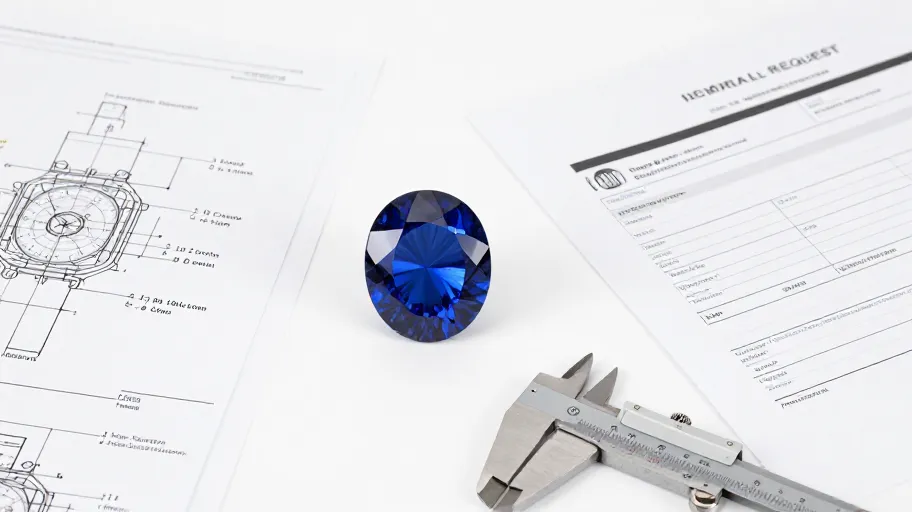
An approved sample becomes a production order only when it is translated into a documented specification: locked drawings, agreed tolerances, defined coatings and inspection criteria, and a clearly scoped commercial request. Give your sapphire watch glass supplier a complete, quote-ready brief, and you get comparable quotations, fewer surprises, and a defensible approval record.
Why an approved sample is not a quotation
Procurement teams reach the sample stage with relief: the crystal fits, the clarity is right, the edge treatment matches the design intent. The instinct is to send a short email — "we approve this sample, please quote for production" — and expect a clean number back.
The fix is structural, not relational. Before you request production pricing, walk your project through five gates.
The Sample-to-Production Gate
| Gate | What you lock down | Evidence you hold | Question that unlocks the next gate |
|---|---|---|---|
| 1. Drawing Lock | Final 2D/3D drawings, revision number, datums and critical dimensions | A version-controlled drawing file, agreed in writing | "Is this drawing revision the sole reference for production?" |
| 2. Spec Confirmation | Material grade reference, thickness, edge finish, coating specification, printing or logo requirements | A written specification sheet referencing the drawing | "Which specification items are fixed, and which remain open to discussion?" |
| 3. Approval Boundary | What the approved sample represents: which attributes are locked, which may vary within agreed limits, and how conformity will be judged | A documented approval note, signed off internally and acknowledged by the supplier | "What exactly does 'approved' cover — geometry only, or coating, finish and fit as well?" |
| 4. Commercial Scope | Quantity scenarios, packaging, labelling, inspection and documentation expectations, delivery terms to be quoted | An RFQ document stating scope items explicitly | "Are we asking every supplier to quote the identical scope?" |
| 5. Production Handoff | Approved specification package transmitted, commercial terms under negotiation, first-article or pilot arrangement agreed | A handoff record: documents sent, open points listed, owners and dates assigned | "What must be settled before mass production is authorised?" |
Move through the gates in order. Skipping ahead — requesting pricing at Gate 1, or authorising production at Gate 3 — is how scope gaps become disputes later.
Gate 1: Drawing Lock
Everything downstream inherits from the drawing. Confirm three things with your team before anything leaves the building: the revision number is current; every critical dimension has a stated tolerance band (your designer and the supplier should agree what "critical" means for this model); and datums are marked so the supplier measures the same features you will inspect.
Questions to resolve at this gate:
- Which drawing revision is authoritative, and who holds change control?
- Which dimensions are fit-critical (e.g., the bezel seat) versus cosmetic?
- How will drawing changes after approval be handled — new revision, re-approval, or rejection?
Gate 2: Spec Confirmation
The drawing defines shape; the specification defines everything else. Write down the material requirement as you understand it, the target thickness range, the edge treatment on dome and flange, the anti-reflective coating description if applicable, any printing, tint or logo requirement, and the intended fitting method.
You do not need to be a sapphire engineer to do this — you need to be explicit about intent and let the supplier respond in technical terms. Then record their response. If your brief says "AR coating on both sides" and the supplier's quotation is silent on coating, that gap is your exposure.
Questions to resolve at this gate:
- Which specification items does the supplier's quotation explicitly cover, and which are silent?
- How will the coating or finish be described in the purchase order so there is one shared definition?
- What documentation will accompany production units (e.g., inspection records, material declarations)? Confirm with the supplier what they can provide; do not assume.
Gate 3: Approval Boundary
This is the gate buyers skip, and it causes the most friction. An approved sample is only meaningful if you define what it approves. Is it geometry only? Geometry and edge finish? Does the coating on the sample form part of the acceptance criteria, or was it a demonstration?
Write a short approval note: the sample ID, the drawing revision it matches, the attributes it locks, the attributes that may vary within limits to be agreed, and the inspection method conformity will be judged by (visual under defined lighting, gauge measurement on stated dimensions, or a method the supplier proposes and you accept). Have the supplier acknowledge it. A boundary that only one side holds is not a boundary.
Questions to resolve at this gate:
- Which sample attributes are locked, and which are permitted to vary within limits we both accept?
- Who performs incoming inspection on our side, against which criteria, and how are non-conformances raised?
- What is the agreed route when a production unit differs from the sample — rework, replacement, or re-approval?
Gate 4: Commercial Scope
Now you can request quotations — because you have something for suppliers to quote against. State the quantity scenarios you want priced, the packaging and labelling requirements, the inspection and documentation expectations carried over from Gate 2, and the delivery terms you want the quote to state. Ask every candidate sapphire watch glass supplier to quote the identical scope; otherwise your comparison table measures assumptions, not capability.
Questions to resolve at this gate:
- Does each quotation itemise the same scope elements, or are some bundled invisibly?
- What sample, tooling, set-up or freight terms apply, and what is the supplier's current written policy on each? Confirm these directly — they are project-specific and changeable, so rely on the supplier's own statement, not on assumptions or hearsay.
- What are the quoted production and delivery schedules for each quantity scenario? (You should ask; we make no claims about any supplier's lead times.)
Gate 5: Production Handoff
Assemble the package: locked drawing, specification sheet, signed approval boundary, accepted quotation. Confirm with the supplier whether they want a first-article or pilot arrangement before the full run, and agree what happens to that first article — who inspects it, against what criteria, and what authorisation releases the balance. Put the open points, owners and dates in a single handoff record. When production questions arise later, that record is your reference.
Quote-ready brief checklist
- Current drawing revision, with critical dimensions and datums marked
- Specification sheet: material reference, thickness intent, edge finish, coating description, printing/branding
- Approval boundary note: locked attributes, permitted variation, inspection method
- Quantity scenarios to be priced
- Packaging, labelling and documentation expectations
- Request for itemised sample, tooling and freight terms as separate line items
- Request for production and delivery schedule per quantity scenario
- Named internal contact for technical questions and one for commercial questions
Questions to confirm directly with JadeZone Sapphire
Before you rely on any commercial or policy assumption, ask and get in writing:
- Current sample policy, including any fees, shipping arrangements and conditions attached to sample orders.
- Current production lead times for your specific drawing, quantity and coating requirements.
- Applicable minimum order quantities for your crystal configuration and coating combination.
- Available quality documentation for production batches, and the inspection methods used.
- Current coating options and how each is specified and verified.
These points are project-specific. Verify each one in the current quotation and purchase order rather than carrying forward terms from a previous project or a different supplier.
FAQ
Do we need a new sample after minor drawing changes? Ask the supplier to assess the specific change. Some changes affect only non-critical features; others touch fit-critical geometry or coatings. The right answer depends on the drawing, so put the question in writing and record the response in your approval boundary before production.
What should we do if two supplier quotations differ significantly in price? First check scope. A lower price may exclude coating, packaging, inspection documentation or freight that the higher quote includes. Normalize the comparison by asking both suppliers to re-quote your identical Gate 4 scope, itemised, before judging the numbers.
How do we specify AR coating without being coating engineers? State the functional intent (e.g., reduced reflection on both faces, or one face only, per your design), reference the sample you approved, and ask the supplier to propose the coating specification and how it will be verified. Confirm the resulting description is written into the purchase order.
Should incoming inspection check every unit or a sample? Agree the method with your supplier at Gate 3 and record it. The practical answer depends on your order size, the criticality of the crystal, and your own inspection capacity — none of which an article can decide for you. What matters is that both parties hold the same written method before production starts.
What documents should we keep after the handoff? The locked drawing revision, the specification sheet, the signed approval boundary, the itemised quotation and purchase order, the handoff record with open points, and any first-article inspection results. Together they form the reference set for reorders, audits and dispute resolution.
Prepare a quote-ready brief. Send JadeZone Sapphire your locked drawing, specification sheet and approval boundary, and request an itemised production quotation against your exact scope. Start your quote-ready brief →
Low-friction next step: download the checklist above as a one-page template, fill in what you already hold, and mark the gaps. Those gaps are your question list for the supplier conversation.