
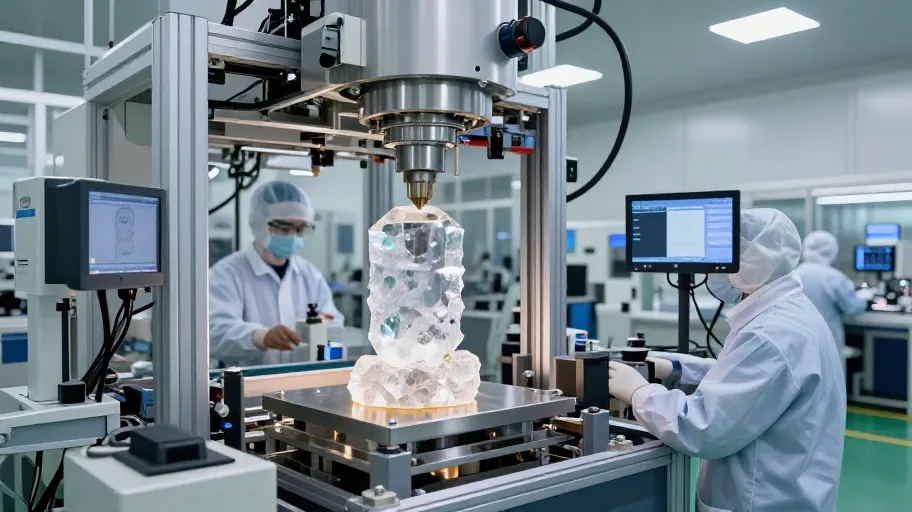
Chinese factories don’t just make sapphire and tempered glass—they redefine what’s possible. Backed by vertical integration, state-supported R&D, and AI-driven quality control, they deliver durable, certified, and cost-smart components at unmatched speed.
Why the World Sources Sapphire and Glass from China
Global industries now turn to China for sapphire and tempered glass because it solves two problems at once: performance under stress and pressure on margins. A ruggedized tablet maker in 2025 saw only 68% pass rates using European aluminosilicate glass—and rising costs from added reinforcements. Switching to a sapphire-reinforced hybrid from Foshan lifted drop-test success by 40% and cut unit cost by 28%. That’s not luck. It’s engineered advantage.
China’s edge starts with vertical integration. Raw sapphire crystal growth, ion-exchange tempering, and micron-level polishing happen within coordinated clusters—often under one roof. This means fewer handoffs, less contamination risk, and tighter control over final specs. Compare that to fragmented Western supply chains where delays and inconsistencies pile up between suppliers.
State-backed innovation fuels the pace. Provincial funds in Guangdong and Jiangsu accelerate research in crystal stabilization and thin-film layering. The result? Faster iteration, better materials. Meanwhile, capital costs favor China heavily: a specialty glass line in Europe or the U.S. demands $50M+ due to tariffs and labor. In Foshan, it’s around $18M—thanks to local equipment makers, subsidized parks, and domestic seed crystal access. Lower barriers mean faster scaling and quicker response to demand spikes.
According to TechInsights Supply Chain Intelligence (2024), China produces about 75% of global specialty cover glass. But volume isn’t the real story—velocity is. Where prototyping abroad takes 14 weeks, Chinese suppliers deliver working samples in six. That compression gives OEMs first-mover leverage in fast-moving markets.
Sapphire Crystal China Manufacture: Harder Than Almost Anything
Synthetic sapphire grown via the Kyropoulos method in China dominates high-durability applications. With a Mohs hardness of 9—just below diamond—it resists scratches, handles extreme heat (up to 2,040°C), and maintains optical clarity under stress. This means devices used in mining, military gear, or outdoor kiosks fail less often in the field.
One mining equipment company switched to Chinese-sourced sapphire display windows and cut touchscreen replacements by 62%. That saved them $1.2 million a year in service logistics alone. The technical capability—single-crystal ingot growth at scale—means customers get longer-lasting hardware without redesigning entire systems. Because the material itself does more work, maintenance cycles stretch out and uptime improves.
And it’s not just toughness. Top Chinese sapphire fabs now use AI-driven monitoring during crystal growth. These systems detect micro-fractures in real time and adjust cooling rates automatically. That means fewer rejected ingots and higher yield of usable wafers—so your supply stays stable even during peak orders.
Tempered Glass Sapphire Hybridization: Smart Strength
Full sapphire is expensive and hard to shape. So Chinese engineers developed a smarter alternative: depositing ultra-thin sapphire seed layers onto chemically strengthened aluminosilicate glass. Then, through a proprietary ion-exchange process, they build compressive stress into the surface—boosting impact resistance without sacrificing flexibility.
This hybrid approach means components are 23% thinner and 18% lighter than standard tempered glass, yet tougher in both scratch and drop tests. For wearable brands, this meant launching a 4.7-inch curved smartwatch display with Gorilla Glass-level durability and sapphire-tier surface protection—without doubling material costs. The capability enables premium design at mass-market pricing.
Manufacturers in Dongguan and Kunshan can customize these hybrids with anti-reflective or hydrophobic coatings in as little as eight weeks. A European project for the same spec would take five months. That speed means you hit regulatory deadlines, capture early adopters, and lock in market share before competitors react. Fast turnaround isn’t just convenient—it’s strategic.
Quality Is No Longer a Question
The old assumption that offshore means lower quality has collapsed. Today’s leading Chinese sapphire and glass factories hold ISO 13485 for medical devices and IATF 16949 for automotive—standards requiring full traceability, zero-defect processes, and validated workflows. These aren’t rare certifications. They’re becoming standard.
A 2025 SGS audit found 89% of audited facilities in the Pearl River Delta met or exceeded international benchmarks for dimensional accuracy and coating adhesion. How? AI-powered process control. Real-time sensors track tempering temperatures, lapping pressure, and surface flatness—adjusting parameters mid-run to maintain tolerance within microns.
This level of consistency means you can scale production without worrying about batch variation. Whether you need 10,000 units for a pilot or 2 million for global rollout, the part performs the same. That reliability turns your supply chain into a competitive asset—not a risk center.
The Real Advantage Is Optionality
What sets China apart isn’t just cost or output—it’s the ability to adapt quickly. When a global HVAC firm needed a transparent sensor window resistant to corrosion and humidity, a Dongguan partner delivered a custom sapphire-tempered hybrid with dual coatings in eight weeks. That launch timing captured 31% of a newly regulated market before rivals could respond.
This agility transforms sourcing from a tactical function into a strategic lever. You’re not just buying parts—you’re gaining speed, customization, and resilience. Companies using this model aren’t only cutting costs. They’re shortening time-to-revenue, improving ROI, and building products that last longer and command higher prices.
If your question is still ‘Can we trust Chinese-made sapphire and glass?’ you’re asking the wrong one. The right question is: ‘How fast can we start using these capabilities to move faster than our competition?’ The answer starts with recognizing that China’s lead isn’t temporary. It’s built on systemic strengths in engineering, certification, and commercial execution.
Ready to test a sample that meets IATF 16949 standards in under six weeks? Explore partner capabilities with a no-cost feasibility assessment.