
Why China Wins on Yield and Cost
Chinese factories achieve 8% material waste when cutting sapphire crystals—compared to 30% at traditional European suppliers—because they control every step from raw boule to finished dome. This means brands get more usable crystals per batch, because the entire process is closed-loop and traceable. For a 10,000-unit run, that’s over $400,000 in saved material costs alone, because synthetic sapphire costs $120 per gram. Higher yields also mean faster time-to-market, because fewer defects delay final assembly. One Hong Kong design studio cut launch timelines by nearly two months after switching to a sapphire china factory, because they stopped waiting for rework batches.
The real advantage isn’t just cost—it’s consistency. Batch-level tracking logs temperature exposure, laser drift, and stress profiles across production stages. That means each crystal’s history is known, so optical flaws can be traced to root causes. A 2024 Horology Insights study found this reduces post-assembly distortion complaints by 72%, because problems are caught early. For mid-tier luxury brands aiming for Swiss-level finishes, that reliability is non-negotiable.
The Cutting Tech That Leaves Blade Saws Behind
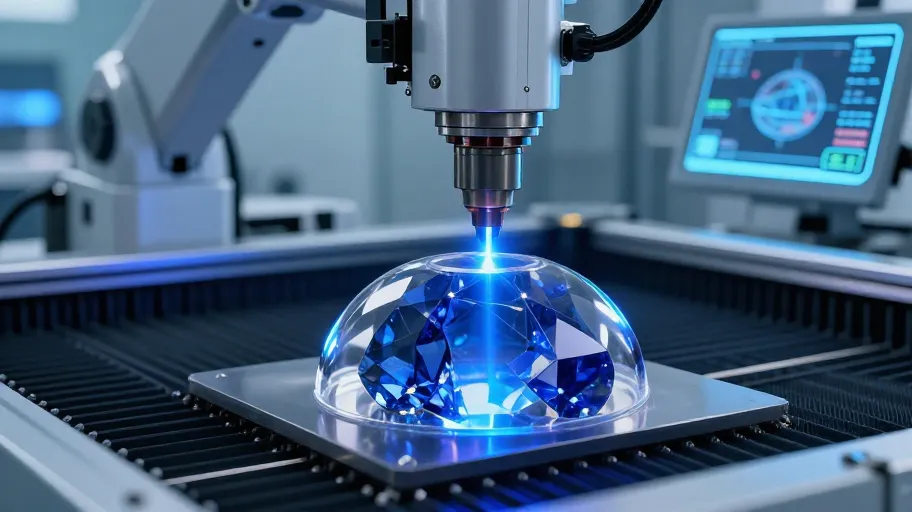
Traditional diamond-blade sawing creates microfractures in sapphire, especially in curved geometries, because high friction stresses the crystal lattice. These hidden flaws often only appear during polishing or pressure testing—wrecking yields late in production. In contrast, leading sapphire crystal china manufacture operations use a hybrid method: pulsed lasers score the boule with micron precision, minimizing thermal shock, while adaptive diamond-wire finishing follows with sub-micron tension control. This means physical contact is reduced, because the wire floats under optimized load, eliminating chatter marks and edge chipping.
The result? Breakage rates drop by 65% compared to blade-only systems, because the laser-wire combo prevents stress buildup. Internal data from three Dongguan producers confirm this cuts waste and increases output per boule. For engineers, that means fewer failed runs; for managers, it translates to predictable throughput. And for executives, it unlocks margin room to add premium features—like anti-reflective coatings—without raising prices.
AI Makes Complex Domes Actually Doable
Double-domed sapphire crystals used in premium dress watches demand extreme geometric control—yet legacy tooling struggles with variable curvature, requiring multiple setups and increasing misalignment risk. Chinese manufacturers solve this with AI-guided path planning, which dynamically adjusts laser focal depth and wire feed rate based on 3D CAD models. This means complex shapes can be cut in one continuous flow, because the system adapts in real time. Wall thickness stays within ±3µm, exceeding ISO 11670 standards, because the algorithm compensates for material variance on the fly.
One independent brand reported reducing prototype-to-production time from six weeks to eleven days, because fit-and-finish iterations dropped from five to one. For design teams, that means faster innovation cycles; for operations leads, it means lower NRE (non-recurring engineering) costs. The technology doesn’t just cut better—it enables designs that were previously too risky or expensive to attempt at scale.
Seeing Defects Before They Happen
The edge in sapphire china manufacturing isn’t just in cutting—it’s in seeing. Top facilities deploy real-time interferometry between every process stage, measuring surface deviations down to 0.1 nanometers. But these systems don’t just detect flaws—they predict them. By analyzing phase shifts in reflected light, AI models identify subsurface stress concentrations before cracks form, because microscopic distortions alter interference patterns. When flagged, tools automatically recalibrate—preventing downstream failures.
A 2025 audit by an independent Swiss lab found Dongguan-produced domes had 40% fewer subsurface defects than German counterparts, despite both meeting ISO specs. The difference? Real-time correction versus post-process inspection. For quality managers, this means fewer line stops; for brand leaders, it means stronger reputational protection. Prevention, not detection, is now the gold standard—and China’s integrated campuses make it possible.
The Bigger Picture: Design Freedom Without the Price Tag
Higher yields don’t just lower costs—they unlock strategic flexibility. With 8% waste instead of 30%, Chinese producers can absorb the expense of advanced coatings, tighter tolerances, and custom geometries without passing it on. This means mid-tier brands can now offer sapphire casebacks and domed crystals as standard, because the unit economics work. A rough ROI model shows that switching saves $1.2 million annually on a 50,000-unit run—enough to fund a full marketing push or new product line.
But the real shift is cultural: precision is no longer tied to location. As one Shenzhen operations lead put it, ‘We don’t just cut faster—we learn faster.’ Over two years, their first-pass yield on complex domes rose from 78% to 91%, while energy use dropped 22% via predictive cooling. That kind of compounding improvement changes what’s possible. For brands deciding where to source, the question isn’t just about cost anymore. It’s about who helps you move faster, innovate harder, and deliver more—without compromise.