
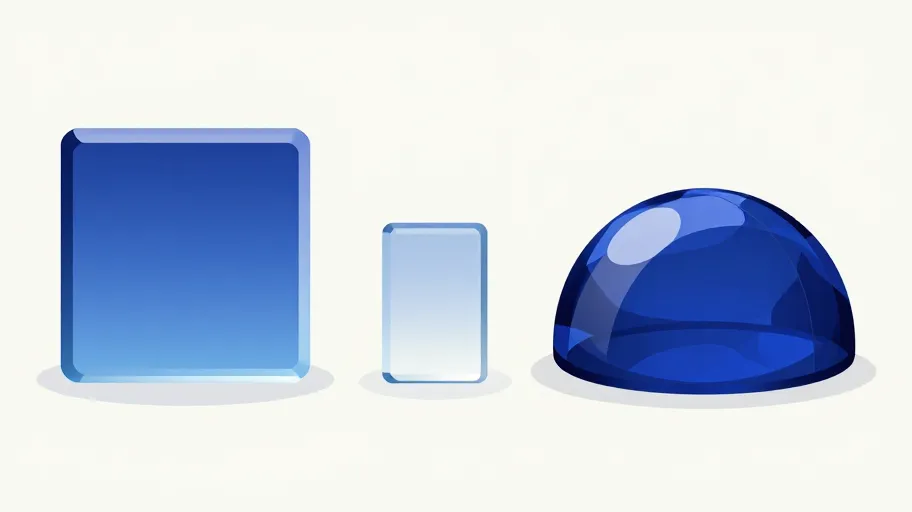
Selecting the correct crystal geometry is a foundational decision in watch development that dictates the timepiece’s aesthetic personality and engineering parameters. Flat, box-type, and domed sapphire watch glass types each offer distinct advantages regarding visual hierarchy, water resistance integrity, and dial legibility. For sourcing managers and designers, the choice requires balancing the desired vintage or modern profile against the practicalities of case sealing and manufacturing yield.
The Optical-Structural Alignment Matrix
To navigate the selection process effectively, we utilize the Optical-Structural Alignment Matrix. This framework evaluates geometry based on two critical vectors: Visual Intent (how the wearer views the watch) and Structural Constraint (how the crystal interacts with the case).
- Visual Intent: Does the design prioritize a low-profile, stealthy appearance (Flat), a magnified, deep vintage look (Domed), or a historical, bubble-like aesthetic (Box)?
- Structural Constraint: Is the case design capable of accommodating the increased central thickness required for high-dome crystals? Does the bezel geometry provide a continuous surface for gasket compression?
By cross-referencing your design sketches against this matrix, you can eliminate geometries that conflict with the case architecture early in the sourcing phase, reducing the risk of costly re-tooling later.
Flat Sapphire: The Standard of Utility
Flat sapphire crystals remain the industry benchmark for tool watches, divers, and contemporary field watches. Their primary advantage lies in their uniform thickness and predictable optical properties.
From a sourcing perspective, flat crystals generally offer the highest manufacturing yield because the polishing process is straightforward. The parallel surfaces ensure minimal distortion of the dial, which is critical for chronographs and watches featuring complex guilloché or detailed indices.
However, a flat profile can sometimes appear visually "thick" from the side to maintain the same water resistance rating as a domed crystal. To counter this, designers often opt for a flat crystal with a distinct bevel. When sourcing flat variants, verify if the edge finish is a simple polished chamfer or a more complex facet, as this influences the feel of the watch against the wrist.
Key Considerations:
- Optics: Zero magnification; truest color representation.
- Sealing: Maximizes contact surface area with the case tube or bezel, simplifying gasket design.
- Application: Ideal for ISO-certified divers and modernist dress watches.
Domed Sapphire: Depth and Vintage Appeal
Domed crystals are defined by their curved upper surface, which bends outward. This geometry is synonymous with vintage re-issues and dress watches seeking a softer, more organic connection to the wrist.
The optical effect of a domed crystal is distinct. As the light hits the curve, it acts as a subtle lens, often magnifying the dial slightly and creating desirable reflections that change with the angle of the wrist. This brings the dial to life, adding perceived depth that a flat crystal cannot replicate.
However, the "Structural Constraint" vector in the Alignment Matrix becomes critical here. As the dome height increases, the central thickness of the sapphire must often increase to maintain pressure resistance, potentially raising the overall height of the watch. Furthermore, high-domed crystals may not fit within the internal clearance of existing case designs without modifying the dial spacing or the movement height.
Key Considerations:
- Optics: Creates a "magnifying" effect; enhances perceived depth of the dial.
- Sealing: Requires a gasket that conforms to the curve or a specialized seating ring.
- Application: Dress watches, pilot watches, and heritage collections.
Box-Type Sapphire: The Retro Specialist
Often confused with standard domed crystals, Box-type sapphire (or "bubble glass") is characterized by an extreme curve height that extends significantly above the bezel. This creates a pronounced, tumescent profile reminiscent of mid-20th-century acrylic crystals.
The sourcing challenge with box-type crystals is twofold: material utilization and installation. Because the blank must be thick enough to accommodate the high curve, the waste material during grinding can be significant, impacting cost. Additionally, the sharp protrusion makes the crystal more vulnerable to edge impacts in daily wear.
Designers choose box-type crystals not for utility, but for strong historical fidelity. If your brand is releasing a faithful reproduction of a historical model, box-type sapphire is necessary to maintain the correct silhouette. It is crucial to discuss the vertical clearance with your manufacturer, as the hands of the watch must be lowered (bent) sufficiently to clear the peak of the crystal without rubbing.
Key Considerations:
- Optics: High magnification; significant distortion at extreme angles (often desired for the vintage look).
- Sealing: Often requires a custom-formed gasket or adhesive bonding, depending on the case architecture.
- Application: Strict vintage reproductions and fashion-forward statement pieces.
Decision Table: Comparing Sapphire Watch Glass Types
| Feature | Flat Sapphire | Domed Sapphire | Box-Type Sapphire |
|---|---|---|---|
| Visual Profile | Low, modern, stealthy. | Curved, organic, classic. | High, pronounced, retro. |
| Dial Legibility | High (No distortion). | Medium (Slight magnification). | Low to Medium (High magnification). |
| Wrist Feel | Can feel thicker vertically. | Sleek taper to edges. | Prominent, catches on cuffs. |
| Case Sealing | Easiest to engineer. | Moderate complexity. | High complexity. |
| Vulnerability | Edges are protected by bezel. | Surface is exposed but strong. | High exposure to side impacts. |
| Design Intent | Tool watches, Sports. | Dress watches, Heritage. | Vintage faithfuls. |
Sourcing Approval Checklist
Before releasing a purchase order for custom sapphire watch glass types, use this checklist to align your technical specifications with the chosen geometry.
- [ ] Clearance Verification: Have the movement hand heights been measured against the apex of the crystal to prevent friction?
- [ ] Gasket Compatibility: Does the case groove geometry match the curvature of the crystal's edge?
- [ ] Anti-Reflective (AR) Coating Placement: For domed and box-type crystals, has it been decided whether the AR coating is applied on the inside, outside, or both? (Outside coatings on domes are more prone to wear).
- [ ] Thickness Tolerance: Has the central thickness been specified to ensure the water resistance rating is met without adding unnecessary bulk?
- [ ] Edge Finish: Is the edge polished, frosted, or faceted, and does this align with the bezel design?
FAQ
Does a domed sapphire crystal distort the time? While high-quality sapphire has excellent clarity, the curvature of a domed or box-type crystal acts as a lens. This can create slight refraction when viewing the dial from an oblique angle. This is often an intentional design feature in vintage-style watches rather than a defect.
Can I replace a flat acrylic crystal with a domed sapphire one? Not without modifying the case. A domed sapphire crystal has a different edge profile and thickness compared to acrylic. Furthermore, sapphire is rigid and requires a gasket for compression, whereas acrylic was often compressed directly or glued. The case groove may need re-machining to accommodate the sapphire geometry.
Which crystal type is most durable? Sapphire itself is rated 9 on the Mohs scale regardless of shape. However, flat crystals generally offer better structural integrity against impact because the force is distributed evenly across a flat plane. Box-type crystals, due to their protrusion, are more susceptible to side impacts that can leverage the crystal out of the case or chip the edge.
How does geometry affect the application of AR coatings? Applying AR coatings to flat surfaces is standard. For domed crystals, the coating process becomes more complex to ensure uniform thickness. If the design calls for an external AR coating on a highly domed crystal, be aware that the coating may wear off at the high point (the apex) faster than on the sides.
Why is box-type sapphire more expensive? The cost is driven by material waste and grinding time. To achieve a high box shape, the manufacturer must start with a significantly thicker block of sapphire and grind away more material than with a flat or gently domed crystal. This increased processing time and raw material consumption reflect in the pricing.