
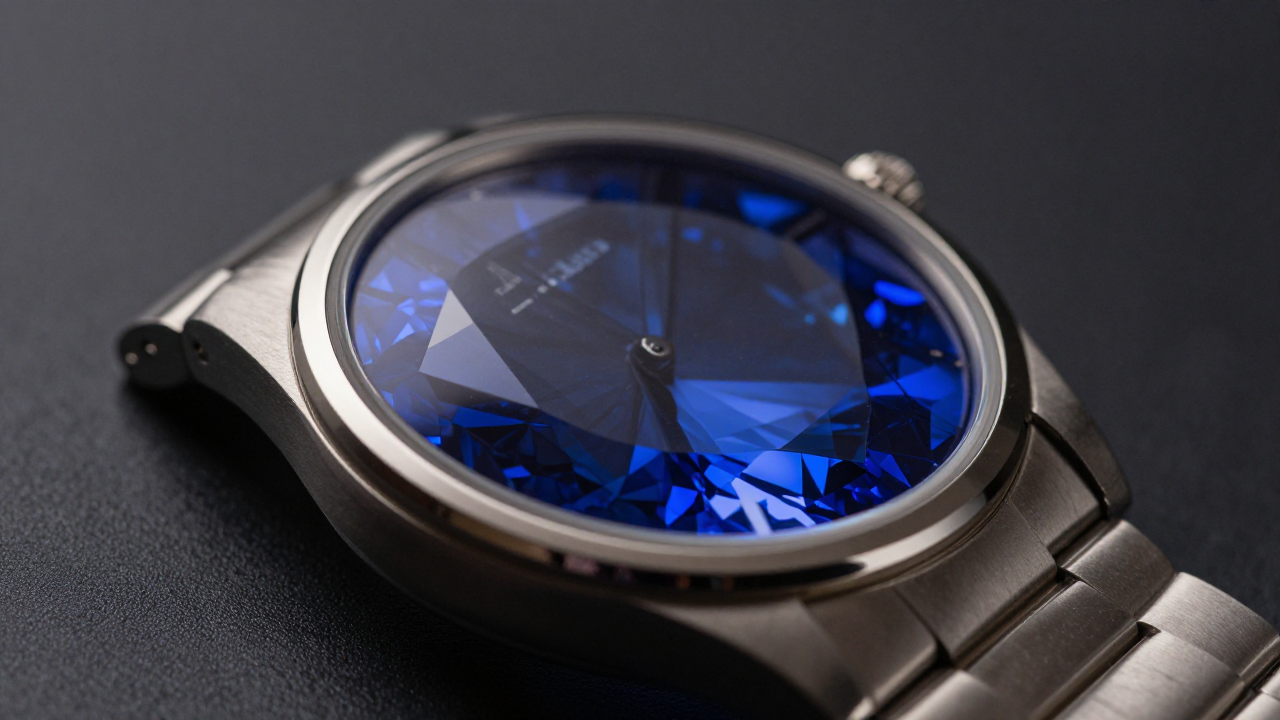
If you’ve bought a watch from any US-based microbrand or Swiss authorized dealer in the past three years, you’ve probably seen “sapphire watch crystal” listed as a selling point.…
In our Shenzhen production line, that phrase sits on roughly 70% of the purchase orders we receive from American clients—not because sapphire is cheap, but because retail buyers now treat it as the minimum bar above $500. Jadezone Optical (HK) Ltd. has watched that shift from the factory floor since 2010.
Why does sapphire watch crystal dominate conversations with US dealers and collectors?
Sapphire watch crystal is synthetic aluminum oxide, Al2O3, grown in a controlled lab process rather than mined. The raw material starts as alumina powder and gets melted at around 2,050°C, then grown into a large cylindrical boule over two to three weeks. That boule is sliced, ground, polished, and cut into round or shaped watch crystals. The result is a material with a Mohs hardness of 9. Diamond is 10. Most sand, keys, and door frames sit far lower on that scale, which is why daily scratches rarely show up on sapphire.
How lab-grown sapphire actually gets from powder to watch crystal
Most high-grade sapphire watch crystals we produce in Shenzhen use the Kyropoulos growth method. A single boule can weigh 40 kg or more, depending on the furnace. After growth, the boule goes through wire cutting, surface grinding, and polishing. The final blank is then CNC-shaped to exact dimensions, chamfered at the edge, and coated if the watch brand specifies anti-reflective treatment.
The step most buyers ignore is the edge treatment. A sharp edge can micro-chip during case fitting. A proper 0.10 mm to 0.20 mm bevel at a 45-degree angle reduces that risk without changing the visible surface. We learned this the expensive way back in 2014, when a batch of un-beveled 36 mm crystals came back from a New York client with edge chipping on 12 pieces out of 600.
The material comparison you won’t see on a spec sheet
Honestly, sapphire is not a magic material. It is hard, but it is also brittle. A hard impact on the edge can crack it. The scratch resistance is real, but the shatter resistance tradeoff is something many first-time buyers don’t understand until they drop a watch on Saltillo tile.
Why do so many US watch buyers ask us about scratch resistance before anything else?
The first question from a new client in the US is almost never about light transmission or coating adhesion. It’s usually some version of “Will this scratch if I wear it every day?” That question makes sense because the most visible defect on a watch crystal is a fine scratch across the dial, especially under direct sunlight.
In September 2022, a jewelry store owner in Scottsdale, Arizona emailed us photos of a sapphire crystal with a chip at the 7 o’clock position. His customer had dropped the watch from counter height onto a tile floor. The crystal didn’t scratch. It chipped. That’s the physical reality of a Mohs 9 material: it resists abrasion extremely well, but it has less elastic give than acrylic or mineral glass.
The scratch test questions we get from Arizona to New York
Most clients don’t run formal lab tests. They run something simpler: keys, screwdrivers, and sandpaper. Those tests are not scientific, but they reflect how buyers think. A sapphire crystal will generally hold up against steel keys and a screwdriver because steel sits around 5.5 to 6.5 on the Mohs scale. Sand can be trickier. Most sand particles are quartz, around 7 on the Mohs scale, so they won’t scratch sapphire. But if the sand contains corundum or silicon carbide particles, those can scratch even sapphire. That nuance rarely makes it into marketing copy.
A clear way to say it is this: sapphire watch crystal eliminates daily micro-scratches from common objects like keys, coins, and desk surfaces. It does not eliminate damage from sharp impacts or extreme abrasives. That specific boundary is what we try to explain to US retailers before they overpromise to their customers.
Clarity is not just a marketing word, it is measurable
Uncoated sapphire typically transmits about 85% to 92% of visible light. That’s not automatically better than mineral glass, which can transmit 90% to 93%. The difference comes when anti-reflective coating is applied to one or both sides. A double-sided AR coating on sapphire can push visible light transmittance to 98% or 99%, which is why a coated sapphire crystal often looks like there’s no crystal at all.
The catch is that coatings sit on the surface, not inside the sapphire. A cheap single-layer coating can show a blue or purple sheen, and it can wear unevenly at the edges. Higher-grade multi-layer coatings are applied under vacuum and tested for adhesion using a cross-hatch tape test or similar method. When a buyer asks us why two sapphire crystals with the same diameter can differ by $4 or $5 per piece, the answer usually lives in these invisible details: alumina purity, edge bevel, coating layers, and dimensional tolerance.
How are top watch brands actually using sapphire crystals to justify $1,000+ price tags?
Sapphire alone doesn’t make a luxury watch. But it has become one of the baseline signals that a brand is serious. From our side of the supply chain, the shift happened gradually. In 2010, most US orders under $300 specified mineral glass. By 2018, $400 microbrand launches started listing sapphire as a non-negotiable. By 2025, we saw Kickstarter campaigns for $299 watches using sapphire as a proof point, even if the crystal was a basic single-domed blank.
The $4.50 difference that nearly broke a Boston microbrand
In March 2023, Jason, a microbrand founder in Boston, called us about a $4.50 per piece gap between two sapphire crystal quotes. His order was 800 pieces. He assumed the cheaper supplier was giving him the same product. It wasn’t. One quote specified 99.5% alumina purity and a 0.15 mm edge bevel. The other didn’t list alumina grade at all and left the edge sharp. The sharp-edged batch cracked during case fitting on his first 40 units. That $4.50 savings turned into a rework cost of nearly $2,800 plus two lost weeks.
That example explains why some brands now write sapphire specs the way OEM buyers write component specs. They ask for alumina grade, thickness tolerance, edge treatment, coating type, and batch consistency. The most serious buyers don’t just ask for “sapphire watch crystal.” They ask for a drawing.
How serious brands spec sapphire beyond the word “sapphire”
A standard production drawing for a sapphire watch crystal might include:
Six specs, but they separate a $1.50 blank from a $9.00 finished crystal. The word “sapphire” on a spec sheet tells you the material family. It doesn’t tell you the quality level. That’s a gap many US buyers learn about only after they receive a batch with uneven coating or one chipped edge per hundred units.
What should a buyer check before paying extra for a sapphire crystal watch?
A sapphire watch crystal usually costs more than mineral glass or acrylic, so the buyer’s first job is to verify what “sapphire” means in that specific watch. One reliable home test is a water drop test. Place a drop of water on the crystal. On untreated sapphire, the drop tends to bead up and roll cleanly. On mineral glass, it often spreads flatter. That test is not perfect, but it works well enough for a quick retail check.
A 6-point buyer’s checklist for sapphire watch crystal
1. Ask for alumina purity, not just the word “sapphire.”
2. Confirm whether the crystal has an anti-reflective coating and how many layers.
3. Check edge treatment under magnification if possible.
4. Look at the dial through the crystal at a shallow angle for blue or purple haze.
5. Ask about dimensional tolerance if you’re buying replacements or doing custom builds.
6. For watches worn hard, consider a thicker crystal and a case with a recessed crystal edge.
That last point matters more than most people expect. A sapphire crystal seated slightly below the bezel has less exposed edge area. That design reduces the chance of a direct edge impact. It’s not a guarantee, but it helps.
The cheap sapphire trap nobody warns you about
I’m getting ahead of myself, but this is the part that usually trips up first-time importers. Some suppliers sell “sapphire” crystals that are actually sapphire-coated mineral glass. That’s a different product. The base is mineral glass with a thin sapphire laminate on top. It may pass a casual glance, but it doesn’t have the full abrasion resistance of solid synthetic sapphire. If a quote seems unusually low for a large-diameter sapphire crystal, ask one question: “Is this solid sapphire or sapphire-coated?” The answer will save you from a costly retail return.
How do you maintain a sapphire crystal without making costly mistakes?
Daily care for sapphire watch crystal is straightforward. Use a microfiber cloth and warm water. If there’s oil or dried sweat, add a drop of mild dish soap. Avoid ammonia-based glass cleaners, especially on coated crystals, because harsh solvents can degrade the AR coating over time. That’s not a theoretical risk; we’ve seen coating delamination on crystals cleaned repeatedly with household window spray.
Daily care without overthinking it
A sapphire crystal doesn’t need special polish or abrasive paste. In fact, polishing compounds are where many owners create problems. A paste designed for metal or glass can leave micro-abrasion on the AR coating. If the crystal is uncoated, it’s more forgiving, but coated sapphire needs a gentler approach. Soap, water, microfiber, and patience are enough.
When to send it to a professional
If the crystal chips at the edge, don’t keep wearing the watch until you can replace it. A small chip can create a stress point that leads to a larger crack. Replacement usually requires a crystal press and new gasket, so this is not a casual DIY job unless you have the right tools. For dive watches, water resistance testing after crystal replacement is critical. A properly seated sapphire crystal loses its sealing value if the gasket is old, pinched, or installed unevenly.
A practical rule we share with US repair shops is this: replace the gasket every time the crystal comes out. The gasket is a few cents, and reusing it is the most common cause of post-service water leaks.
As a category, sapphire watch crystal has moved from premium option to expected standard. The material itself is only half the story. Edge design, coating quality, alumina purity, and dimensional control decide whether that crystal holds up over ten years or fails in the first month. If you spec it correctly, sapphire stops being a buzzword and starts being the last crystal you’ll replace.