
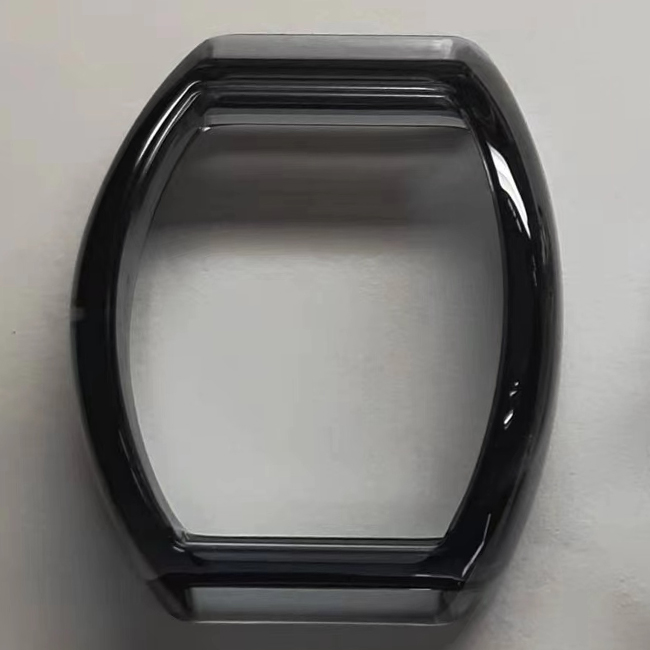
To specify a custom sapphire watch crystal, give your supplier six things: outer shape and profile, critical dimensions with tolerances, edge or bevel treatment, anti-reflective coating spec, sapphire material grade, and the case-to-gasket interface that fixes the crystal. Miss any one and the RFQ turns into guesswork on both sides — which is exactly how quotes drift and samples come back wrong.
Why a drawing alone is not an RFQ
Most sapphire crystal sourcing problems start before the supplier ever touches a boule. A diameter and a photograph is enough to start a conversation. It is not enough to produce a quote you can compare across suppliers.
What kills timelines is ambiguity: a profile assumed flat when the case needs a dome, a coating left unspecified and then argued about on the sample, a tolerance implied but never written down. The fix is not more detail for its own sake — it is the right detail, in the right fields, early enough to shape the quote.
The framework below is what JadeZone Sapphire uses internally to read an incoming drawing. It works whether you are developing a new reference or reverse-engineering a service part.
The S.C.A.L.E. specification framework
Every custom sapphire watch crystal RFQ should resolve five fields before price is discussed. Think of them as the minimum viable specification.
| Field | What it covers | Why it matters |
|---|---|---|
| S — Shape and profile | Flat, single-domed, double-domed, beveled, stepped, or a combination | Profile drives both tooling and optical behaviour. A domed crystal refracts at angles a flat crystal does not. If you give only outer diameter and thickness, most suppliers will assume flat — and a flat crystal on a case cut for a dome becomes a rework event. |
| C — Critical dimensions and tolerances | Outer diameter (or width × length for non-round crystals), total thickness, and — for domed profiles — the rise or crown height | These are the three numbers a polisher actually holds. The tolerance class matters as much as the nominal: a crystal quoted at ±0.05 mm and one at ±0.10 mm are not interchangeable parts. |
| A — AR coating and optical treatment | Anti-reflective coating, single-side or double-side, and the colour band (blue, green, neutral) if it matters against the dial | Uncoated is also a valid specification — state it explicitly so the supplier does not assume omission means "coated, supplier's choice." |
| L — Lot acceptance and material grade | Sapphire grade language varies by supplier and is not standardised across the industry. Define what you will reject: visible inclusions under a stated magnification, bubbles above a stated size, striae that affect transparency. | Put this in the inspection clause, not in a verbal note. Grade labels alone (AAA, optical grade, watch grade) are not reliable across suppliers. |
| E — Edge interface | Bevel angle, chamfer, tension-ring seat, gasket land, and cement or UV-glue allowance | This is the field most often left off inbound drawings, and it is the field most likely to cause a sample that "looks right but won't seat." Even a dimensionally correct crystal fails if the edge interface is wrong. |
Decision table: the three choices that shape the quote
Most "the price changed" stories trace back to these three rows. Lock these before you ask for commercial terms.
| Decision | Common options | What it drives | What to confirm |
|---|---|---|---|
| Profile | Flat / single dome / double dome / stepped / beveled combo | Tooling, optical clarity at off-axis angles, hand clearance underneath | Section view on drawing matches intended look on wrist |
| Coating | None / single-side AR / double-side AR | Reflection, perceived dial colour, inspection burden for coating defects | Colour band agreed against actual dial sample |
| Edge | Flat bevel / chamfer / stepped seat / tension-fit / cement-fit | Case compatibility, gasket choice, mounting method, seating reliability | Edge detail cross-referenced to case-mouth dimension |
Tolerances and lot acceptance — say what you mean
Tolerances on a sapphire crystal are not cosmetic. They determine whether the crystal seats, whether the gasket compresses correctly, and whether the hands clear the underside. Be explicit about:
- OD tolerance band — and whether the case mouth is measured on the same datum
- Thickness tolerance, especially at the thinnest point for slim profiles
- Bevel angle and width tolerance
- Dome rise tolerance, if applicable
- Acceptable inclusion, bubble, and striae limits, referenced to a grade standard both sides agree to in writing
If you do not have an internal tolerance standard, ask the supplier to propose one and mark it subject to buyer approval. You are not obligated to accept a supplier's default tolerance class — but you do need to know what it is before you compare quotes.
What to fix vs. what to leave open
A common mistake is over-specifying early and under-specifying late. In practice:
- Fix before RFQ: profile, OD, thickness, edge type, coating choice, and grade/rejection criteria. These define the part.
- Leave open until sample: exact bevel width within a band, dome rise within a range, and final tolerance tightening. These are negotiable once a sample proves the concept.
- Never leave open: case-mouth interface dimension and the inspection clause. These are where disputes live.
Sample approval questions before production sign-off
Before you approve a sample for production, you should be able to answer these in writing. If the answer to any of them is "we'll sort it in production," do not approve.
- Does the sample seat in the actual case with the intended gasket or cement, with no rocking and no daylight?
- Does the AR coating, if specified, match the agreed colour band when viewed against the real dial — not a reference card?
- Are inclusions within the grade you agreed, when inspected under a 10× loupe by both parties?
- Does the edge treatment match the drawing — bevel width, chamfer, seat depth?
- Is the thickness within tolerance at both the thinnest and thickest measured points, not just the nominal?
- Has the supplier documented the inspection method, sample size, and AQL for the production lot?
Frequently asked questions
1. What dimensions do I need to provide for a custom sapphire watch crystal?
At minimum: outer diameter or footprint, total thickness, profile type (flat, domed, stepped), bevel or edge detail, and the case-mouth or gasket dimension the crystal must seat against. A 2D drawing with a section view is ideal; a structured dimension sheet covering all of the above is acceptable.
2. Should I specify single-side or double-side AR coating?
It depends on dial reflectivity, case design, and how much inspection burden you will accept. Single-side AR is common and reduces internal reflection from the dial; double-side AR maximises transparency but adds a second coated surface to inspect and protect. State the preference and the acceptance criteria for coating defects.
3. What sapphire grade should I specify for a custom sapphire watch crystal?
"Watch-grade" and "optical-grade" are common terms but they are not standardised across suppliers. Define grade by what you will reject: visible inclusions under 10× magnification, bubbles above a stated size, striae affecting transparency. Reference that in the inspection clause rather than relying on the grade label alone.
4. How tight should tolerances be?
Tight enough to seat reliably, not so tight that production yield collapses. OD tolerance typically tracks case-mouth tolerance; thickness tolerance tracks hand clearance. Ask the supplier what tolerance class they can hold in volume, then match your drawing to that — and document it.
5. Can I send a sample crystal instead of a drawing?
Yes, and many buyers do, especially for service parts or reverse-engineering. But a sample without a drawing leaves edge treatment and tolerance open to the supplier's interpretation. Best practice: send the sample and request a measured drawing back for your written approval before any production quote is issued.
Submit a drawing or dimension sheet
If you have a drawing, a dimension sheet, or even a sample crystal with measurements, send it. JadeZone Sapphire's technical team will review it against case compatibility, coating choice, edge interface, and tolerance feasibility — before any commercial discussion. The goal is a grounded technical response, not a placeholder quote.
Before you send: 5-point self-check
Run this checklist before you submit. It catches most of the ambiguity that slows sapphire crystal RFQs.
| ☐ | Outer shape and profile are stated explicitly (flat / single dome / double dome / stepped) |
| ☐ | OD and thickness are on the drawing, each with a tolerance band |
| ☐ | Edge treatment is specified — bevel angle, chamfer, or seat depth |
| ☐ | Coating choice is explicit: none / single-side AR / double-side AR, with colour band if relevant |
| ☐ | Material grade or rejection criteria are written into the inspection clause, not left as a label |
Get these five right and the RFQ stops being a back-and-forth. It becomes a technical conversation about a part both sides can see clearly.
To discuss your project with a trusted sapphire watch glass supplier, start a direct inquiry through our official contact page: https://jzsapphire.com/index.php/contact-us