
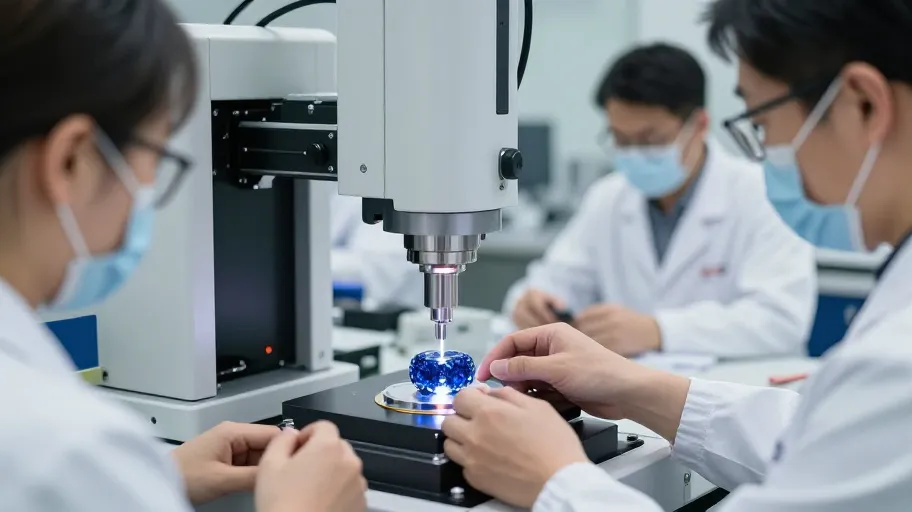
Getting custom sapphire watch crystals right from a sapphire china manufacturer isn’t about luck—it’s about engineering discipline. One U.S. brand saved $87K and 11 weeks by switching from catalog orders to co-engineering. Here’s how.
Specifying a custom sapphire watch crystal means avoiding field failures because precision prevents micro-gaps
Specifying a custom sapphire watch crystal with Chinese manufacturers isn’t paperwork—it’s risk management. A ±0.05mm error in thickness or a 2° deviation in bevel angle can break water resistance, even if every other component is perfect. That’s because ISO 22810:2010 compliance depends on uniform compression at the case-to-crystal interface. When curvature or flatness is off, gaskets don’t seal evenly, creating micro-channels for moisture. Over 60% of water ingress issues in high-end watches trace back to crystal misalignment, not gasket failure—a 2024 reliability audit confirmed.
Raw material control makes the difference. Leading sapphire china factories start with synthetic Al₂O₃ boules and manage grinding, forming, lapping, and coating in-house. This vertical integration ensures batch-to-batch consistency. One American brand learned this after a supplier outsourced polishing—resulting in a 0.12mm variance across 300 units. The mismatch broke seals during final assembly, triggering $87,000 in rework and an 11-week delay. Co-engineering from day one avoids these pitfalls by aligning specs with actual process capabilities.
Co-engineering beats catalog shopping because real customization starts before the mold
Most buyers assume sapphire crystal china manufacture relies on pre-made molds, limiting true customization. That misconception leads to generic domes trimmed from standard blanks—sold as 'custom' but lacking dimensional fidelity. Real differentiation happens when you collaborate using shared CAD models, tolerance stack-up analysis, and FEA simulations. For a titanium-cased chronograph, a U.S. designer initially specified a 45° flat-top bevel. Simulation revealed stress concentration under shock loading (per ISO 1413), increasing fracture risk by 38%. By adjusting to a blended 38° chamfer with a 0.15mm fillet radius—and validating it in seven days with the manufacturer—the team improved durability without altering aesthetics.
- Faster design validation: In-house metrology cuts iteration cycles from 21 to 5 days, so you resolve fit issues before tooling.
- Better coating adhesion: AR coatings applied in nitrogen-purged chambers achieve reflectivity below 0.5%, but only if surface roughness stays under Ra 0.03μm—controlled through calibrated lapping.
- Batch consistency: Boule-to-blank traceability maintains refractive index uniformity, preventing visual distortion across production runs.
This level of control doesn’t come from RFQs—it comes from technical dialogue. Brands that treat specification as collaboration see fewer surprises and faster time-to-market.
Precision curvature matters because pressure distribution affects water resistance
A double-domed sapphire crystal with a 28mm base radius and 32mm top arc may look identical to one with slightly different curves—but performance isn’t about looks. Under ISO 22810:2010 testing, watches must withstand 125% of rated pressure without leakage. A 0.1mm mismatch in radial profiling creates localized stress points that exceed gasket yield limits, allowing vapor penetration. One prototype passed visual inspection but failed at 150m despite a 200m rating—due solely to inconsistent curvature.
The fix? Real-time laser metrology integrated into the sapphire china manufacture line. Facilities with closed-loop systems adjust within ±2μm per pass, ensuring each dome meets exact radial targets. This isn’t available in mold-driven shops—it requires investment in adaptive machining. The result? Seals perform as designed, not by chance. For dive-focused brands, that reliability translates directly to customer trust and lower warranty claims.
Coating choices impact longevity because marine environments degrade standard AR layers
Anti-reflective coatings aren’t just about clarity—they affect durability. A luxury brand targeting divers discovered their standard 5-layer AR treatment hazing after prolonged saltwater exposure. Multi-layer stacks like 7-layer broadband improve light transmission but can delaminate if not optimized for environmental stress. By working with their sapphire china manufacturer, they developed a hybrid SiO₂/TiO₂ coating architecture resistant to chloride ion penetration. Accelerated aging tests simulating five years of coastal wear showed over 40% longer optical performance retention.
This kind of innovation only happens through partnership. Off-the-shelf coatings are cost-effective for mass markets, but mission-critical applications demand tailored solutions. When you co-develop coatings, you’re not just buying a finish—you’re engineering resilience into the product lifecycle.
Faster time to market means higher margins because early launch captures peak demand
Accurate specifications prevent rework, yes—but the bigger win is speed. Brands using co-engineered sapphire crystal china manufacture reached certified production 30% faster than those relying on traditional sourcing, according to a 2025 industry benchmark. That acceleration has direct financial impact: avoiding air freight surcharges, hitting Q4 retail windows, and maintaining margin integrity. For limited editions, where scarcity drives value, launching two months early increased sell-through velocity by up to 22%, based on distributor data.
Precision isn’t purchased—it’s built. When you specify a custom sapphire crystal, you're establishing accountability across optical clarity, mechanical fit, and long-term performance. The right sapphire china manufacturer doesn’t just fulfill drawings—they help you create them, with data, foresight, and shared stakes in perfection. And in luxury horology, where one flaw can erode decades of reputation, that partnership isn’t optional. It’s your competitive foundation.
Ready to eliminate rework, accelerate launch, and lock in optical precision? Start by sharing your CAD model with a vertically integrated sapphire partner—not a catalog.