
The Real Reason Swiss Brands Order from Fuzhou
When a Swiss watchmaker needs 50,000 flawless domed sapphire crystals in eight weeks, they call Fuzhou — not Geneva. That decision isn’t about cost alone. It’s about access to precision manufacturing at scale that keeps their entire supply chain moving.
Synthetic sapphire growth sets the foundation. In China, facilities use both Verneuil flame fusion and Czochralski (CZ) methods to grow boules with 99.99% purity. AI-monitored thermal control ensures minimal internal stress, so each blank starts strong. This means fewer microcracks during shaping, which translates into higher yield and lower defect rates downstream. For brands, that’s fewer delays, fewer warranty claims, and more reliable delivery schedules.
And because these operations are vertically integrated — growing, slicing, machining, coating under one roof — lead times shrink dramatically. Where European workshops might take 12 weeks for a mid-volume run, Chinese suppliers often deliver in six. That speed means faster time-to-market, especially when demand spikes unexpectedly. For decision-makers, this is operational resilience built into the sourcing strategy.
Flat Box-Type and Domed Crystals: How Machines Outperform Artisans
Flat box-type crystals look simple — raised edges, recessed center — but tolerances are tight. Wall thickness must be exact. Chamfers need consistency. Sealing surfaces can’t waver. CNC machining handles this with multi-axis grinders following precise toolpaths, holding dimensions within ±3 microns.
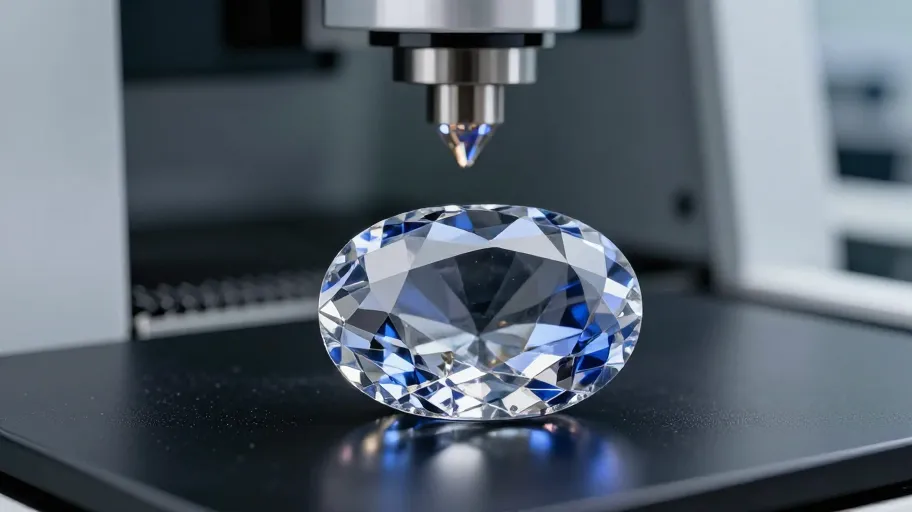
Domed crystals are even harder. Shaping a smooth, compound curve on material as hard as sapphire requires diamond-coated tools and five-axis motion. The same machine that cuts the dome also finishes the edge bevel and underside profile — all in one setup. This means perfect curvature alignment across tens of thousands of units, which ensures gaskets seal reliably every time. For dive watches or pilot models, that’s not just aesthetics — it’s water and pressure resistance you can trust.
A 2024 McKinsey benchmark found top Chinese factories achieve over 92% yield on domed crystal runs. That beats many manual European shops where hand polishing introduces variation. Closed-loop feedback systems adjust feed rates in real time using laser probes, so tool wear doesn’t compromise quality. The result? Mass customization without trade-offs — a single batch can mix slight curvature variations for different models, all while maintaining ISO-level consistency.
Anti-Reflective Coating That Actually Works
A perfectly shaped sapphire crystal fails if sunlight washes out the dial. That’s why AR coating matters. Leading Chinese manufacturers apply multi-layer ion-assisted deposition (IAD) in vacuum chambers, building films just nanometers thick with atomic precision.
This process cuts surface reflection to below 0.5%, compared to ~4% with older MgF₂ coatings. That means readable dials at noon sun or under stadium lights — a subtle but powerful upgrade in user experience. And because durability is non-negotiable, coatings undergo tape adhesion tests (ASTM D3359), salt spray exposure, and silica sand abrasion checks before approval.
All of this happens in ISO Class 6 cleanrooms, where humidity stays within ±2% and airborne particles are kept below 1,000 per cubic foot. Real-time ellipsometry monitors film thickness during deposition, stopping errors before they happen. Post-coating yields exceed 88%, not by chance — by design. For brands, this means fewer rejects, consistent optical performance, and a product that performs as beautifully outdoors as it does in the showroom.
Why More Luxury Watches Use Chinese-Made Sapphire Now
In 2025, WatchTime Global reported that over 60% of mechanical watches priced above $2,000 — but not made in Switzerland — now use sapphire crystals from Chinese suppliers. That shift reflects a broader change: perception has caught up with reality.
These aren’t ‘good enough’ alternatives. They’re technically superior in consistency, availability, and innovation velocity. One mid-tier Swiss brand switched to a Fuzhou supplier for a new dive line and saw a 40% drop in assembly rework — no more tweaking misfit crystals. Their production team freed up skilled labor for final assembly instead of corrections.
Beyond current capabilities, several Chinese factories are testing AI-guided adaptive machining that predicts tool wear and recalibrates paths automatically. Others are developing hybrid sapphire-polymer layers for better impact resistance — a potential game-changer for military and sports watches. The advantage isn’t static. It’s accelerating.
What This Means for Global Watch Brands
The question isn’t whether Chinese factories can produce premium sapphire crystals. They already do — at scale, with precision, and with evolving innovation. The real question is whether your brand can afford to ignore that capability.
Sticking with legacy assumptions risks slower launches, higher costs, and inconsistent quality. Partnering with advanced Chinese suppliers unlocks faster iteration, higher reliability, and better end-user experiences. Whether you need flat box-type or complex domed sapphire watch glass, the infrastructure exists today to deliver excellence — without the bottleneck.
See how your next launch could move two months faster with stable, high-yield sapphire supply. The future of watchmaking isn’t just Swiss-crafted. It’s co-engineered in eastern China — and ready for integration.