
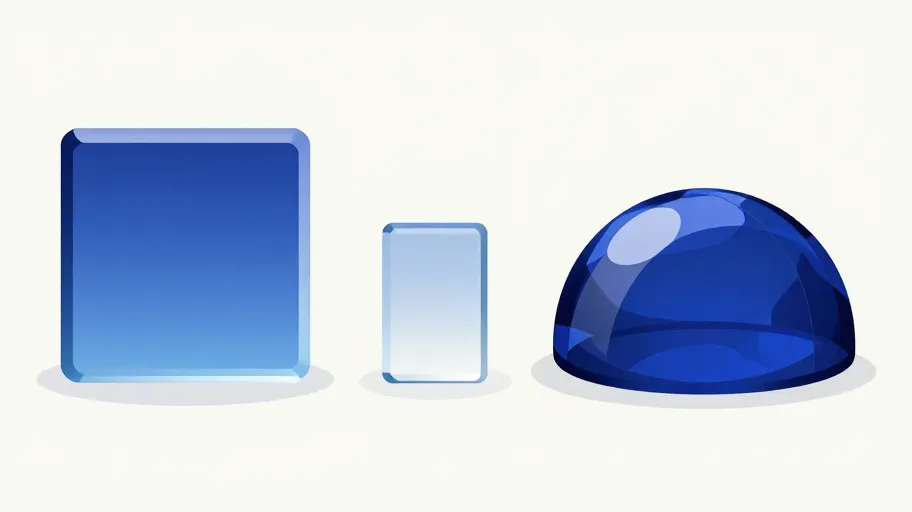
Selecting the correct sapphire crystal geometry is a foundational decision that defines a watch’s visual identity, durability, and price point. For sourcing managers and product developers, the choice requires balancing the desired aesthetic against engineering constraints like water resistance and manufacturing yield. By analyzing the specific utility of flat, box-type, and domed configurations, buyers can align their component specification with their brand positioning without compromising technical integrity.
The Geometry-Utility Matrix (GUM)
To streamline the selection process, we apply the Geometry-Utility Matrix (GUM). This framework evaluates three core variables—Optical Clarity, Structural Integrity, and Installation Complexity—against the three primary glass types. The goal is not to find a "perfect" shape, but to identify the geometry that maximizes utility for the specific use case, whether it is a rugged field watch or an elegant dress piece.
When utilizing GUM, consider the primary "job" of the watch. If the timepiece is intended for high-impact environments, structural integrity takes precedence. If the piece is a showcase for movement finishing, optical clarity is paramount. Installation complexity directly impacts tooling costs and potential for assembly delays.
1. Flat Sapphire Watch Glass
Flat sapphire is the baseline standard for the industry. It is characterized by a parallel top and bottom surface, creating a slab of synthetic sapphire that is usually ground to a precise thickness.
From a sourcing perspective, flat crystals offer the highest manufacturing yield and the most predictable sealing performance. Because the geometry is simple, the grinding and polishing processes are straightforward, resulting in consistent dimensional control. For the buyer, this translates to lower tooling investment and faster turnaround times on prototypes.
The primary disadvantage is aesthetic. Flat glass lacks the visual depth of domed alternatives and can catch the light in a way that highlights surface scratches, despite the material’s high hardness. However, for tool watches, divers, or aviation pieces where legibility under flat angles is critical, the flat profile remains the superior technical choice. It allows for maximum thickness without adding height to the case, a crucial factor for maintaining a low profile while achieving high depth ratings.
2. Box-Type (Double Domed) Sapphire
Box-type, often referred to as double-domed sapphire, features a convex external surface and a concave internal surface. This geometry is historically significant, mimicking the acrylic crystals of mid-20th-century vintage timepieces.
The double curve serves a specific optical function: magnification. By acting as a lens, a box-type crystal can magnify the dial, which is particularly desirable for vintage-inspired dials with small indices or intricate details. However, this shape introduces the "lens effect." If the crystal is too thick or the curves too aggressive, the dial can become distorted when viewed from an angle.
From a manufacturing standpoint, box-type crystals are more challenging to produce than flat ones. The internal concave shape requires specialized tooling to polish, increasing production complexity. For the buyer, the critical consideration is the relationship between the internal dome and the movement. A deep internal dome may reduce the available vertical clearance between the dial and the crystal, potentially causing interference with tall hands or a protruding calendar wheel. Sourcing managers must verify the internal clearance (free height) rigorously when specifying this geometry.
3. Domed (Single Domed) Sapphire
The single domed crystal features a convex external surface with a flat (or minimally angled) internal surface. This is the dominant choice for contemporary luxury sports watches and dress watches alike.
This geometry offers the best compromise between aesthetics and practicality. The external dome provides a pleasing visual distortion that can make the watch appear slimmer while adding a sense of vintage warmth without the extreme magnification of the box type. The flat internal surface ensures that the dial remains legible and that hands do not scrape the glass.
However, domed crystals present unique engineering challenges regarding water resistance. To achieve a watertight seal, the gasket must compress evenly around the perimeter. If the dome extends too close to the edge, or if the case seat is not perfectly radiused to match the crystal’s curvature, the seal may fail. Buyers must work closely with manufacturers to ensure the crystal’s "overhang" and the case’s "bezel seat" are geometrically compatible. A common failure point in product development is attempting to fit a high-dome crystal into a case designed for a flat one, necessitating a complete redesign of the case bezel.
Decision Table: Sapphire Watch Glass Types
The following table provides a comparative reference to assist in the preliminary selection phase.
| Feature | Flat Sapphire | Box-Type (Double Domed) | Domed (Single Domed) |
|---|---|---|---|
| Primary Aesthetic | Industrial, utilitarian, stark. | Vintage, warm, magnified. | Modern, elegant, fluid. |
| Optical Effect | Minimal distortion. True to dial color. | High magnification. Can distort edges. | Moderate magnification. Enhances depth. |
| Internal Clearance | Maximum. Easy for tall complications. | Reduced. Risk of hand interference. | High. Flat interior preserves space. |
| Sealing Complexity | Low. Easy gasket compression. | Moderate. Requires precise fit. | High. Case geometry must match curve. |
| Manufacturing Yield | High. Lower cost per unit. | Lower. Complex grinding/polishing. | Moderate. Standard for luxury. |
| Ideal Application | Dive watches, Field watches, Chronographs. | Vintage re-issues, Dress watches with small dials. | Pilot watches, Daily drivers, Modern sports watches. |
Technical Sourcing Checklist
Before moving to the tooling or mass production phase, use this checklist to validate your selection with the manufacturer. Do not assume standard dimensions; verify every variable against your specific case design.
- Geometry Verification: Have you confirmed the internal radius versus the external radius? For box-type, does the internal curve clear the highest point of the hour hand and the central seconds hand?
- Case Compatibility: Does the case seat (the ledge where the crystal sits) match the curvature of the crystal? A flat seat on a domed crystal creates a pivoting point that compromises water resistance.
- Thickness vs. Height: Are you balancing the need for impact resistance with the overall watch height? A thicker flat crystal may offer better shock resistance but sit taller than a thinner domed option.
- Edge Treatment: How will the edges be finished? A polished edge (bevel) is standard for luxury, but a chamfered or flat edge might be required for specific gasket structures.
- Coating Interaction: How will the selected curvature affect the application of AR (Anti-Reflective) coating? Curved surfaces require specific fixture jigs to ensure even coating deposition. Ask the manufacturer how they control coating thickness on complex curves.
FAQ
Does a domed crystal affect water resistance? Yes, but not because the shape is inherently weak. The challenge lies in the compression of the gasket. A flat crystal compresses a gasket evenly. A domed crystal focuses pressure on the outer ring. Ensure the case design accounts for this by providing a perfectly angled seating surface to match the crystal's profile.
Which crystal type is most durable? Flat sapphire generally offers the highest impact resistance because the parallel plates distribute force more evenly across the surface. Domed crystals can be structurally rigid, but if impacted on the high point of the dome, the force is concentrated. However, domed crystals are less prone to edge chipping during daily wear compared to sharp-edged flat crystals.
Can I swap a flat crystal for a domed one in an existing design? Rarely without modification. The case bezel and the crystal gasket are designed for a specific geometry. Introducing a dome usually requires redesigning the case seat to accommodate the curve and ensure the gasket seals correctly. It also changes the overall height of the watch, which may affect the crown and tube positioning.
Why choose box-type over single domed? Choose box-type if the design intent is strictly vintage recreation and the dial requires magnification for legibility. Choose single domed if you want the aesthetic of a dome but need the internal space for a modern movement or high complication modules.
How does curvature affect anti-reflective coating? Highly curved surfaces can cause "rainbowing" or uneven color shifts if the AR coating is applied too thickly. It is essential to discuss the refractive index of the coating with your supplier to ensure visual clarity is maintained across the entire curve of the crystal.
Conclusion
The choice between flat, box-type, and domed sapphire watch glass is not merely aesthetic; it is a complex engineering decision that influences the watch's legibility, durability, and assembly success. By applying the Geometry-Utility Matrix and rigorously checking internal clearances and sealing surfaces, sourcing managers can mitigate production risks. The most successful projects are those where the crystal geometry is selected in tandem with the case design, rather than as an afterthought.
Compare crystal geometries Submit your technical drawings for a geometry feasibility analysis
Download our Sourcing Checklist PDF: Sapphire Crystal Specification Checklist