
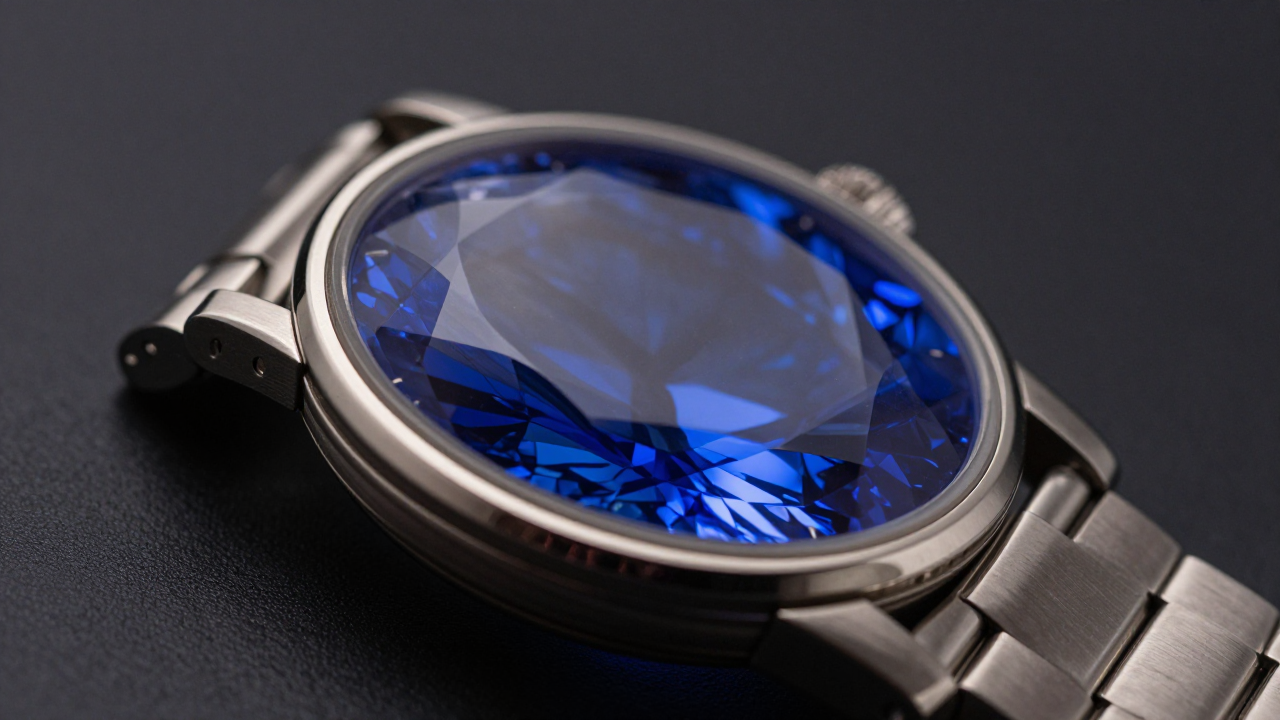
At 11:47 p.m. on a Tuesday in November 2023, a watch repair shop owner in Tucson, Arizona, sent us a photo that stopped me mid-scroll.…
A sapphire watch crystal had fractured along its chamfer—not from a drop, he insisted, but while he pressed a new gasket into place. The material was genuine synthetic sapphire. The edge angle, however, had been cut too steep. That single distinction, material versus machining, is where a lot of people shopping for a sapphire watch crystal in 2026 lose money.
The Tucson Email That Started This
We started Jadezone Optical in 2010 as a sapphire window supplier, and the company now runs just over 300 people in Shenzhen. Most of what you read online about sapphire crystals reads like it was written by someone who has never felt one chip under a polishing wheel. This guide is for watchmakers, microbrand founders, and collectors who want real bench-level criteria, not spec-sheet fluff.
Hardness Is Only Half the Story
Synthetic sapphire is aluminum oxide, Al2O3, grown in a crystal ingot. On the Mohs scale, it sits at 9; diamond is 10. That sounds like marketing gold, but hardness does not mean indestructible. It means scratch-resistant, not shatterproof. A hard knock at the right angle can crack a 1 mm-thick blank.
Three materials dominate watch crystals in 2026: acrylic, mineral glass, and sapphire. Acrylic is tough and flexible, scratches easily, and polishes back with a tube of compound. Mineral glass is harder but more brittle. Sapphire resists scratches from almost everything except diamond and some abrasive ceramics, yet edge impact remains its weak point.
A 9 on the Mohs scale sounds bulletproof. It is not. That is the first thing I tell microbrand founders when they call in a panic after their Instagram comments turn hostile.
Clarity is another trap. Uncoated sapphire reflects more light than mineral glass, which is why cheap sapphire watches sometimes look milky. A good double-sided anti-reflective coating pushes light transmission from about 86 percent to above 94 percent. Without quality AR, a sapphire watch crystal can look worse than a $5 mineral glass under bright light. Get the coating right or do not bother with sapphire.
Most watch blanks are grown by the Verneuil flame-fusion method. It creates a pear-shaped boule that gets drilled and sliced. Kyropoulos-grown sapphire, the kind used in aerospace windows and smartphone lenses, is overkill for a 30 mm watch crystal. Flame-fusion material can still meet a 0.03 mm thickness tolerance if the grinding line knows what it is doing. We have plenty of fused boule stock that fails only after someone rushes the edge polish.
On the retail side, an aftermarket sapphire watch crystal runs $25 to $70 for a standard round piece. Branded service centers charge $120 to $300 installed, which is mostly labor. That price gap is why independent watchmakers and microbrands buy direct from suppliers like us.
How We Test a Sapphire Watch Crystal
The first thing you can do without a lab is look at the edge. A well-machined sapphire watch crystal has a smooth, consistent chamfer—usually 0.3 to 0.5 mm wide on the top edge. If the edge looks rough or the bevel is uneven, walk away. That is the highest-stress point during installation.
In our Shenzhen plant, we run three checks on every batch. Dimensional control comes first: thickness tolerance of ±0.03 mm, diameter tolerance of ±0.02 mm for round crystals. Then we run a thermal shock test from room temperature to 100 degrees Celsius. Finally, a visual inspection under 10x magnification. We reject around 7 percent of incoming polished blanks before they ever reach the AR coating line. The most common failure is edge chip, not surface scratch.
Use a caliper to measure thickness at 12, 3, 6, and 9 o'clock positions. If thickness varies more than 0.03 mm, the crystal will not seat evenly. That is not a theory; we have seen dials shift and gaskets pinch because a blank was off by less than half a human hair.
Ask any retailer for the AR coating configuration. Single-sided coating protects the underside; double-sided is better for legibility but shows oil more. A 2024 batch we coated for a dive watch brand in Santa Barbara used double-sided AR, and the owner told us returns dropped 12 percent compared with their previous single-sided supplier. That number stuck with me—coatings drive fewer complaints than hardness.
Mike Kovac, a watchmaker in Cleveland, told me in April 2025: "The AR coating on cheap sapphire is the first thing that goes. Customers think they scratched their crystal, but it is just the coating peeling." His shop now photographs every incoming crystal under a UV light before quoting a repair. It takes four minutes. It saves them more.
Brands That Get It Right, and the Shortcuts to Avoid
Rolex began phasing in synthetic sapphire during the 1970s, and today nearly all luxury pieces use it. Omega uses domed sapphire on the Speedmaster Professional; Seiko still puts Hardlex on budget Prospex divers but upgrades to sapphire on many models above $400. Citizen fits sapphire to most Eco-Drive pieces above $300. These specifications are not accidents—they reflect the physical demands of each case design.
What changed in 2024 and 2025 is the sub-$400 microbrand wave. Dozens of American brands now advertise sapphire as standard on field watches. That pushes wholesale volume up, but it also attracts suppliers who cut corners on edge finishing. A Kansas City microbrand ordered 800 flat sapphire watch crystals in September 2025. The first article samples from one supplier had edge chips visible under a 5x loupe. They sent them back and switched to our blanks. Assembly breakage fell under 0.5 percent. Nobody notices a good edge until they install a bad one.
The phrase "sapphire coated" is another shortcut to avoid. True sapphire watch crystal is solid synthetic corundum, not a mineral glass core with a sapphire veneer. Some budget listings blur this. If the listing says "coated," ask for a density test. Solid sapphire has a specific gravity around 3.98. Mineral glass is typically 2.4 to 2.6. That one measurement settles the argument.
There is no universal labeling standard that forces sellers to distinguish solid sapphire from laminated sapphire. A laminated sapphire watch crystal—usually a thin sapphire layer over glass—is lighter and cheaper, but it does not have the same scratch resistance as a solid blank. Legitimate manufacturers list it as "laminated." Resellers sometimes forget that word.
A 2026 Buying Method You Can Steal
If you are replacing one crystal, not building five hundred, start with the case, not the catalog. Remove the old crystal and measure the opening with digital calipers. Write down diameter, edge thickness, and profile. Then check the gasket. A new crystal with an old, flattened gasket will fail water resistance no matter how hard the material is.
The order of priority I give watchmakers is:
1. Confirm the blank is solid synthetic sapphire, not mineral glass with a coating.
2. Check edge chamfer width and consistency under 5x magnification.
3. Ask for the AR coating specification—single or double-sided—and light transmission percentage.
4. For any watch that goes near water, match the original crystal thickness within ±0.05 mm.
5. Buy one extra crystal for every four you install, especially on domed profiles.
That last point comes from experience. In February 2024, a watchmaker in Minneapolis ordered 20 domed sapphire crystals for a vintage chronograph restoration. He installed 16 successfully. Three fractured during hand pressure, and one was out of tolerance. The one extra he had kept the project moving. That ratio is not unusual.
Honestly, the step most people skip is measuring the old crystal. They guess. Then they blame the material.
Care, Repair, and the Myths That Refuse to Die
Sapphire does not need much care, but the AR coating does. Clean it with warm water and a microfiber cloth. Avoid ammonia-based glass cleaners if the crystal has exterior AR coating; they can strip it over time. We have seen coating failure after six months of daily use with harsh detergents. That is not the crystal failing—it is the coating.
You can scratch sapphire with diamond, tungsten carbide, and some abrasive ceramics. If you see a scratch on a sapphire crystal, check your environment before assuming the crystal is fake. One customer in Phoenix scratched a sapphire crystal by wiping it with a cloth that had ceramic dust in it from a bathroom renovation. The crystal was real. The cloth was the problem.
When should you replace instead of polish? If the crystal has a chip along the edge or a crack that reaches the gasket seat, replace it. Polishing a cracked sapphire watch crystal is temporary and weakens the edge further.
Here is the open question we keep circling inside the industry: as synthetic sapphire prices fall, will consumers start treating crystals as disposable, like phone screens? In 2010 the answer was no. In 2026 the economics have flipped. A mass-produced round sapphire crystal now costs less than some leather straps. Whether that is a good thing for watchmaking depends on who you ask in the repair community.