
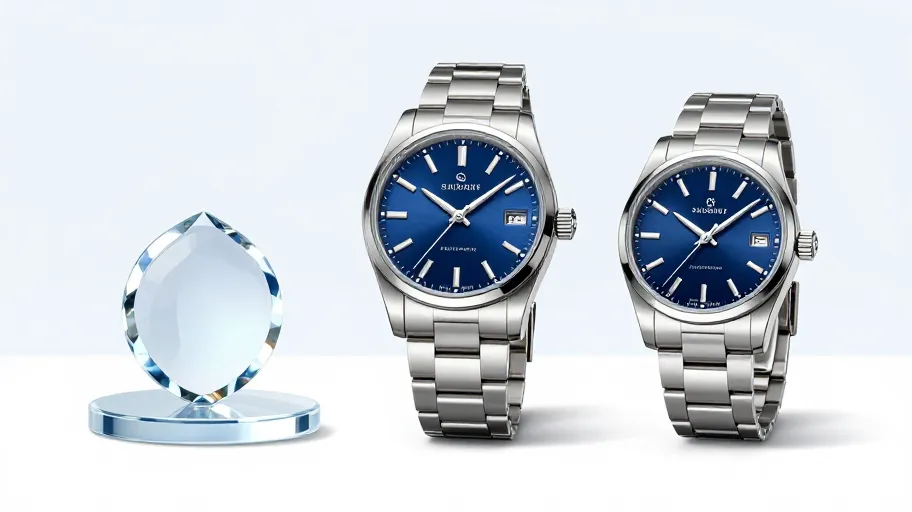
Selecting a sapphire watch crystal manufacturer requires verifying technical capability and process control rather than simply comparing price quotes. To mitigate supply chain risks, procurement teams must apply a rigorous verification framework that assesses raw material sourcing, precision metrology, and quality assurance protocols before committing to a production run.
Sourcing precision optics for timepieces is a high-stakes procurement decision. Unlike generic watch parts, a sapphire crystal defines the aesthetic appeal and durability of the final product. When buyers fail to vet manufacturers effectively, they often encounter批次 inconsistency (batch inconsistency), optical distortion, or components that fail pressure testing. To navigate this, we recommend using the Three-Axis Verification Model. This framework moves the conversation beyond "unit price" to an evaluation of Process Capability, Metrology Proof, and Commercial Responsiveness.
Axis 1: Process Capability and Manufacturing Depth
The first axis of comparison determines whether you are dealing with a vertically integrated manufacturer or a trading company that outsources critical steps. For high-end watchmaking, control over the entire production line—from the sapphire boule to the final coated crystal—is essential.
When evaluating a supplier, you must map their production workflow. A capable manufacturer should be transparent about their equipment. Ask specifically about their grinding and polishing machinery. Do they utilize CNC grinding centers for complex geometries, or are they relying on manual grinding for curved shapes? The difference impacts the consistency of the dome radius and the fit of the gasket groove.
Furthermore, inquire about the anti-reflective (AR) coating process. Is the coating applied in-house or sent to a third party? If outsourced, the supplier loses control over the adhesion quality and the environmental conditions during application. A critical indicator of process maturity is the supplier's ability to perform hydrophobic coating applications simultaneously with AR layers to ensure long-term durability.
Key verification points for Axis 1:
- Raw Material: Does the supplier grow their own sapphire boules or source blanks? Sourcing from multiple growers can lead to variance in refractive index and color tint.
- Fabrication: Is the beveling and edge polishing done mechanically or by hand? Mechanical processing ensures tighter dimensional control.
- Coating: Can they provide spectral transmission curves for their AR coatings to verify color neutrality?
Axis 2: Metrology Proof and Quality Assurance
Claims of precision are easy to make; data to back them up is what separates a professional vendor from a workshop. In the sapphire industry, the tolerance for flatness and parallelism is microscopic. A trustworthy sapphire watch crystal manufacturer should not hesitate to share inspection reports for previous orders or current samples.
You should require documentation of specific surface quality parameters. Request data on Surface Roughness (Ra). While a specific numerical target depends on your design standard, the supplier must be able to measure and report this consistently. Similarly, ask about their Flatness measurement methods. Do they use interferometry or laser displacement sensors? If they cannot quantify the flatness of a watch glass, they cannot guarantee it will sit flush on the watch case.
Quality assurance must also extend to destructive testing. Ask the supplier how they verify the hardness and impact resistance of their crystals. While sapphire is theoretically rated at a 9 on the Mohs scale, poor annealing processes can create internal stresses that make the crystal brittle. A qualified manufacturer will have protocols for stress viewing and thermal shock testing.
Key verification points for Axis 2:
- Measurement Equipment: Do they possess Coordinate Measuring Machines (CMM) or optical profilometers?
- Defect Standards: Do they inspect against a recognized standard (e.g., ISO 10110) or an internal, documented standard?
- Traceability: Can they trace a finished crystal back to the specific boule and production shift?
Axis 3: Commercial and Engineering Support
The third axis is often overlooked but vital for long-term success: engineering collaboration. Sourcing sapphire is not just buying a commodity; it is a technical partnership. During the RFQ (Request for Quotation) stage, observe how the supplier engages with your technical drawings.
A low-value supplier will simply say "yes" to every drawing without comment. A high-value partner will review the design for manufacturability. They might ask if the radius of the dome is too steep for the thickness specified, or if the corner radius is too tight for the grinding wheel, risking chipping. This feedback loop is a strong indicator of their experience.
Additionally, assess their packaging and logistics protocols. Sapphire is heavy and brittle. Improper packaging can lead to micro-fractures that only manifest after the crystal is installed and subjected to pressure. Ask to see their packaging standards and request evidence of their damage rates in transit.
Decision Matrix: Integrated Manufacturer vs. Assembler
To simplify your comparison, use the table below to categorize potential partners.
| Evaluation Criterion | Integrated Manufacturer | Component Assembler / Trader |
|---|---|---|
| Production Control | Full control over grinding, polishing, and coating. | Outsources coating or complex shaping; limited oversight. |
| Technical Feedback | Proactive design for manufacturability (DFM) advice. | Passive acceptance of drawings; higher risk of production errors. |
| Metrology Data | Provides detailed CMM and interferometry reports. | Provides basic dimensional checks; limited optical data. |
| Responsiveness | Longer initial setup, highly stable production. | Quick to quote, but variable quality and delivery stability. |
| Customization | Can develop custom tooling for unique shapes. | Limited to standard shapes and catalog tooling. |
Approval Questions for Your Next RFQ
To operationalize this framework, include the following questions in your next Request for Proposal. Their answers will reveal their true capability:
- Process Verification: "Please outline your internal workflow for a custom dome crystal, specifically identifying which stages are performed in-house versus by subcontractors."
- Metrology: "What specific equipment do you use to measure surface roughness (Ra) and flatness, and can you provide a sample report with a typical tolerance range?"
- Coating Durability: "How do you test the adhesion of your AR coatings (e.g., tape test, humidity test), and can you share the pass/fail criteria?"
- Defect Management: "What is your documented protocol for handling a batch that falls outside of optical or dimensional tolerance?"
- Material Consistency: "How do you ensure color consistency across different batches of sapphire blanks, particularly for tinted crystals?"
FAQ
How can I verify if the AR coating will peel off over time? Request the supplier to perform and document a cross-hatch adhesion test (ASTM D3359 or equivalent) on a sample. Additionally, ask for results from salt spray or humidity testing to simulate long-term wear.
What is the difference between "float glass" and "grown sapphire" in manufacturing? Float glass refers to a process used for standard mineral glass. For sapphire, the crystal must be grown (typically via the Kyropoulos or Verneuil methods) into a boule and then sliced. A manufacturer using "float" terminology for sapphire may be misrepresenting their material or confusing it with mineral glass.
Why do quotes for the same specification vary so much between suppliers? Price variances usually reflect the depth of processing. A lower price may indicate the supplier is buying pre-polished blanks from a third party and only doing simple edging, whereas a higher price often includes in-house shaping, strict optical inspection, and higher-grade raw material.
Can a manufacturer guarantee zero breakage during assembly? No reputable manufacturer guarantees zero breakage, as sapphire is brittle. However, a high-quality supplier will optimize the edge treatment (chamfering and polishing) to eliminate micro-fractures that cause breakage during press-fitting.
How do I check for "orange peel" effect on coated crystals? Ask the supplier for a visual inspection report under specific lighting conditions (e.g., ring light or collimated light). You can also request a sample to perform your own visual inspection, looking for ripples in the coated surface.