
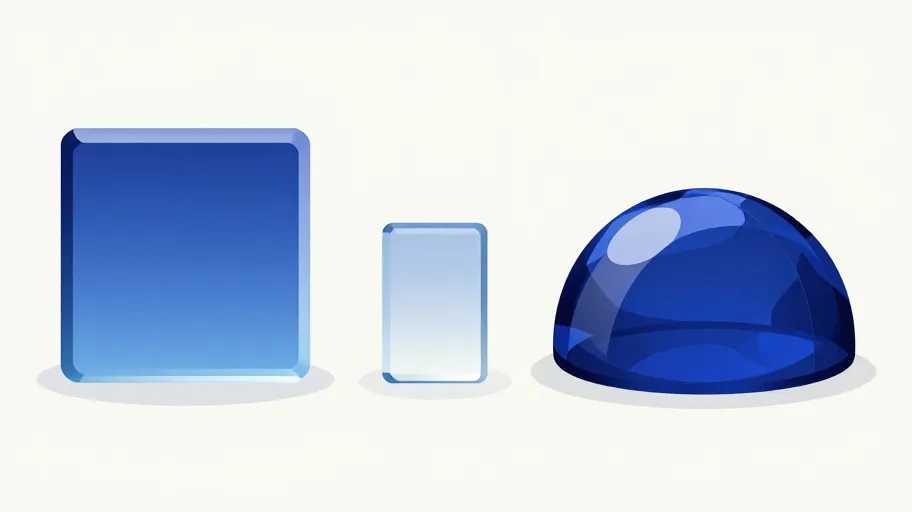
Selecting the correct sapphire watch glass type is a foundational decision in watch design that balances aesthetics against structural integrity. Flat crystals provide optimal legibility and straightforward assembly, while domed and box-type geometries offer distinct visual depth and magnification. Sourcing managers must evaluate the manufacturing feasibility of each curvature to ensure alignment with the case design and brand identity.
The Visual-Function-Complexity (VFC) Matrix
When sourcing custom sapphire components, the selection process often suffers from a disconnect between the design team’s vision and manufacturing realities. To bridge this gap, we utilize the Visual-Function-Complexity (VFC) Matrix. This framework forces product developers to rate their priorities across three axes before approaching a supplier:
- Visual Profile: Does the brand language demand a razor-thin modern profile or a voluptuous vintage bubble?
- Functional Requirement: What are the pressure ratings (water resistance) and shock absorption needs?
- Manufacturing Complexity: How does the curvature impact the thickness required to maintain integrity?
By using the VFC Matrix, buyers can determine if a design is viable or if it requires modification to avoid yield issues during production.
Flat Sapphire: The Standard of Utility
The flat sapphire crystal remains the industry standard for tool watches, divers, and modern field watches. Its primary advantage lies in its relationship with the case and the dial.
Advantages for Sourcing From a manufacturing standpoint, flat crystals are the most efficient to produce. They allow for uniform thickness, which simplifies the grinding and polishing processes. For the buyer, this often translates to predictable quality control.
Furthermore, flat crystals provide the highest clarity for dial legibility. Because the light passes through parallel surfaces, there is minimal refraction or distortion of the dial indices. This is critical for pilot watches or dive watches where instant readability is a safety requirement rather than just an aesthetic choice.
Considerations The main drawback is the lack of visual fluidity. A flat crystal can make a watch case appear taller and more slab-sided compared to a domed alternative. Additionally, while the surface is hard, the lack of curvature means that an impact is transferred directly through the crystal to the movement, potentially requiring more robust shock absorption systems in the movement mount.
Domed Sapphire: The Balance of Style and Strength
Domed sapphire represents the middle ground in the spectrum of sapphire watch glass types. It features a single external curve, while the internal surface may remain flat or be slightly concave to reduce visual distortion.
Aesthetics and Magnification The primary reason designers select a domed crystal is the vintage aesthetic and the "magnifying dome" effect. A dome with a high center point (height) relative to its width (diameter) will act as a lens, slightly enlarging the dial. This can make smaller dials feel more present and legible.
Structural Implications A dome is structurally stronger than a flat plate of the same thickness due to its geometry (similar to an arch). However, sourcing managers must verify the "thickness ratio." As the dome gets higher (steeper radius), the blank required to cut it must start significantly thicker. This increases material usage and machining time. It is crucial to confirm with the supplier what the final thickness will be at the center versus the edges to ensure it fits within the case bezel.
Box-Type Sapphire: The Vintage Specialist
Often confused with high-domed crystals, "Box" sapphire specifically refers to a geometry that mimics the acrylic crystals of the 1950s and 60s. It is characterized by a high, symmetrical curve—often a "double dome" where both the exterior and interior surfaces are curved.
The Double Dome Difference A true box-type crystal is usually a double dome. This means the inside surface is concave. This internal counter-curve is essential for optics. If the crystal were thick and domed on the outside but flat on the inside, it would significantly distort the dial, making indices look wavy or "swimming" when viewed from an angle. The double dome corrects this refraction, allowing for a dramatic bubble shape while maintaining dial clarity.
Sourcing Challenges Box-type crystals are the most challenging to manufacture among the sapphire watch glass types. The polishing process for a deep double dome is labor-intensive. The risk of chipping at the edge is higher because the crystal must be ground down to a thin profile at the rim while retaining thickness in the center. Buyers must ask their manufacturer about the edge treatment—typically a polished bevel is required to remove any micro-fractures from the grinding process.
Decision Framework: Selecting the Right Geometry
To assist in the product selection phase, use the following comparison to align your design intent with the appropriate manufacturing category.
| Feature | Flat Sapphire | Domed Sapphire | Box-Type (Double Domed) Sapphire |
|---|---|---|---|
| Visual Profile | Modern, utilitarian, clean. | Balanced, slight vintage feel. | Strong vintage, distinct "bubble" aesthetic. |
| Dial Magnification | None (1:1). | Low to Medium (depends on height). | High (significant magnification effect). |
| Legibility | Highest clarity, no distortion. | Good, slight edge distortion possible. | Excellent if double-domed; otherwise distorted. |
| Case Integration | Requires minimal case height. | Requires increased case height/depth. | Requires significant case depth and special bezel. |
| Manufacturing Yield | High (Standard). | Medium. | Lower (Complex geometry increases risk). |
| Shock Resistance | Good (relies on case construction). | Better (Arch geometry disperses force). | Variable (Edge thickness is critical). |
Technical Approval Checklist
Before releasing a purchase order for custom sapphire, product developers must verify the following technical parameters with their sourcing partner. Do not assume standard dimensions apply to custom geometries.
- Radius of Curvature: Have you specified the radius (e.g., R200, R500) for both external and internal surfaces?
- Center vs. Edge Thickness: Do you know the exact thickness at the thickest point (center) and the thinnest point (edge)?
- Clear Aperture: Does the crystal diameter account for the glue ring (seat) required for case bonding?
- Coating Feasibility: If applying AR coating, has the supplier confirmed that the coating chambers can accommodate the dome height without shadowing?
- Bevel Specification: For box-type crystals, is the edge bevel (e.g., 45-degree) specified to prevent chipping during installation?
FAQ: Sapphire Watch Glass Types
What is the difference between a dome and a box sapphire crystal? While both are curved, a "dome" usually refers to a standard external curve, whereas a "box" crystal implies a higher, more pronounced curve often found on vintage watches. Most high-quality box crystals are "double domed," meaning the inside is also curved to correct optical distortion.
Does a domed crystal affect water resistance? The geometry itself does not inherently compromise water resistance; however, the installation method does. A domed crystal often requires a different gasket compression ratio than a flat one. It is vital to verify that the case design and the crystal's seat angle are compatible to maintain the rated pressure depth.
Can all sapphire watch glass types be treated with anti-reflective coating? Yes, but the application difficulty varies. Coating a flat surface is straightforward. Coating a deep box-type crystal requires specialized dipping or vacuum racks to ensure even coverage. Sourcing managers should confirm that the supplier has validated their coating process for the specific curvature selected.
Why are box-type sapphire crystals more difficult to source? The difficulty lies in the raw material waste and the precision required during grinding. To achieve a high box shape, a thick piece of sapphire must be ground down significantly, which consumes more raw material and machine time. Additionally, the risk of breakage during the edge polishing phase is higher, which can impact delivery schedules if not managed correctly.
How does thickness impact the cost of custom sapphire? Cost is generally driven by the volume of the raw sapphire blank and the machining time. A flat crystal uses less material than a thick box crystal. Furthermore, complex geometries require more time to polish to optical clarity. Always request a breakdown of how the geometry impacts the unit price.
Conclusion
The choice between flat, domed, and box-type sapphire is not merely aesthetic; it is a technical decision that influences water resistance, legibility, and manufacturing yield. By applying the Visual-Function-Complexity Matrix, brands can move beyond subjective preference to a specification-driven sourcing strategy.
Compare crystal geometries [Link to JadeZone Sapphire Geometry Comparison Guide / Contact Form]
Download your Crystal Spec Sheet Checklist [Link to PDF Checklist: 10 Points to Verify Before Ordering]