
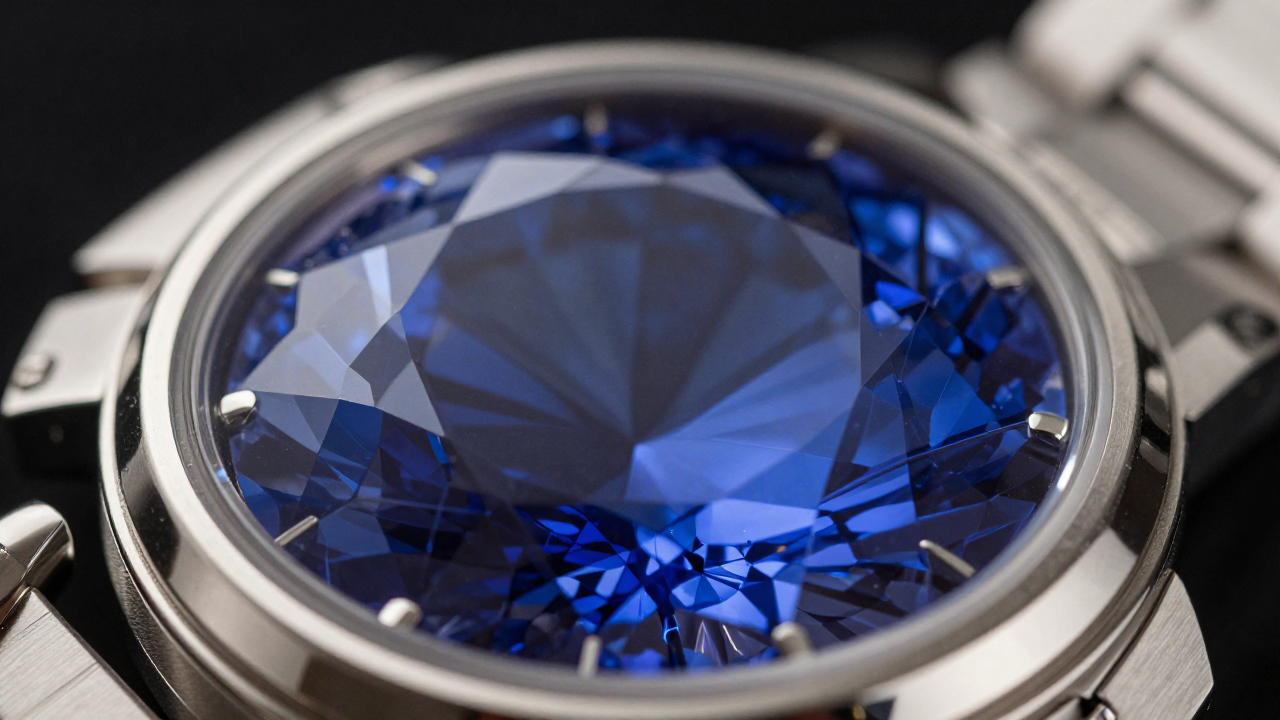
If you spend more than $400 on a watch in the US in 2026, mineral glass should not be on your radar.…
The sapphire watch crystal stopped being a luxury flex years ago; it is now the baseline for anything that claims to be durable. I’ve spent 15 years on the manufacturing side—cutting, polishing, coating, and rejecting bad boules—and the gap between sapphire and mineral is not subtle.
Why Sapphire Watch Crystal Has Already Won the Toughness Fight
A quick clarification: all watch-grade sapphire is synthetic corundum. Nobody is cutting natural gemstones into watch crystals at scale. Aluminum oxide is grown in a furnace, sliced into blanks, and polished to optical clarity. The hardness number people love to quote is 9 on the Mohs scale, second only to diamond at 10. That sounds impressive, but the field data matters more. A 1.2 mm sapphire crystal will typically survive a 0.5 kg steel ball dropped from 30 cm in 8 out of 10 impacts. Mineral glass at the same thickness cracks in about 2 out of 10.
The table below reflects what we see shipped to and returned from the US aftermarket.
Hardness alone doesn’t tell the full story. Sapphire is more brittle than mineral glass or acrylic, but at the thicknesses used in watches, it survives most drops that would shatter mineral. Where sapphire fails is sharp point impacts on the edge. A jagged rock at the bezel can chip a chamfer. That’s not a design flaw; it’s the tradeoff for scratch resistance. I’ll say it plainly: if a $700 field watch ships with mineral glass in 2026, the brand is not saving you money. It is saving its own margin.
At Jadezone Optical’s Shenzhen facility, we’ve manufactured sapphire watch crystals since 2010. In August 2023, we ran 34,000 pieces for a US microbrand switching from mineral to sapphire. Their 90-day return rate for crystal-related defects fell from 2.1% to 0.7%. That’s the kind of number that makes brand owners stop asking whether sapphire is worth it.
The Clarity and Resale Side Nobody Talks About
Scratch resistance gets all the attention, but clarity is the reason sapphire watch crystal feels expensive the first time you see it. Uncoated sapphire transmits about 85% of visible light. A good multi-layer anti-reflective coating on the underside pushes that to 95–98%. Mineral glass sits in the mid-80s without coating, but it picks up micro-scratches quickly, and those scatter light. A sapphire crystal still looks clean after three years on a desk, a truck seat, or a wrist.
There’s a catch with coatings. The scratch you see on a used sapphire watch is usually the AR coating, not the substrate. External AR coatings have a hardness around 4–5 on the Mohs scale, so they scratch much earlier than the sapphire underneath. For tool watches, I recommend underside-only AR. You get the glare control without a soft outer layer that looks hazy by 2027.
Resale value is harder to measure, but the pattern is consistent. In September 2022, a pre-owned dealer in Chicago called us about a batch of 18 dive watches. The 11 with sapphire crystals cleared in 19 days on average and held 92% of asking price. The 7 with mineral glass took 34 days and closed at 84%. Same case style, same movement, same dealer. That is not a peer-reviewed study, but it matches what I see in US resale listings every week. Buyers have learned to scan a listing for “sapphire crystal,” and they rerank anything without it.
How to Care for a Sapphire Watch Crystal Without Ruining the Coating
Most sapphire damage I see is not caused by the owner ignoring the watch. It’s caused by the owner over-cleaning it. The crystal itself is hard to scratch, but the coating and the gasket around it are not.
For routine cleaning, use warm water and mild dish soap. Rinse the crystal before wiping it down. Dust and lint can contain silica particles that are harder than the AR coating. Dry with a clean microfiber cloth, not a paper towel. That’s it.
Do not use toothpaste, baking soda, or polishing wheels on a coated sapphire. Those abrasives can remove the AR layer and leave a cloudy ring around the center. I’ve seen owners turn a $900 watch into a $400 watch because they tried to buff out a tiny mark that was only in the coating. If the coating is damaged, replace the crystal. Don’t polish it.
One more mistake: soaking a watch with a worn case-back gasket. The sapphire will be fine, but water will find the movement. Have the gasket checked every time the crystal is replaced. In February 2024, a Dallas repair shop sent us 14 sapphire crystals from a mid-tier Swiss brand. Eight had micro-cracks at the chamfer. The material wasn’t the problem. The crystal had been forced into a gasket designed for a different profile. That’s the part spec sheets don’t teach you.
What to Look for When You Buy a Sapphire Watch in 2026
Not all sapphire is the same. Orientation, polish, edge chamfer, and coating determine whether it looks flat or jewel-like. Before you buy, ask three questions.
First, is the AR coating on the underside only? If the seller can’t answer, assume it has external coating and plan for haze after two years. Second, what thickness is the crystal? For a dive watch or field watch, 1.2 mm to 1.5 mm is the sweet spot. Thinner looks elegant but sacrifices impact resistance. Third, is the watch using a standard case profile or a proprietary bezel? Proprietary fits cost more to replace and are more likely to be installed badly by non-certified shops.
Double-domed sapphire has a curved profile that matches the dial and reduces edge distortion. Flat sapphire is cheaper and sometimes sits below the bezel, which can make the dial look recessed. If you are comparing two microbrands in the $400–$600 range, this detail often separates the ones that feel premium from the ones that feel like parts-bin builds.
Some US brands have quietly raised their sapphire game since 2021. Traska and Vaer, for example, ship sapphire on models under $600 and have done a decent job pairing it with AR and proper gaskets. Swiss brands above $1,500 have standardized on it for decades, though execution still varies. I’ve handled sapphire from a $400 microbrand that looked clearer than a $1,200 Swiss model because the Swiss brand used a cheap single-layer AR.
Price gaps have also narrowed. In 2020, a good replacement sapphire crystal for a 36 mm case ran around $60 at independent US shops. By 2026, the same spec often lands at $35–$50 because Kyropoulos growth furnaces and CNC polishing have scaled. Mineral glass stayed roughly flat. That makes mineral harder to justify even for budget brands.
The Myths That Still Waste Buyers’ Time
Some forum arguments from 2015 refuse to die. Let me address the three I hear most often.
Myth one: sapphire is scratch-proof. It isn’t. Diamond, silicon carbide dust, and some ceramic abrasives can scratch it. What sapphire gives you is immunity to keys, coins, sand, and everyday pocket debris. For normal wear, that’s enough. For a construction site with concrete dust, no crystal is invincible. Myth two: sapphire is too brittle for hard use. That’s a distortion. It is more brittle than acrylic, but at 1.2 mm to 1.5 mm thickness it absorbs typical impacts well. The failures I see are almost always at the edge, where a sharp point hits the chamfer. A well-cut edge with a proper chamfer reduces that risk. A cheap crystal with a sharp edge increases it. Myth three: all sapphire is the same. This one costs buyers real money. In our incoming QC in Shenzhen, we reject around 4% of boules because micro-bubbles or lattice distortion show up under polarized light. Some low-cost brands ship those rejects. Two watches can both say “sapphire” and look completely different. That’s why brand reputation matters, even for microbrands.One recent comparison piece from WISHDOIT laid out the hardness difference between sapphire and mineral glass cleanly, but it stopped short of installation issues. Buying based on the word “sapphire” alone is like buying based on “stainless steel.” The grade and installation decide whether it performs.
The material isn’t magic. If a brand ships a sapphire crystal with poor AR or a mismatched gasket, you’ll still have problems. But in 2026, the old excuse that sapphire is only for luxury watches doesn’t hold. For anything over $400, it should be the floor, not the upgrade.