
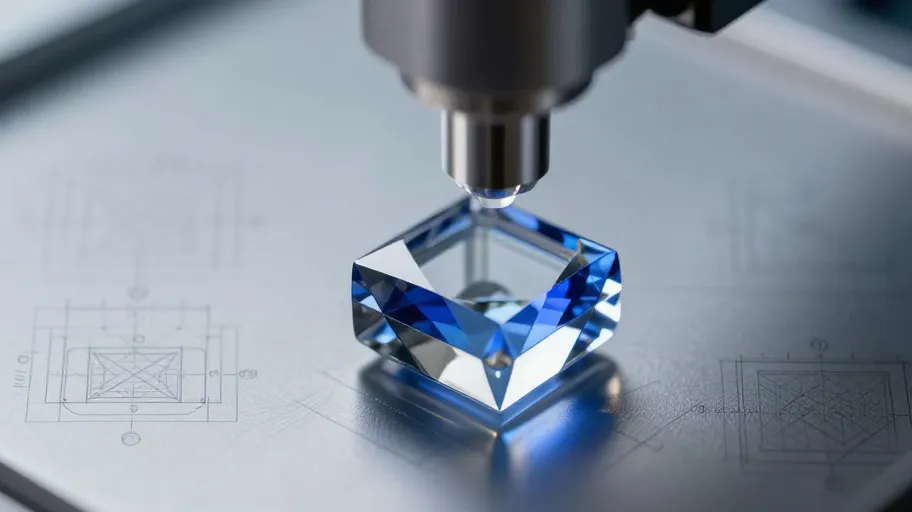
Eliminate specification errors before they cost you $78K
Most prototype failures aren’t manufacturing flaws—they’re communication gaps. A U.S. microbrand lost $78,000 on a mold because “flat” meant different things to them and their supplier. The factory met basic flatness, but not the optical-grade planarity needed for bezel fit and AR coating adhesion. That single ambiguity delayed launch by 14 weeks and triggered ripple effects across assembly and marketing.
Geometric Dimensioning and Tolerancing (GD&T) fixes this. It means your team speaks the same technical language as the factory, because it defines how parts must perform—not just how they should look. Specifying flatness with a datum tied to the case interface ensures every micron is measured against real-world assembly, not lab ideals. This precision matters: anti-reflective coatings can delaminate if substrate warpage exceeds 2μm. Brands using full GD&T report up to 40% faster approval cycles—because there’s no debate over who missed the mark.
Perfect specs fail if material science is ignored. One myth still trips up buyers: 'All sapphire is scratch-resistant.' Bulk hardness is Mohs 9, yes—but edge durability depends on crystallographic orientation during CNC grinding. Cutting perpendicular to the c-axis creates edges prone to chipping under press-fit stress. Aligning the primary face normal to the c-axis maximizes resistance where it matters most. Leading sapphire china manufacture partners now use X-ray diffraction to map and orient blanks before machining. Brands using this capability see up to 60% fewer edge defects—meaning lower scrap rates and smoother automation downstream.
Why AR coatings fail and how to stop it
Multi-layer anti-reflective coatings fail not because of design, but environment. A 2024 Optics & Photonics International study found uncontrolled humidity in coating chambers increased interlayer delamination by 22% under accelerated aging (85°C/85% RH for 500 hours). Yet most purchase orders only specify reflectivity (<1.5% across 400–700nm), not process conditions. The result? Field returns spike months later—after reputation damage is done.
Process-qualified requirements prevent this. Requiring chamber log files, deposition rate consistency, and ASTM C1650 adhesion testing means defects are caught before shipment, because environmental control is enforced at the source. Some brands go further: embedding witness samples in each batch for spectral verification. One Austin-based maker used this for a desert-launch collection and saw zero coating-related returns—even under extreme thermal cycling. A competitor with identical formulas faced a 9% return rate due to hazing. Process transparency doesn’t slow production—it prevents catastrophic restarts.
Material grade alignment is just as critical. 'Optical grade' sapphire isn’t standardized—until now. ISO 24153 is emerging as the benchmark for synthetic crystalline materials in wearables. Early adopters report faster customs clearance, fewer QA disputes, and stronger IP protection through traceable pedigrees. More importantly, compliant stock ensures refractive index stability (±0.001) and minimal bubbles (< Level 2 per USP <660>), which directly impacts clarity and camera-based authentication in smart timepieces.
Turn specs into your competitive advantage
When you combine precise GD&T, crystallographically aware machining, process-controlled AR coating, and ISO 24153-compliant material, development transforms. Six prototype iterations shrink to two. Teams spend less time firefighting and more time innovating—on thinner profiles, complex domes, or hybrid bonding. One Swiss-American collaboration cut development from eight months to 11 weeks simply by front-loading these four disciplines into their RFQ. Their supplier didn’t get better overnight—the specs made capability measurable.
Looking ahead, the next competitive edge isn’t in the factory—it’s in the first PDF sent from designer to supplier. As AI-driven optical simulation tools go mainstream in 2026, predictive accuracy hinges on fully defined parameters. Vague drawings won’t run in simulation engines. Only machine-readable GD&T files enable that leap. The brands that dominate won’t be those with the flashiest designs, but those with the smartest specs. They’ll lock in faster time-to-market, higher perceived quality, and supply chains immune to interpretive drift.
How to Specify a Custom Sapphire Watch Crystal isn’t a checklist—it’s a strategy. Master sapphire china factory collaboration with technical rigor, and you don’t just avoid $78K mistakes. You build a repeatable system for precision, speed, and trust. Ready to turn your next prototype into a flawless launch? Start with the spec.