
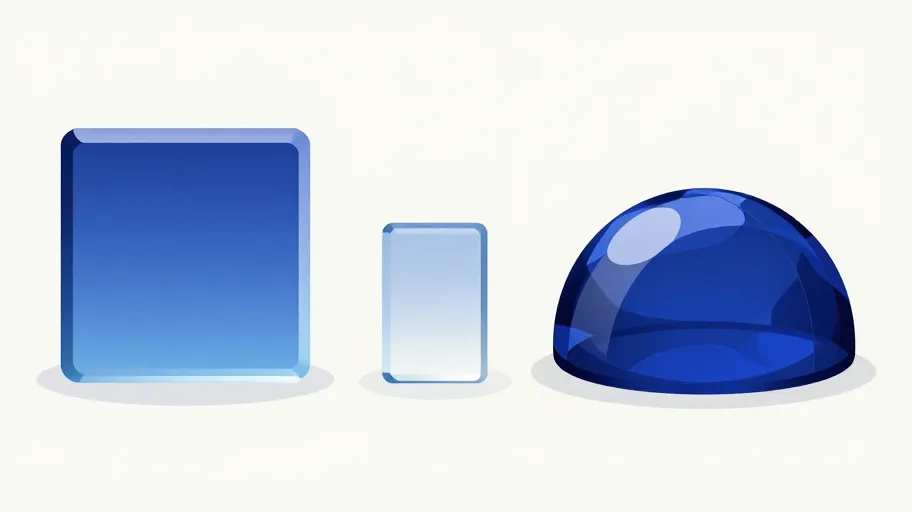
Selecting the correct geometry is a foundational step in watch development that dictates both aesthetic language and structural integrity. For watch designers and private-label brands, choosing between flat, box-type, and domed sapphire watch glass types requires balancing the desired visual profile against the practicalities of case sealing and impact resistance. This guide provides a technical framework to validate your selection against engineering constraints.
The Geometry-Durability-Optics (GDO) Assessment
To move beyond subjective preference and toward a technically sound sourcing decision, we utilize the Geometry-Durability-Optics (GDO) Assessment. This framework evaluates crystal shapes based on three vectors:
- Geometry: The physical fitment within the case, including the verticality of the walls and the required case height.
- Durability: How the shape distributes impact force and interacts with gaskets for water resistance.
- Optics: The way the curvature refracts light, affecting dial legibility and the perceived thickness of the crystal.
By applying this framework, product developers can isolate which geometry aligns with their specific design and performance requirements.
Flat Sapphire: The Standard of Precision
The flat sapphire crystal is the benchmark for modern tool watches and contemporary dress watches. Characterized by a parallel top and bottom surface, it offers the most straightforward integration into standard case architectures.
From a Geometry standpoint, flat crystals allow for the lowest possible case height profile. This is critical for slim dress watch designs or field watches intended to slide easily under cuffs. The vertical thickness is consistent from the center to the edge, simplifying the calculation of the case back clearance and movement height.
In terms of Durability, flat crystals offer a predictable surface for impact resistance. Because the surface is perpendicular to the force of a direct blow, the structural load is distributed evenly across the crystal. Furthermore, flat crystals provide the most reliable surface for gasket compression. The flat interface ensures an even seal against the case band, which is a critical factor for divers or high-water-resistance applications.
Regarding Optics, flat crystals introduce zero magnification. This is ideal for dials with intricate details or typography where distortion must be avoided. However, flat surfaces can suffer from specular glare. While this is mitigated by AR coating application, the flat geometry does not inherently deflect light away from the eye, making anti-reflective treatments a necessity for legibility.
Box-Type Sapphire: Structural Verticality
Box-type sapphire crystals are often confused with high-domed crystals, but they are structurally distinct. A true box-type crystal features a flat top surface with vertical, or nearly vertical, sides that drop down to the seating surface. This mimics the acrylic glass crystals found on mid-century military watches.
The Geometry of the box type creates a visual "box" over the dial. It adds significant visual height to the watch without requiring a thick movement. The vertical sides are designed to sit flush with the internal step of the case, providing a distinct vintage aesthetic.
In the Durability category, the vertical walls of a box-type crystal are generally thicker than the edges of a flat or domed crystal. This provides excellent resistance to lateral impacts. However, the sharp internal corners where the vertical wall meets the flat top can be points of stress concentration during manufacturing. When sourcing, verify that the manufacturer has optimized the polishing process to eliminate micro-fractures at these interior angles.
Optically, the box type provides a "window" effect. Because the top surface is flat, there is no magnification of the dial, preserving the true scale of the hands and markers. However, the high vertical walls can create a view of the dial from extreme angles that is blocked by the crystal thickness, a "tunnel vision" effect that is often a desired vintage trait.
Domed Sapphire: Aesthetics and Refraction
Domed crystals are defined by a continuous curvature from the center to the edge. They are a staple of vintage re-issues and dress watches, offering a classic, organic feel. Within this category, it is vital to distinguish between a single dome and a double dome.
Geometry is the primary driver for this choice. A single dome is curved on the outside but flat on the inside. A double dome is curved on both the exterior and the interior. The double dome allows for a higher, more dramatic external arch while keeping the center thickness of the sapphire manageable. This helps maintain a low internal profile, preventing the crystal from contacting the sweep second hand or high dial elements.
Durability is a nuanced subject with domed crystals. While the arch shape is inherently strong against distributed pressure (increasing depth rating potential), the apex of a high dome is more exposed to direct point impacts. Additionally, as the dome height increases, the edge thickness necessarily decreases to fit into a standard case. Sourcing managers must confirm with the supplier that the edge thickness remains sufficient to support the tension ring or gasket without chipping.
The Optics of a domed crystal are its most defining feature. A single dome acts as a magnifying lens, enlarging the dial. This can be advantageous for smaller dials or vintage-style handsets, but it can distort the appearance of the hour markers when viewed from an angle. A double dome, when engineered correctly, cancels out this distortion, offering the vintage look of a high dome without the visual "fishbowl" effect.
Decision Matrix: Sapphire Watch Glass Types
| Feature | Flat Sapphire | Box-Type Sapphire | Domed Sapphire |
|---|---|---|---|
| Visual Profile | Modern, low-profile, utilitarian. | Vintage, prominent verticality. | Classic, elegant, high-profile. |
| Dial Magnification | None (True 1:1 scale). | None. | Single Dome: High; Double Dome: Low/None. |
| Water Resistance | Excellent (Easy gasket seal). | Very Good (Large surface area). | Good (Dependent on edge thickness). |
| Impact Resistance | High (Even distribution). | High (Thick vertical walls). | Moderate (Apex exposure; thinner edges). |
| Coating Complexity | Low (Flat surfaces). | Moderate (Internal corners). | High (Curvature requires precise masking). |
| Ideal Use Case | Dive watches, modern field watches. | Military re-issues, pilot watches. | Dress watches, vintage-inspired divers. |
Project-Specific Approval Questions
When engaging with a manufacturer for custom sapphire components, avoid assumptions. Use the following questions to verify feasibility for your specific project:
- For Box-Type: "Can you confirm the minimum radius possible at the internal top-corner transition to avoid stress fracturing during polishing?"
- For Domed: "What is the maximum dome height achievable for a case diameter of X mm while maintaining a center thickness of Y mm?"
- For Double Domed: "Is the internal radius perfectly matched to the external radius to ensure zero optical distortion?"
- General: "How will the proposed geometry affect the minimum achievable edge thickness, and does this align with our specified water resistance rating?"
Sourcing Approval Checklist
Before finalizing technical drawings or releasing purchase orders, verify the following checkpoints:
- Geometry Definition: Confirm if the design requires single domed, double domed, box, or flat profiles.
- Optical Calibration: Verify that the magnification factor (if any) aligns with the brand’s design intent for dial legibility.
- Clearance Check: Ensure the internal height of the crystal (especially for box or double domed types) does not interfere with the hand stack.
- Edge Treatment: Specify the required edge finish (polished, beveled, or ground) to ensure proper gasket compression.
- Coating Specification: Define AR coating requirements (inside, outside, or both) specifically accounting for curvature challenges.
Compare crystal geometries with our engineering team to validate your technical drawings and ensure optimal material selection.
Download the Sourcing Approval Checklist to prepare your design files for manufacturing review.