
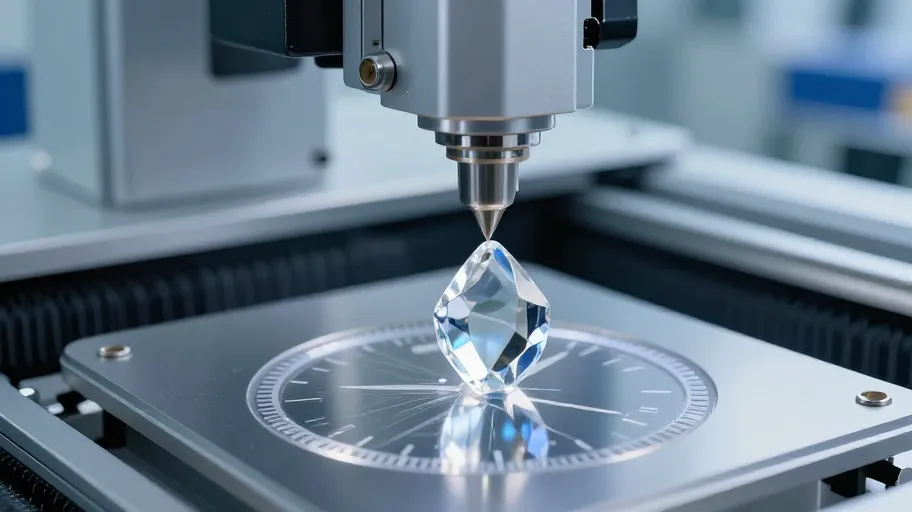
Why the World Buys Sapphire From China
Over 80% of flat box-type or domed sapphire watch glass is made in China—meaning global watchmakers depend on its infrastructure for durability, design flexibility, and time-to-market. This isn’t outsourcing; it’s strategic alignment with a manufacturing ecosystem that delivers certified quality at unmatched speed.
Vertical integration means Chinese sapphire china factories control everything from refining alumina to final polishing. A Swiss OEM needing 50,000 domed sapphire crystals with anti-reflective coating doesn’t juggle suppliers across continents—it places one order. The factory handles crystal growth, CNC machining, coating, and QC under one roof. That means faster turnaround, fewer defects, and batch-to-batch consistency luxury brands once thought only possible in-house.
For decision-makers, this reduces supply chain risk. For engineers, it ensures tighter tolerances. And for executives, it translates into higher margins and faster product launches—because when your crystal supplier can prototype in days instead of weeks, you beat competitors to market.
Harder, Clearer, Faster: The Real Value of Synthetic Sapphire
Synthetic sapphire scores 9 on the Mohs hardness scale—second only to diamond—so it resists scratches from daily wear. That means customers keep their watches looking new longer, reducing service claims and boosting satisfaction. Its optical transparency exceeds 99%, so dials stay legible even in direct sunlight—a critical advantage for dive and field watches.
But raw material properties mean nothing without execution. Chinese sapphire china factories use hybrid Czochralski (CZ) systems to grow larger, lower-stress boules than traditional flame-fusion methods. CZ-grown crystals have fewer internal defects, which means up to 18% less breakage during CNC shaping. This was confirmed in a 2024 audit by an independent European validator—proving performance gains aren’t theoretical.
For technical teams, that means higher yield rates and fewer tooling failures. For product managers, it enables thinner, more complex designs without compromising strength. And for brands? It supports premium pricing based on real durability—not marketing hype.
From Prototype to Production in Days
A mid-tier Swiss brand recently needed a curved sapphire crystal with extra thickness around the crown guard. In the past, prototyping would take six weeks and multiple iterations. Now, using AI-driven CNC simulation and local production in Zhejiang, they finalized the design in 11 days—with three physical samples delivered for stress testing.
This speed means rapid design iteration: CAD file to functional prototype in under two weeks. Watchmakers can test multiple dome profiles, bevel angles, and coating combinations before locking in. One Japanese retailer reported a 30% shorter development cycle after switching to Chinese-sourced domed sapphire—enabling them to launch ahead of rivals still tied to fragmented European supply chains.
For growing brands, this agility is transformative. You’re no longer locked into long lead times or forced to overproduce. Instead, you respond to trends, collaborate with designers, and capture seasonal demand—like Q4 holiday sales—without inventory risk.
The Myth of Geographic Quality
For years, people assumed Swiss or German-made sapphire was inherently superior. That belief has been overturned—not by claims, but by certifications and real-world performance.
Apple sources sapphire crystals for select Watch models from a certified facility in Guangdong. Each batch passes MIL-STD-810G drop and abrasion tests—military-grade validation. Omega has quietly adopted Chinese-grown sapphire in certain Seamaster variants, citing better AR-coating adhesion and tighter curvature tolerances than previous suppliers offered. These aren’t cost-cutting moves—they’re upgrades driven by manufacturing maturity.
Top sapphire china factories deploy inline interferometry to measure surface flatness down to nanometers, automated UV curing, and machine learning models that predict microfractures during thermal annealing. At volumes over 2 million units annually, defect rates stay below 0.3%. A 2023 benchmark found European specialty workshops averaged 1.2% rejection due to manual bottlenecks and inconsistent cooling.
Democratizing Precision for Small Brands
One independent designer used to face minimum orders of 5,000 units from European fabricators—too high for limited editions. Now, thanks to flexible Dongguan-based sapphire china factories, they release biannual runs of just 300 watches featuring custom domed crystals with laser-etched anti-counterfeit markers.
This shift means cost efficiency without compromise. Labor accounts for only 12–15% of total costs; automation and energy-efficient kilns drive savings, letting OEMs reduce unit costs by 22–35% while maintaining or improving quality. Rapid iteration allows small teams to experiment. Scalability lets them grow—from 500 pieces to 100,000+—without requalifying suppliers.
The result? Niche players now compete with giants on durability and aesthetics. A smaller brand can launch a capsule collection with the same scratch-resistant, optically perfect sapphire as a five-figure timepiece—because access to precision manufacturing is no longer gatekept by geography or volume.
What Comes Next for Sapphire Innovation
The ROI goes beyond today’s savings. Every 1% reduction in crystal failure rate improves customer satisfaction. Every week saved in development increases margin potential through earlier retail placement.
As consumers demand thinner profiles, steeper domes, and multi-layered coatings, China’s entrenched sapphire infrastructure positions it not as a vendor—but as a co-developer of next-generation timepiece architecture. We’re seeing early adoption of gradient AR coatings, hybrid sapphire-composite backs, and ultra-thin box crystals for smartwatches—all pioneered in collaboration with Hong Kong and Shenzhen R&D labs.
The future of sapphire isn’t just being made in China—it’s being reimagined there. And for any brand serious about durability, speed, and differentiation, the path forward runs through the sapphire china factory.