
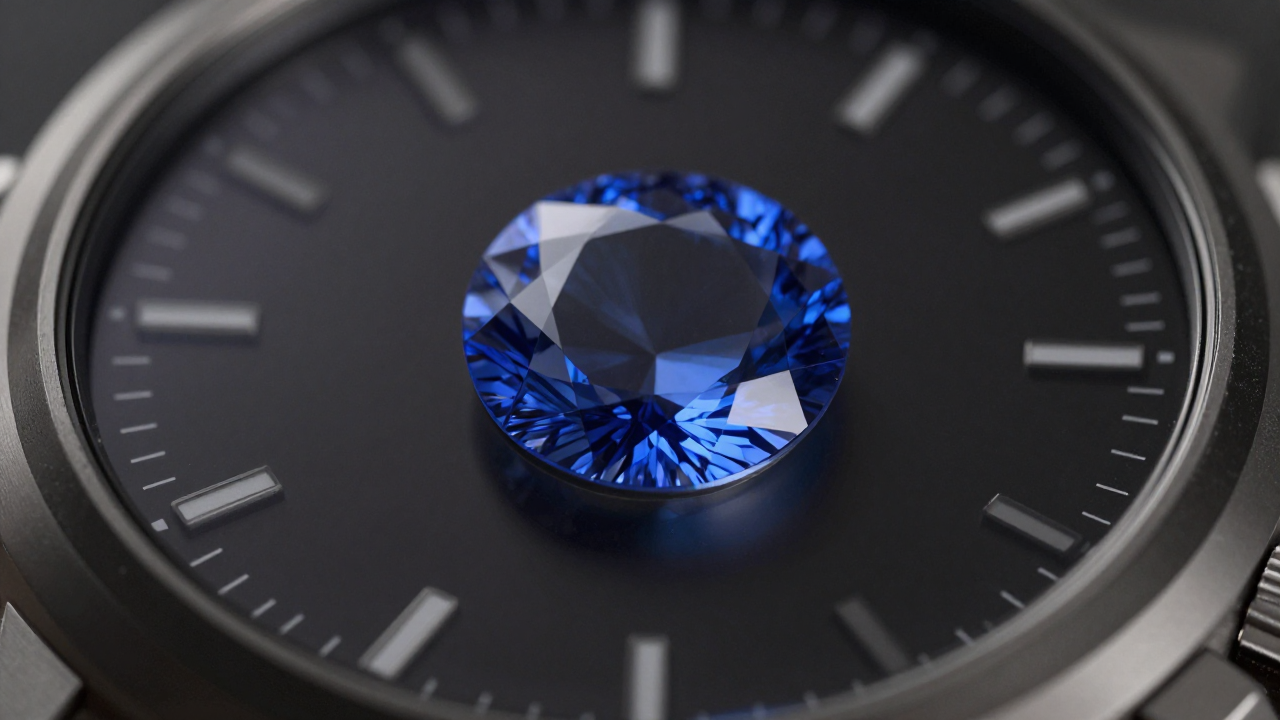
The sapphire watch crystal stopped being a meaningful differentiator around 2019, but Rolex’s marketing engine still carries the aura of exclusivity.…
That disconnect is exactly why 2026 will be the year the crown genuinely loses control of the material conversation. I’ve spent 15 years on watch crystal production floors and in sourcing meetings from Shenzhen to Chicago, and I can tell you the technical gap that once separated Rolex from everyone else is gone. What remains is brand gravity, and brand gravity doesn’t hold forever.
The Sapphire Watch Crystal Stopped Being a Differentiator. That’s the Whole Story.
Hardness Won the Bench Test Years Ago, But That’s Not the Whole Story
The reason sapphire became the default for luxury watches is simple: it scratches almost nothing in daily life. On the Mohs scale, acrylic sits around 3, mineral glass around 5.5, and synthetic sapphire comes in at 9. Only diamond and a few exotic abrasives beat that. A sapphire watch crystal can survive pocket sand, door frames, car keys, and the occasional drunken stumble against a brick wall. Mineral glass can’t.
But hardness alone doesn’t explain the shift. Acrylic has its own advantage—it flexes under impact and tends to absorb shock instead of cracking. Sapphire is brittle. If you drop a watch face-down on a tile floor, sapphire won’t scratch, but it can shatter. Acrylic will gouge, but it won’t splinter. That trade-off still matters, and I’ll come back to it because most buyers misunderstand the risk.
The real reason sapphire won is legibility. Synthetic corundum, when properly grown and polished, produces a nearly colorless, optically clear window. With a good anti-reflective coating on the underside, light transmission can top 95%, which makes the dial readable in direct sun. Acrylic and mineral glass can’t match that combination of hardness and clarity over a decade of wear.
The Manufacturing Process Is Where Cheap Suppliers Get Exposed
Sapphire watch crystals are grown as boules using either the Verneuil method or the Kyropoulos method, then cut, ground, and polished to tolerances that most consumers never see. The difference between a $4 crystal and a $25 crystal isn’t material—it’s edge geometry, flatness, and coating consistency. We’ve measured plenty of low-cost blanks at our Shenzhen facility. A cheap crystal might pass visual inspection but fail under a polarized light test because the polishing introduced micro-stress that weakens the edge.
Typical mid-range sapphire watch crystals run from 1.5mm to 3.0mm thick. Domed crystals, especially double-dome designs, add cost because the optical curve has to match the dial and hands without creating distortion. The edge profile matters too. A poorly beveled edge can chew through a rubber gasket and compromise water resistance. We’ve seen crystals with a 0.3mm edge radius fail at 5 bar because the case groove wasn’t machined to match.
Here’s what the material landscape looks like from a supplier’s perspective:
Honestly, “sapphire glass” is a pet peeve of mine—it’s not glass at all. It’s lab-grown corundum. But the industry settled on the name decades ago, and we’re stuck with it.
Rolex Built the Modern Sapphire Watch Crystal Standard, Then Everyone Borrowed It
Rolex didn’t invent the sapphire watch crystal. Industrial crystal growers were making synthetic corundum for optics and electronics long before Geneva started using it. What Rolex did was make sapphire aspirational. By the early 1980s, the brand had moved much of its sports line from acrylic to flat sapphire, and consumers began treating acrylic as vintage or cheap. That was a masterstroke of product positioning. Rolex didn’t just upgrade the material; it made the material a sign of seriousness.
But here’s what watch forum lore usually misses: Rolex’s transition was gradual and driven as much by service economics as by consumer demand. Acrylic crystals scratch easily, and scratched crystals generate warranty claims and service visits. Sapphire reduced that cost. Rolex likes vertical integration, but the crystals themselves have always come from specialist suppliers—many of them shared by Omega, Breitling, IWC, and a dozen microbrands. The idea that Rolex uses some secret, superior sapphire formula is mostly fiction.
Where Rolex Still Leads and Where It Doesn’t
Rolex still does case integration better than most. The way a Rolex crystal sits in the mid-case, the gasket compression, the water resistance consistency—that’s genuine engineering discipline. Not all brands match it. But the crystal itself? A 2025 order from a Miami distributor proved the point. He sourced flat sapphire crystals for a private-label fashion brand at $2.10 more per unit than mineral glass. The scratch-related warranty requests dropped by roughly 70% over the next 12 months. That’s not because Rolex was involved. It’s because sapphire is now a commodity.
Rolex’s anti-reflective coating strategy also looks conservative in 2026. Omega and Breitling have pushed harder on multi-layer AR stacks, sometimes on both sides of the crystal. Rolex has been slower to adopt external AR, partly because it can scratch and show wear. That’s a legitimate design choice, but it leaves Rolex dials harder to read in harsh overhead light compared to some competitors. The technical gap, once huge, is now negligible or negative in specific areas.
The 2026 Field Is More Interesting Than Rolex’s Marketing Suggests
By 2025, based on our order book and conversations with U.S. distributors, more than 70% of new mechanical watches priced above $1,500 shipped with a sapphire watch crystal. The material has become table stakes—wait, I avoid that phrase. It has become the default. That changes the competitive question. If everyone has sapphire, the differentiator shifts to geometry, coating, and integration.
Omega, Breitling, IWC, and the Coating War
Omega has been the most aggressive of the big names. Its double-side AR coating on speedmasters and divers produces near-invisible crystals in certain light, though the outer layer does wear over time. Breitling leans into thicker crystals and complex bezel-to-crystal transitions that survive pressure testing. IWC pushes flat crystals with extremely tight inner AR layers that reduce reflection without the risk of outer coating damage.
These are not trivial differences. A double-dome crystal with two-layer AR can cost three times what a flat single-dome crystal costs. But because sapphire is now widely available, brands can spend their differentiation budget on optical design instead of raw material scarcity. Rolex’s old playbook of controlling the sapphire story doesn’t work when the same suppliers sell to everyone.
Microbrands Are Rebuilding the Price Curve From the Bottom
The more disruptive force is below the luxury tier. In November 2022, an independent watchmaker from Austin, Texas sent us 300 single-dome sapphire crystals for a limited-run field watch. He had been using 1.5mm mineral glass and was seeing roughly 8% of units come back within 90 days with visible scratches. We moved him to a 1.8mm flat sapphire with underside AR only. Six months later, his crystal-related returns were below 0.5%. He raised his retail price by $60 to cover the change, and his customers thanked him for it.
That story is now repeating across microbrands, Kickstarter launches, and private-label projects from Chicago to Los Angeles. Sapphire watch crystals that once required a high-end supplier are now available in smaller batches with custom edge profiles and AR stacks. The price curve has bent downward, and Rolex can’t stop that.
Misconceptions Keep Smart Buyers Overpaying
Most buyers overestimate what sapphire does for a watch. They think scratch-proof means indestructible. It doesn’t. Sapphire cracks, chips, and can fail catastrophically under point impact. Mineral glass is actually more forgiving in some drop scenarios. Acrylic is practically unbreakable in normal use, which is why it still shows up on vintage-inspired dive watches and some Omega Speedmaster models.
“Sapphire Can’t Crack” and Other Dangerous Myths
The worst myth is that sapphire is maintenance-free. Outer AR coatings can develop hairline scratches over two to four years of daily wear. The crystal underneath stays clear, but the coating looks foggy. Some brands will re-coat; many will not. Buyers should ask whether the AR layer is on the inside, outside, or both before buying. If it’s outside, expect wear. If it’s inside only, the dial may still reflect enough to annoy you in bright sun.
Another misconception is that thicker sapphire is always better. Thicker crystals resist flex but add weight and can distort the dial if the curve isn’t calculated properly. We’ve measured thickness tolerances down to ±0.02mm on production blanks. A 0.1mm error on a double-dome crystal can change the focal point enough to blur the date window. More material doesn’t fix bad geometry.
What Actually Matters for Daily Wear
For an everyday watch, a flat or single-dome sapphire crystal with underside anti-reflective coating is the sensible choice. It’s cheaper, easier to service, and less likely to catch edge impacts. Divers and tool watches benefit from a slightly thicker crystal—2.5mm to 3.0mm—paired with a properly matched gasket. If you’re buying aftermarket, ask for three distinct specs: substrate thickness, AR coating stack, and edge profile. If a supplier can’t separate those three in a quote, walk away.
What We See From the Production Floor at Jadezone Optical
We’ve shipped sapphire watch crystals from our Shenzhen plant since 2013, and the shift in inquiries over the last three years has been stark. In September 2021, a Miami-based distributor called us about 4,000 flat sapphire crystals for a fashion brand switching from mineral glass. The conversation was mostly about cost. By March 2024, the same distributor was asking about double-dome profiles, AR color shift at 10-degree viewing angles, and whether a 0.15mm edge radius would compromise water resistance at 10 bar. That’s not an anecdote about us being clever. It’s a signal that the market has moved from “is it sapphire?” to “exactly which sapphire?”
The answer has become a three-line spec, not a brand logo. Substrate, polish, coating. Rolex no longer owns any of those three. That’s the precise reason its dominance in sapphire watch crystals is over in 2026.
The Next Three Years Will Be About Geometry and Coatings, Not the Material
Sapphire is now a known quantity. The next differentiation will come from crystal shapes that interact with bezels, chapter rings, and dial depth in new ways. We’re already seeing more requests for domed crystals with edge bevels that reduce light spill, and AR stacks tuned for specific dial colors. Some brands are experimenting with curved sapphire over complex dials that would have been unthinkable at scale five years ago.
The forecast is straightforward: by 2028, sapphire will be the default on nearly every mechanical watch above $800, and on a growing share of quartz field watches. Rolex will still make excellent watches. But the era when the crown could claim unique material authority is finished. The sapphire watch crystal has become a specification, not a status symbol. And once something becomes a spec, no single brand controls the narrative.