
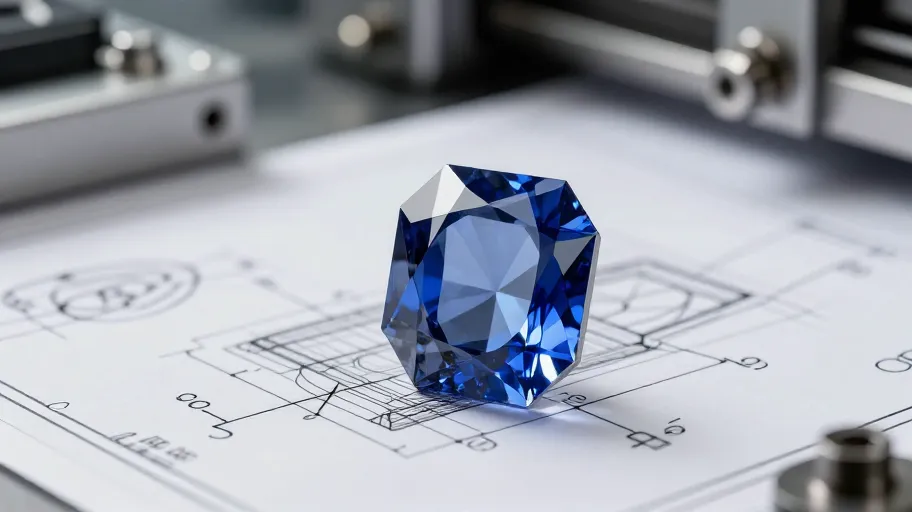
Custom sapphire watch crystals are beautiful—but sourcing them from sapphire china factories can turn into a slow, costly guessing game. A complete quote-ready drawing and review pack changes everything: it means faster, accurate quotes, fewer revisions, and real control over your timeline.
Why quoting takes weeks instead of days
Most delays in sapphire crystal china manufacture don’t come from factory capacity—they come from missing information. A U.S. microbrand racing to launch before Baselworld learned this the hard way. Without full specs, their initial request sparked six weeks of back-and-forth: clarifying bevel angles, redefining AR coating durability, correcting misunderstood geometries. Each round of questions added cost and risk. Tooling runs $12,000 per revision. Non-recurring engineering fees pile up fast. Missing data doesn’t save time—it destroys it.
Providing incomplete drawings means suppliers must guess your intent. One might assume CNC polishing; another defaults to lapping. That mismatch leads to apples-to-oranges quotes. The result? Delayed decisions, inflated bids, and prototypes that miss the mark. This isn’t inefficiency—it’s preventable friction.
How a technical pack turns chaos into clarity
A complete Custom Sapphire Watch Crystal: Build a Quote-Ready Drawing and Review Pack eliminates ambiguity by consolidating all critical parameters into one audit-ready document. It includes material grade (optical vs. industrial sapphire), bevel angles to ±0.5°, surface roughness targets (Ra values), AR coating wavelengths, and tolerances under ISO 2768-mK or custom GD&T. These aren’t just details—they’re decision drivers.
Specifying “CNC ground edge with Ra ≤ 0.2 µm followed by double-side polishing” means the factory knows exactly what process to use. No interpretation needed. That precision means faster feasibility checks, accurate costing, and no hidden assumptions. You’re not paying for engineering discovery—you’re buying execution readiness.
Real results from real projects
One microbrand sent basic sketches and verbal notes like “high-clarity” to three sapphire china factories. Two quoted high, assuming vacuum forming was required. One underbid, skipping secondary lapping. All three quotes were invalid. After resubmitting with 3D models, annotated cross-sections, and inspection points, they got three valid, comparable responses—with zero follow-up questions.
The quoting cycle collapsed from 47 days to 6. Prototype delivery accelerated by 22 days. That speed wasn’t luck—it came from eliminating guesswork. Teams using standardized packs average just 1.1 design revisions before approval. Those without face 2.3 on average. Fewer iterations mean lower IP exposure, reduced mold costs, and tighter launch control.
From supplier questions to supplier validation
A complete technical pack shifts the relationship between designer and manufacturer. Instead of spending hours decoding intent, engineers in Shenzhen or Dongguan verify conformance. They flag true exceptions—not clarify missing data. That shift means your R&D team spends less time managing emails and more time improving designs.
Procurement gains too. Competitive bid rounds become meaningful because variances reflect actual cost structures, not misinterpretations. When every supplier works from the same verified specs, comparison becomes objective. No more choosing based on vague promises of “premium quality.” Now they must prove capability with interferometry reports or spectral graphs.
Future-proofing against smarter factories
Automation is rising in sapphire china manufacture—AI-guided CNC programming, digital twin simulations for thermal stress, machine-readable inspection protocols. Tomorrow’s smart factories won’t accept ambiguous drawings. They’ll reject them outright.
The Custom Sapphire Watch Crystal: Build a Quote-Ready Drawing and Review Pack isn’t just about today’s efficiency. It’s the foundation for tomorrow’s integrated supply chain. Structured, precise inputs will soon be mandatory. Those who adopt them now won’t just save weeks on their next project. They’ll gain a lasting edge when others scramble to catch up.