
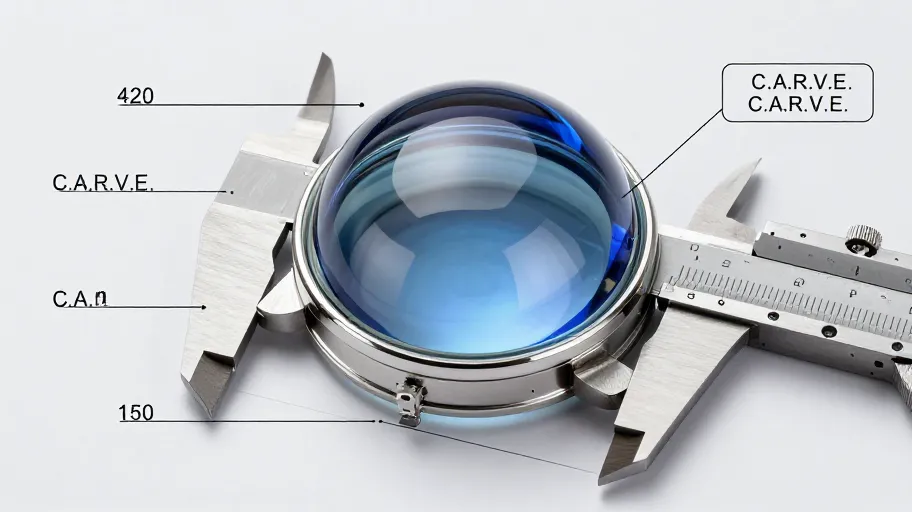
To source domed sapphire watch glass successfully, prepare a quote-ready drawing pack detailing curvature geometry, edge transitions, coatings, and case interface dimensions. Use the C.A.R.V.E. framework to document every variable, enabling your supplier to verify manufacturability and confirm optical specifications before production begins.
Comparing Domed Sapphire Watch Glass Profiles
Selecting the correct curvature impacts both the aesthetic of the final timepiece and the complexity of the manufacturing process. When comparing options, evaluate how the dome interacts with the watch hands, dial, and case bezel.
| Profile type | Structural characteristics | Sourcing considerations |
|---|---|---|
| Single dome | Features a curved top surface with a flat underside. | Verify tooling compatibility and confirm optical distortion parameters at the edges. |
| Double dome | Features curved top and bottom surfaces, reducing edge distortion. | Document the exact radius of both curves. Confirm production capability for complex geometries. |
| Beveled dome | Integrates a domed center with a flattened or angled peripheral edge. | Specify exact bevel angles and transition points to prevent fitment rejections. |
| Step dome | Incorporates a stepped edge to fit specific case recesses. | Provide detailed cross-sectional drawings. Confirm supplier ability to execute precision steps. |
The C.A.R.V.E. Drawing Pack Framework
A drawing pack is the foundation of an accurate quotation. Missing variables lead to assumptions, which create risk. The C.A.R.V.E. framework ensures your request for domed sapphire watch glass contains all necessary technical data.
C – Curvature geometry Explicitly document the radius of the dome. Indicate whether the curve is spherical or cycloidal. Provide exact tangent points where the curve transitions to the edge. Ask your supplier to verify if the proposed radius introduces optical magnification or distortion that affects dial legibility.
A – Apex thickness Define the maximum thickness at the highest point of the dome. Relate this to the minimum thickness at the edge. Because sapphire is a hard material, edge thickness dictates structural integrity. Ask the supplier what minimum edge thickness they recommend for your specific case diameter to prevent chipping during assembly.
R – Retention and edge profile Document the edge profile precisely. Is it flat, stepped, or beveled? If beveled, provide the angle. Specify the dimensions of any step designed to seat into the case bezel. Confirm the surface finish required on the edge, as this impacts how the glass adheres to the case.
V – Vibration and coating (AR) If you require Anti-Reflective (AR) coating, specify whether it applies to the top surface, the bottom surface, or both. Define the target wavelength band for the coating. Document the desired reflectance percentage. Ask the supplier to confirm their coating process parameters and how they verify adhesion and scratch resistance.
E – Environmental and interface dimensions Supply the exact inner diameter, outer diameter, and any complex interface dimensions. Note how the crystal mates with the case. Specify if the retention relies on a gasket, adhesive, or friction fit. Confirm the tolerance requirements for these dimensions with your supplier to ensure a seamless assembly process.
Supplier Approval Questions
Before finalizing your domed sapphire watch glass design, present these questions to your supplier to confirm capabilities and avoid project delays.
- Can you verify the manufacturability of the specified dome radius based on the provided case diameter?
- What dimensional tolerances do you recommend for the outer diameter to ensure a successful gasket fit?
- How do you document and inspect the optical centering of the dome?
- Can you confirm your process for applying the specified AR coating and verifying its performance?
- What are your current policies regarding prototype samples, and how do we initiate a production order?
Frequently Asked Questions
What is the primary risk of omitting the transition tangent in a domed sapphire watch glass drawing? Omitting the transition tangent leaves the exact start of the dome curve undefined. This forces the supplier to estimate the geometry, which can result in a crystal that sits too high or too low in the bezel, compromising both aesthetics and water resistance. Always document exact tangent points.
How should a buyer specify an Anti-Reflective coating for sapphire glass? Specify the application surface (top, bottom, or both), the target wavelength band, and the desired reflectance percentage. Include this directly in the C.A.R.V.E. drawing pack. Ask the supplier to confirm their specific layering method and how they validate the coating's durability.
Why does edge thickness matter in double domed sapphire watch glass? Edge thickness directly impacts the structural integrity of the crystal. If the edge is too thin, the glass becomes susceptible to chipping during pressing or friction fitting into the watch case. Document the minimum edge thickness and request a manufacturability review from the supplier.
How does a step domed profile affect the sourcing process? A step domed profile requires precise machining to create the recessed lip that seats into the case. This adds complexity to the drawing pack. You must provide a detailed cross-sectional view with exact step dimensions and request the supplier to verify their capability to hold those specific geometries.
What internal dimensions must a buyer provide for a custom sapphire crystal? A buyer must provide the outer diameter, inner diameter (if applicable), and the exact dimensions of the mating surface inside the watch case. Providing these interface dimensions allows the supplier to calculate the necessary tolerances for a secure fit.
Next Steps for Component Buyers
Submitting a comprehensive drawing pack reduces iterations and accelerates the prototyping phase.
Request a curvature review Send your C.A.R.V.E. drawing pack to our technical team to verify your domed sapphire watch glass specifications and confirm manufacturability.
Pre-submission checklist
- Dome radius and tangent points documented
- Apex and edge thickness specified
- Edge profile and bevel dimensions detailed
- AR coating surfaces and bands identified
- Case interface dimensions and tolerances provided