
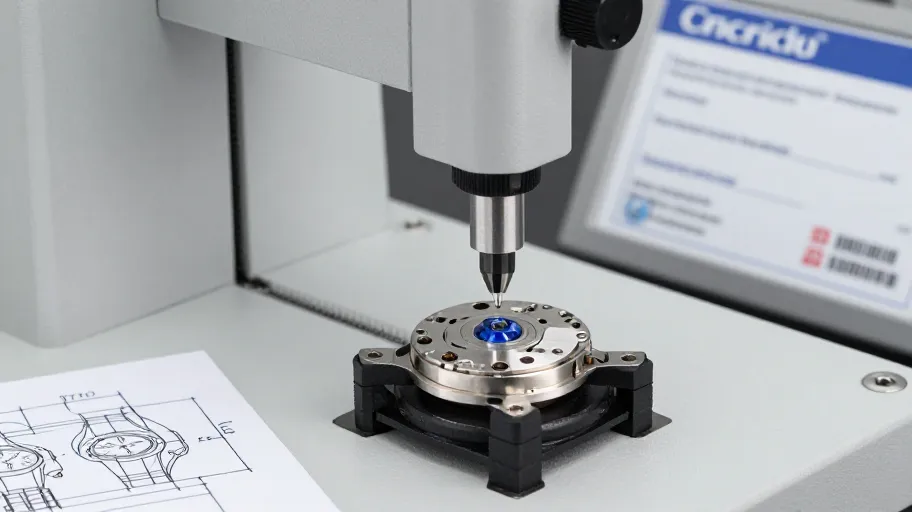
Sourcing a custom sapphire watch crystal requires documented evidence of supplier capability, process control, and dimensional accuracy before finalizing any purchase order. Buyers must transition from evaluating marketing claims to demanding verifiable data. By structuring your technical questions, you can compare suppliers systematically, mitigate tooling risks, and ensure the selected manufacturing partner aligns with your exact engineering specifications.
The Pre-Order Evidence Framework (POEF)
When developing a new watch component, the technical drawing is the single source of truth. However, the transition from a drawing to a physical custom sapphire watch crystal involves multiple variables in machining, polishing, and coating. The Pre-Order Evidence Framework (POEF) is designed to help product developers and sourcing managers collect objective data from potential suppliers before committing to tooling or production.
The framework focuses on three pillars: manufacturing capability, measurement verification, and process consistency. Instead of asking a supplier if they can produce a part, the POEF requires the supplier to document how they will produce, measure, and control it. This approach mitigates risk and prevents miscommunications.
Capability Documentation Questions
Before proceeding with an order, a sourcing manager must demand specific evidence regarding how the supplier will manufacture the custom sapphire watch crystal. Sapphire is an extremely hard material, and machining it requires specialized equipment and expertise. You should ask the supplier to document their processes clearly.
Ask the supplier to provide details on their grinding and polishing methods. How do they achieve the specified surface finish? What measurement systems do they use to verify flatness or curvature? You should request details on their inspection equipment. Do they use optical comparators, interferometers, or contact profilometers? Furthermore, you must ask how they handle edge finishing. Whether the crystal features a flat, domed, or faceted profile, the execution of the edge is critical for fitment.
The supplier must provide documented workflows for these processes. Do not accept general statements of capability. Instead, ask for documented process flows or capability matrices that align with your specific part geometry.
Coating and Treatment Verification
Many watch brands require anti-reflective (AR) coatings or other surface treatments to enhance legibility. The application of these coatings to sapphire requires precise control. Sourcing managers must ask potential suppliers to document their coating application process.
Ask the supplier to explain their deposition method. How do they ensure adhesion? What tests do they perform to verify coating durability? You should ask the supplier to document how they apply coatings to different geometries. If the custom sapphire watch crystal features a domed design, the coating uniformity becomes more complex.
Ask the supplier to define the specifications they can meet regarding light transmission and reflectance. Can they provide spectral transmission data for their coatings? How do they verify the thickness of the coating layer? These questions are critical because optical performance is highly dependent on the quality of the coating process.
Confirm the current policy directly.
Dimensional Accuracy and Fit
The interface between the watch crystal and the case is critical. A custom sapphire watch crystal must fit the case housing perfectly to ensure water resistance and structural integrity. Sourcing managers must demand evidence of dimensional accuracy.
Ask the supplier how they verify the dimensions of the finished crystal. Do they have a documented quality control process that includes dimensional inspection of every part or a defined sampling plan? How do they handle tolerances? You must ask the supplier to confirm if they can achieve the specific tolerances outlined in your drawing.
You should also discuss the bevel and step features. If your design includes a step bevel or a decorative bevel, ask the supplier to document their ability to produce these features consistently. Ask for examples of how they measure complex geometries.
Pre-Order Approval Decision Table
Use the table below to evaluate supplier responses. This will help you maintain an objective standard when selecting a partner for your custom sapphire watch crystal.
| Evaluation Criteria | Acceptable Evidence | Risk Level if Unconfirmed |
|---|---|---|
| Process Documentation | Documented workflow for grinding, polishing, and edge finishing. | High risk of inconsistent surface quality and poor edge definition. |
| Measurement Systems | Defined inspection equipment list (e.g., interferometers, optical comparators). | High risk of dimensional inaccuracy and poor fitment within the case. |
| Coating Application | Documented deposition process and adhesion testing methods. | High risk of coating delamination and poor optical performance. |
| Tolerance Conformance | Written confirmation of achievable tolerances based on drawing review. | High risk of part rejection during assembly. |
| Quality Control Plan | Documented sampling plan and final inspection criteria. | High risk of batch-to-batch variability. |
Pre-Order Approval Checklist
Before finalizing any agreement, ensure the supplier has provided answers to the following checklist items. This checklist serves as a low-friction way to initiate a technical dialogue.
- Supplier has reviewed the dimension sheet and confirmed the feasibility of the geometry.
- Supplier has provided a documented process workflow for machining the custom sapphire watch crystal.
- Supplier has listed the specific measurement equipment used for quality control.
- Supplier has documented their AR coating application and verification process.
- Supplier has confirmed their ability to meet the specified dimensional tolerances.
- Supplier has confirmed the current policy directly.
If the supplier cannot provide clear answers to these points, you must reconsider the partnership. A reliable supplier will welcome these technical questions. JadeZone Sapphire is structured to engage with these exact engineering inquiries.
Frequently Asked Questions
What information is needed to get a quote for a custom sapphire watch crystal? To provide an accurate assessment, the supplier needs a detailed 2D drawing or 3D model, including all dimensions, tolerances, and specifications for any coatings or surface treatments. The more detailed the drawing, the more accurate the supplier can be in evaluating the project.
How is the quality of a custom sapphire watch crystal verified? Quality is verified through a combination of dimensional inspection, surface finish measurement, and optical testing. The supplier should use specialized equipment to check flatness, thickness, and the performance of any applied coatings. Ask the supplier to document their specific quality control procedures.
Can a supplier modify an existing sapphire crystal design? Yes, suppliers can work with modified designs. You should provide the modified drawings to the supplier so they can assess the feasibility of the new geometry. Ask the supplier to confirm the current policy directly.
What should a buyer do if the supplier cannot provide detailed process documentation? If a supplier cannot provide process documentation, it is a significant risk. You should request a detailed explanation of their manufacturing steps. If they still cannot provide the evidence, it is advisable to seek a different supplier.
How are complex geometries like domed or faceted crystals handled? Complex geometries require specialized machining and polishing techniques. You must ask the supplier to document their experience with similar geometries and explain how they will measure and verify the complex curves.