
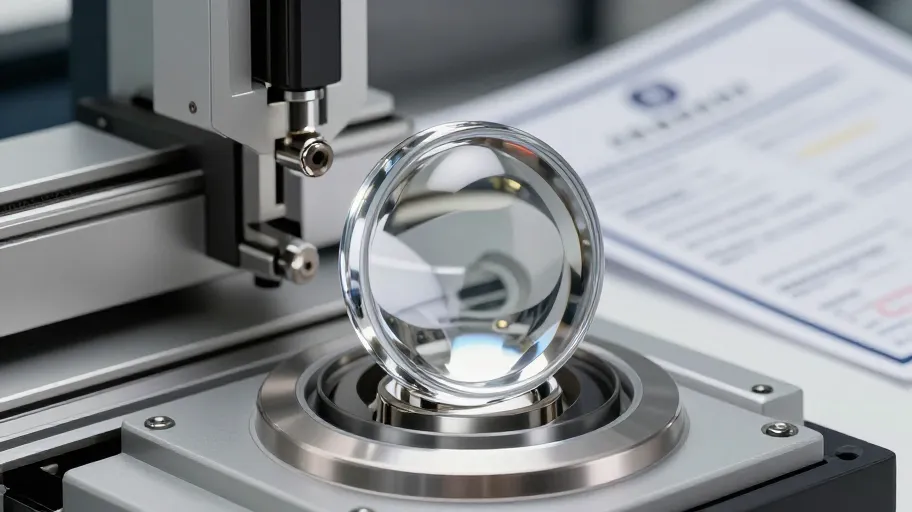
Buying domed sapphire watch glass from China can save costs — but only if you verify the right evidence upfront. Skip due diligence and you risk field failures, customer backlash, and six-figure losses. Here’s what to demand before hitting ‘order’.
Start with the Sapphire Source — Not the Quote
Synthetic sapphire isn’t just a material — it’s a process. The growth method determines whether your domed crystal will last decades or haze in months. CZ-grown sapphire means higher scratch resistance and optical clarity because it forms under controlled conditions that reduce internal stress. Verneuil-grown material may look identical but carries micro-fractures that spread during CNC shaping, especially on complex domes. That means early failure under thermal cycling or impact.
Buyers who skip source verification pay later: one Swiss brand lost $200K when their supplier used unverified boules, leading to invisible cracks that surfaced after packaging. Requiring a certificate of origin — including batch number, growth method, and dopant profile — turns vague claims into traceable facts. This isn’t paperwork; it’s liability protection. When defects appear, you don’t guess — you audit.
CNC Tooling Logs Reveal Real Production Discipline
Precision machining means consistent dome geometry because micron-level deviations distort light near the bezel edge. Without up-to-date calibration logs, you’re trusting blind. A drift of 0.03mm in grinding pressure won’t show in photos — but it will cause refraction errors visible at certain angles.
We’ve seen buyers accept samples without asking for tooling records, then face delays when production units fail interferometry tests. One Hong Kong OEM avoided $85K in rework by requiring metrology reports per lot — catching polishing inconsistencies before scaling. These logs aren’t optional extras; they’re proof the factory controls its process. For engineers, this ensures optical compliance. For managers, it reduces NRE cycles. For executives, it de-risks time-to-market.
AR Coating Tests Protect Legibility and Reputation
Multi-layer anti-reflective coating means over 90% reduction in glare because modern stacks cut reflection from ~8% to under 1%. But adhesion depends on substrate purity, chamber gas quality, and deposition temperature. Skip batch-specific spectral reflectance graphs and humidity resistance data, and you risk peeling coatings — especially in tropical markets.
A European luxury brand faced this when AR films delaminated across Southeast Asia. The root cause? Recycled process gases in unmonitored runs. Their fix was simple but powerful: mandate ellipsometry thickness maps and gas purity logs for every batch. Result: rejection rates dropped below 0.3%. Now, every shipment arrives with performance evidence baked in — not promised after the fact.
Factory Audits Separate Fact from Marketing
ISO 9001:2015 certification means structured quality assurance because audited facilities follow documented workflows. Manual inspection alone misses sub-surface flaws common in domed sapphire. Facilities using automated vision systems catch defects earlier, reducing rework and accelerating approval cycles.
Data backs this: a 2023 analysis found audited factories with digital QA reduced NRE costs by up to 40% over three years. One U.S. microbrand launched six weeks early because their supplier’s system eliminated tolerance disputes mid-run. That window captured Q4 retail demand, lifting initial revenue by 27%. For decision-makers, this isn’t about compliance — it’s about predictability. For brands, it’s about showing up on time, fully compliant, and defect-free.
The Real Cost of Skipping Pre-Order Proof
Three unverified assumptions mean avoidable losses because undocumented processes create hidden liabilities. Consider the typical program: $15K in NRE, 3–5 design iterations without baseline data, each adding $2K–$4K and 10–14 days. Total cost: over $25K and more than six weeks lost — all preventable.
Flip the model: lock specs with verified data from day one, compress development to two cycles, and launch five weeks earlier. That saves $18K and captures early-season margins. More importantly, it shifts accountability upstream. When defects arise, you don’t negotiate — you disqualify based on non-conformance. In high-stakes watchmaking, the domed sapphire isn’t just a cover. It’s a promise backed by proof, not hope.
Next Step Validate Don't Just Collect
Documents are only as good as their interpretation. A certificate means nothing if the test method doesn’t match your use case. Next, we’ll break down how to technically validate each document — from reading interferometry reports to verifying coating layer counts — so you don’t get fooled by forged PDFs or recycled data sheets. Because in precision sourcing, trust is earned through scrutiny, not supplied with the invoice.