
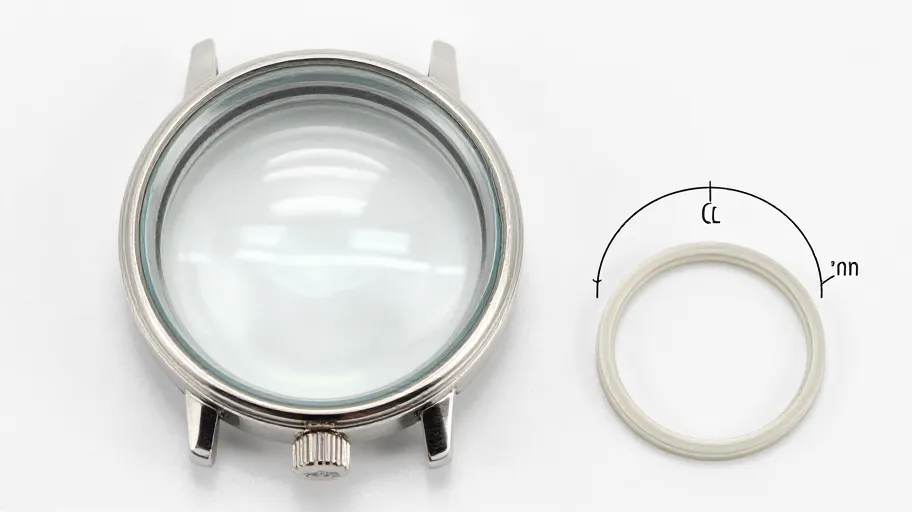
Domed sapphire watch glass requires precise alignment between the crystal curvature, the case bezel, and the watch crown to prevent assembly failures and moisture ingress. Buyers must document exact curvature radii, bezel recess angles, and gasket compression zones before approving tooling. This checklist provides a structured method to verify geometry and approve components.
The Curvature-Case-Crown (CCC) Alignment Framework
Sourcing a custom sapphire crystal is a multi-variable engineering task. A mismatch in any single variable forces tooling revisions, delays timelines, and compromises the final product's integrity. The Curvature-Case-Crown (CCC) Alignment Framework isolates these variables to help buyers verify fit before committing to production.
1. Curvature
The curvature of a domed sapphire watch glass defines its optical properties, height, and structural profile. Buyers must specify the radius of curvature, the total height of the dome apex from the edge baseline, and the transition geometry at the periphery. A steeper curvature yields a distinct vintage aesthetic but introduces optical distortion at acute viewing angles. A shallower curvature maintains dial legibility but offers less mechanical clearance for underlying hands or a recessed movement.
Buyers must answer these curvature questions before requesting a quote:
- What is the required radius of curvature for the primary viewing surface?
- Does the design require a single-domed, double-domed, or asymmetric bubble profile?
- How does the dome transition into the ground edge where it meets the case bezel?
- What is the maximum acceptable optical distortion at a specified peripheral viewing angle?
2. Case
The case bezel dictates how the crystal seats, aligns, and seals. A custom crystal cannot be evaluated in isolation; it exists as part of a mechanical assembly. Buyers must map the bezel recess dimensions, the gasket groove profile, and the bezel inner diameter.
The case interface requires documentation of the following:
- The exact bezel inner diameter.
- The depth of the bezel recess.
- The cross-section of the gasket utilized.
- The compression ratio required for the target seal.
- The presence of any step, lip, or notch within the recess.
3. Crown
The crown, pushers, and internal hands must clear the underside of the domed sapphire watch glass. A high dome provides ample clearance, but the transition point where the curvature begins its arch is critical. If the transition begins too far inward, the space above the dial decreases prematurely. Buyers must verify the clear height available directly above the dial edge, the maximum hand stack height, and the horizontal sweep space required by the hands.
Decision Table: Crystal Geometry Comparison
Selecting the correct curvature profile impacts functionality, cost, and component clearance. Use this table to compare the geometric options for your project.
| Geometry profile | Optical profile | Hand clearance | Bezel interface requirement | Sourcing consideration |
|---|---|---|---|---|
| Single-domed | Higher distortion at extreme angles | Moderate; clearance decreases from center to edge | Flat or slightly recessed bezel | Confirm transition point from dome to edge |
| Double-domed | Balanced distortion; symmetrical magnification | High; consistent vertical clearance | Stepped or deep recess | Verify inner and outer radius alignment |
| Bubble (acrylic-like) | Strong magnification; distinct vintage look | Highest; deep central arch | Specific recess designed for high dome | Verify case dimensional stability under pressure |
| Flat with beveled edge | Minimal optical distortion | Lowest; minimal vertical clearance | Flat gasket groove | Verify hand clearance against crystal base |
Fit, Geometry, and Approval Checklist
Before authorizing tooling or approving a production run, review this checklist with your engineering and procurement teams. Every item must be verified against your technical drawings.
Curvature Verification
- The required radius of curvature is specified in the engineering drawing.
- The total dome height from the baseline is documented.
- The optical distortion parameters are agreed upon with the design team.
- The curvature transition point aligns with the case diameter constraints.
Case Interface Verification
- The bezel inner diameter matches the crystal's outer diameter dimensions.
- The bezel recess depth accommodates the specified crystal edge profile.
- The gasket cross-section matches the crystal's ground edge.
- The required gasket compression ratio is verified for the selected materials.
- Any step, lip, or notch in the bezel recess is documented in the supplier's files.
Crown and Hand Clearance Verification
- The clear height above the dial edge accommodates the maximum hand stack.
- The horizontal sweep of the hands clears the crystal's inner transition curve.
- The crown and pushers do not intersect the crystal's outer curvature.
- The movement tolerances account for positional variance.
Supplier Verification
- The supplier confirms the ability to produce the specified curvature radius.
- The supplier confirms the specified dimensional tolerances are achievable.
- The supplier's inspection criteria align with the buyer's approval parameters.
- The supplier confirms current policy regarding samples, lead times, and minimum order quantities directly.
Concrete Approval Questions for Supplier Engagement
Engage the supplier using these specific questions to verify capability and project feasibility. JadeZone Sapphire, operating as a Shenzhen and Hong Kong B2B manufacturer, can address these technical points during a project review.
- "Based on the attached case drawing, what is the maximum achievable curvature height before risking optical distortion or mechanical interference?"
- "How do you document the transition geometry from the dome apex to the ground edge for a double-domed profile?"
- "What inspection methods do you use to verify the dimensional tolerance of the ground edge against the bezel recess?"
- "Can you produce an asymmetric bubble profile, and what technical drawings do you require to verify the case fitment?"
- "What is the current policy for sample production, lead time, and minimum order quantities for this specific geometry?"
Do not assume previous parameters apply to new geometries. Confirm current policies directly with the supplier for every new project.
Frequently Asked Questions
How does the curvature radius affect the structural integrity of the sapphire crystal?
The curvature radius dictates how force distributes across the surface. A tighter radius concentrates stress at the edges, while a flatter profile distributes force across the apex. The supplier must verify the thickness relative to the chosen radius to ensure the specified geometry meets the required structural performance.
What edge profiles are available for a domed sapphire watch glass?
Edge profiles include flat ground, stepped, milled, and beveled configurations. The selection depends entirely on the case bezel design and the gasket interface. The buyer must specify the edge profile dimensions in the engineering drawing to ensure a precise fit.
How do you verify gasket compression with a custom domed crystal?
Gasket compression verification requires cross-referencing the crystal's ground edge dimensions, the gasket's material properties, and the bezel's recess geometry. The supplier must confirm the achievable dimensional tolerances of the ground edge to ensure the specified compression ratio is attainable.
What information must the buyer provide to request an accurate curvature review?
The buyer must provide a complete case drawing, including the bezel inner diameter, recess depth, gasket groove profile, and maximum hand stack height. Providing the desired dome height and optical requirements allows the supplier to assess the project feasibility accurately.
Does an anti-reflective coating perform differently on a domed surface?
Applying an anti-reflective coating to a steep curvature presents specific application challenges regarding uniformity. The supplier must evaluate the specific curvature radius to confirm the feasibility of the coating process for the requested geometry.
Call to Action
To verify your geometry and fitment parameters, Request a curvature review with JadeZone Sapphire. Provide your case drawings to receive a technical assessment of your specified domed geometry.
For a streamlined sourcing process, Download the fit, geometry, and approval checklist to use during your internal engineering review.