
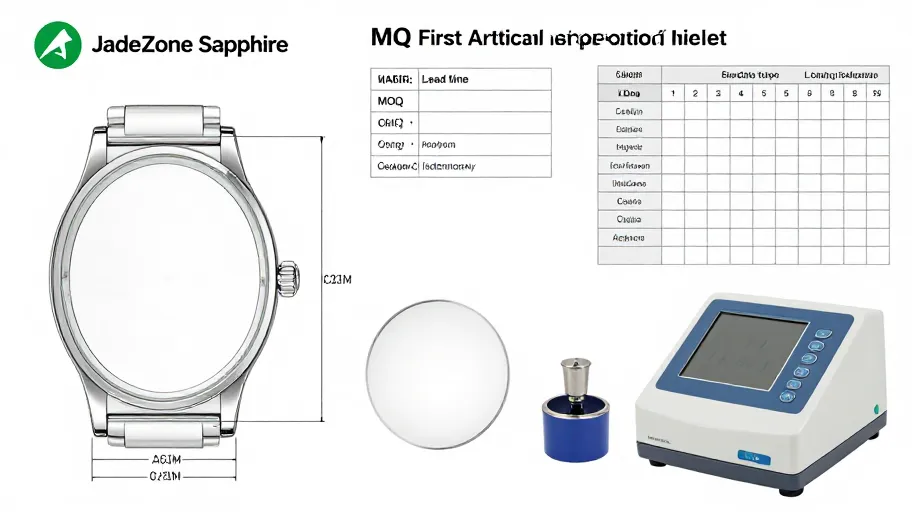
A custom sapphire watch crystal project succeeds when product developers and sourcing managers align fit, geometry and approval criteria before requesting a quote. Supply a complete dimension sheet, define the crystal profile and document first-article inspection requirements. Confirm all production policies, MOQ, lead times and coating validation methods directly with JadeZone Sapphire before approving any batch.
The Fit-Geometry-Approval Framework
The FGA Framework structures a custom sapphire watch crystal project into three review stages. Each stage captures engineering and procurement inputs required to move from concept to approved production.
Fit defines how the crystal interfaces with the watch case, bezel and gasket. Product developers must document diameter, height, chamfer angle, bevel location and gasket seat dimensions. Without these inputs, the supplier cannot evaluate tooling or quote accurately.
Geometry specifies the crystal profile: flat, single dome, double dome, step, faceted or complex curve. Geometry drives material removal, polishing workflow and tooling complexity. Sourcing managers must confirm which geometry inputs the supplier needs to evaluate manufacturability.
Approval establishes the first-article inspection criteria. Product developers define dimensional measurement points, visual inspection standards and coating validation methods. Sourcing managers confirm production policies, lead times and capacity directly with JadeZone Sapphire before authorising production.
Geometry decision table
| Crystal geometry | Required inputs from buyer | Supplier questions to confirm |
|---|---|---|
| Flat | Diameter, thickness, chamfer dimension | What gasket seat tolerance does the supplier recommend? |
| Single dome | Diameter, dome height, base thickness | What measurement method verifies dome curvature? |
| Double dome | Diameter, outer dome height, inner dome depth | What tooling approach handles compound curvature? |
| Step | Diameter, step height, step width | How does the supplier validate step transition? |
| Faceted | Diameter, facet count, facet angle | What polishing process produces facet clarity? |
| Complex curve | Full 3D CAD, tolerance callouts | What inspection equipment validates complex surfaces? |
Concrete approval questions
Product developers and sourcing managers should resolve the following questions before approving a custom sapphire watch crystal batch.
Dimensional approval questions
- Which measurement points does the supplier report on the first-article inspection document?
- What instrument does the supplier use to verify diameter, height and chamfer?
- How does the supplier document gasket seat conformity?
- What dimensional deviation triggers a rework or remake before approval?
- How does the supplier handle tolerance callouts the buyer has not specified?
Geometry approval questions
- What profile data does the supplier need beyond the drawing?
- Does the supplier require a 3D model for complex curves?
- How does the supplier verify dome height and curvature consistency?
- What edge finish does the supplier apply, and does it match the drawing callout?
Coating approval questions
- Does the supplier apply anti-reflective coating internally or subcontract it?
- Which coating placement does the buyer require: single-side, double-side or underside only?
- What adhesion or durability validation method does the supplier use?
- How does the supplier document coating uniformity and defect absence?
Production and policy questions
- What is the current MOQ for this crystal configuration?
- What lead time applies to first article and production batches?
- What is the current production capacity for this geometry?
- What sample policy applies before production approval?
- What testing or certification documentation can the supplier provide?
Supplier verification checklist
Use this checklist to document every answer before approving production.
- Dimension sheet submitted with diameter, height, thickness, chamfer and bevel data
- Crystal geometry specified with full profile callouts
- Gasket seat dimensions and interface requirements documented
- Edge finish defined and agreed with the supplier
- Anti-reflective coating type, placement and validation method confirmed
- First-article inspection criteria agreed in writing
- Measurement points and instruments confirmed
- Tolerance callouts provided for every critical dimension
- Visual inspection standard agreed
- Production MOQ confirmed directly with JadeZone Sapphire
- Lead time for first article and production confirmed directly
- Production capacity for the geometry confirmed
- Sample policy confirmed directly with the supplier
- Testing and certification documentation requested
- Coating performance and durability validation method confirmed
- No claims accepted without written supplier confirmation
FAQ
What information must a drawing include to quote a custom sapphire watch crystal?
A drawing should include diameter, total height, base thickness, dome height if applicable, chamfer or bevel angle, gasket seat dimensions and edge finish callouts. For complex geometries, a 3D model helps the supplier evaluate tooling and manufacturability. Confirm any missing dimensional data directly with JadeZone Sapphire before requesting a quote.
How do sourcing managers validate a complex crystal geometry?
Sourcing managers should ask the supplier which inspection equipment validates the geometry. For double domes, faceted profiles or complex curves, confirm whether the supplier uses contact probing, optical measurement or 3D scanning. Document the measurement method and the acceptance criteria before approving the first article.
What anti-reflective coating options should product developers specify?
Product developers should specify coating placement: single-side, double-side or underside only. Confirm whether the supplier applies coating internally or through a subcontract partner. Request documentation of the coating adhesion and durability validation method. Do not assume coating performance without written confirmation of the test method and results.
How does the FGA Framework reduce approval risk?
The FGA Framework separates fit, geometry and approval inputs so that product developers and sourcing managers resolve dimensional, profile and inspection questions before production. This structure prevents rework caused by incomplete drawings, undefined geometry or absent first-article criteria.
What production details must sourcing managers confirm directly?
Sourcing managers must confirm MOQ, lead time, capacity, sample policy, testing documentation and certification status directly with JadeZone Sapphire. No production parameter should be assumed from prior projects. Each crystal geometry and coating configuration may carry different requirements and constraints.
Submit a drawing or dimension sheet to JadeZone Sapphire and begin the FGA Framework review for your custom sapphire watch crystal project.
Download the approval checklist and use it to prepare your dimension sheet before contacting the supplier.