
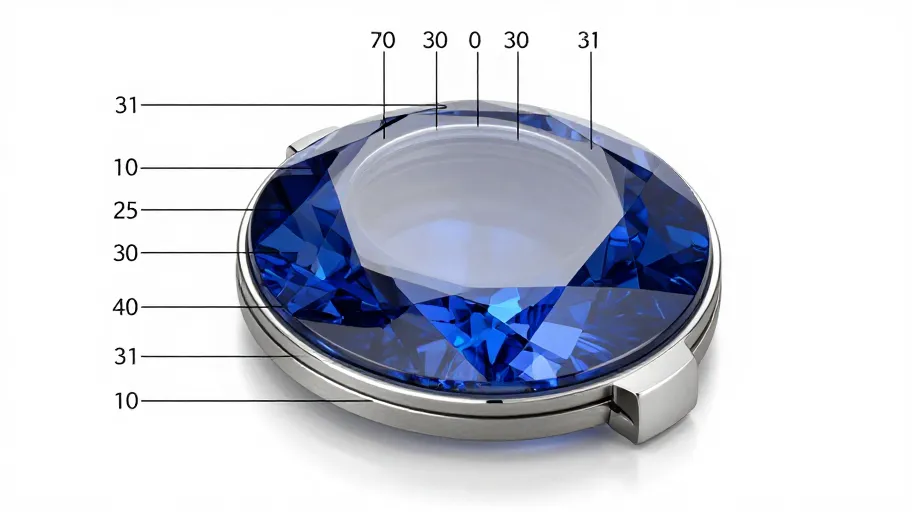
To receive an accurate quote for a custom sapphire watch crystal, you must provide your supplier with exact dimensional data, geometry specifications, coating requirements, and surface treatments. Applying the Crystal Definition Protocol ensures your engineering package contains the necessary parameters, allowing the manufacturer to assess tooling, verify manufacturability, and return a project-specific proposal.
The Crystal Definition Protocol (CDP)
The CDP is a documentation framework designed to bridge the gap between a product developer’s design intent and a supplier’s manufacturing reality. When sourcing a custom sapphire watch crystal, incomplete data forces suppliers to make assumptions. Assumptions lead to revised quotes, delayed timelines, and unverified prototypes. By adhering to the CDP, you present a verifiable technical package that minimizes ambiguity.
To implement the CDP, prepare your engineering documentation to address four distinct pillars:
1. Dimensional and geometric baseline
A dimension sheet or 2D technical drawing is the foundation of a verifiable quote. The supplier needs to know the exact outer diameter, overall thickness, and any specific edge profiles. Does the design require a flat profile, a domed curve, or a complex 3D facet? Every geometric transition must be documented. Ensure your drawing specifies the exact bevels, chamfers, and step features required for the crystal to interface correctly with the watch case.
2. Coating and optical specifications
Sapphire crystals require specific optical treatments to meet functional requirements. You must document whether the design requires an anti-reflective (AR) coating, and if so, whether it is applied to one side or both sides. Specify the desired reflectance percentage if you have a specific target. If the coating must pass particular adhesion or environmental tests, include those testing parameters in the initial documentation so the supplier can verify their process compatibility.
3. Surface treatments and functional features
Beyond the base sapphire and AR coating, document any additional surface treatments. Does the crystal require a water-repellent coating? Are there printed indices, logos, or date window magnifiers? If the crystal features a magnifying window, specify the exact magnification power and the designated optical center. Detailing these features upfront prevents downstream engineering revisions.
4. Tolerance and quality parameters
While specific numerical tolerances must be confirmed with your supplier based on the geometry, you must document your acceptable range for dimensional variance, surface flatness, and cosmetic defects. State your inspection criteria clearly. If your internal quality system requires specific incoming inspection protocols, outline them in the initial documentation to allow the supplier to assess capability.
Decision table: Procurement complexity by crystal geometry
When evaluating your custom sapphire watch crystal project, use this decision table to understand how different geometries impact the quoting and manufacturing evaluation process.
| Geometry type | Documentation required | Procurement consideration |
|---|---|---|
| Flat round | Basic dimension sheet: diameter, thickness, bevel | Evaluate tooling availability; verify standard raw material utilization. |
| Domed / Bubble | 3D CAD file or precise cross-section profile | Assess polishing complexity; confirm curvature consistency parameters. |
| Tonneau / Rectangular | 2D drawing with precise corner radii and angles | Verify edge polishing capability; assess raw sapphire block cutting yield. |
| Complex 3D / Faceted | Full 3D CAD model, tooling draft analysis | Evaluate specialized tooling creation; assess machine axis capabilities. |
| Integrated magnifier | 2D drawing with magnifier section and optical center | Verify single-block machining versus element bonding; document optical testing. |
Concrete approval questions for your supplier
Before finalizing your engineering package and requesting a formal quote, present these questions to your supplier to ensure alignment:
- Manufacturability: Can your engineering team review our 2D drawing or 3D CAD file to identify any features that complicate sapphire machining or polishing?
- Coating process: What internal verification process do you use to confirm AR coating adhesion and performance on a custom sapphire watch crystal?
- Tooling: Does this specific geometry require new custom tooling, and how is tooling ownership documented in the manufacturing agreement?
- Quality limits: What are your established inspection parameters for surface defects on complex curved geometries?
- Policies: What is your current policy regarding sample provision, and what are the associated costs or shipping arrangements? We require direct confirmation of these terms.
Frequently asked questions
What is the minimum order quantity for a custom sapphire watch crystal? MOQs vary depending on the geometry, tooling requirements, and production setup. You must confirm the specific MOQ for your project directly with JadeZone Sapphire after submitting your initial dimension sheet.
Can the supplier sign an NDA before reviewing the technical drawings? Yes. JadeZone Sapphire engages in B2B procurement under strict confidentiality. A mutual non-disclosure agreement is established before any detailed technical transfer or design review occurs.
How are dimensional tolerances verified during production? Tolerance verification depends on the specific geometry and the agreed-upon inspection protocol. You must define your acceptable tolerances on your drawing. The supplier will then confirm if they can meet those parameters and outline their measurement and inspection methodology.
Does JadeZone Sapphire provide anti-reflective coatings in-house? JadeZone Sapphire provides comprehensive sapphire solutions. To verify current coating capabilities for your specific custom sapphire watch crystal, document your optical requirements in the initial inquiry. The engineering team will confirm capability and process validation.
What happens if the initial prototype does not meet our optical specifications? Prototype evaluation is a structured phase of the development cycle. If a prototype requires adjustment, the engineering team reviews the deviations against the original documentation, identifies the root cause, and implements a revision plan. The specific terms of prototype revisions and re-sampling must be confirmed directly with the supplier.
Ready to move forward? Submit a drawing or dimension sheet to our engineering team for a comprehensive manufacturability review and project-specific assessment.
Not ready to share full drawings yet? Download our low-friction custom crystal pre-quote checklist to ensure your internal documentation is complete before initiating technical contact.