
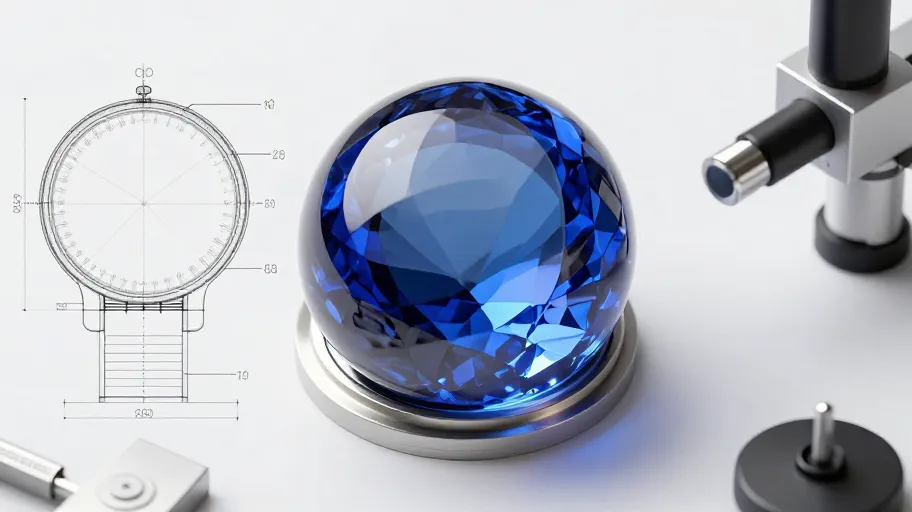
To secure an accurate quote for domed sapphire watch glass, your supplier requires complete geometric data, material specifications, and optical requirements. You must supply detailed 2D drawings with referenced 3D models, explicit curvature profiles, defined tolerance bands, and specified coatings. Without these exact parameters, any estimate remains a projection rather than a fixed quotation.
The Curvature Quotation Readiness (CQR) Framework
When sourcing custom sapphire components, the transition from a rough estimate to a binding quotation depends on the clarity of your technical package. The Curvature Quotation Readiness (CQR) Framework isolates the exact variables a manufacturer needs to calculate material, processing time, and yield risk for domed sapphire watch glass.
1. Geometric Profile Data
Domed sapphire is complex to manufacture. A supplier cannot quote accurately on a simple diameter measurement. They require the base diameter, the total height of the dome at the apex, the specific radius of the curvature, and the edge thickness. If the dome is asymmetric or features a double dome, both radii must be documented. Provide a 3D STEP file alongside a 2D drawing that explicitly details these callouts.
2. Mechanical Interface and Step Dimensions
The watch glass must interface with the watch case seamlessly. You must document the step dimensions, bevel angles, and any gasket seating grooves. A flat step on the underside of the dome requires precise depth and width measurements. If these mechanical interfaces are left undefined, the supplier cannot assess the tooling complexity or the mounting feasibility.
3. Optical and Surface Specifications
Sapphire requires specific optical treatments to meet design intent. Define whether the domed sapphire watch glass requires an anti-reflective coating, and specify if it is single-sided or double-sided. Furthermore, detail the surface finish requirements for both the top domed surface and the flat base. Any polish applied to the edge must be documented.
4. Tolerance Allocation
Tolerances dictate manufacturing yield. A supplier needs to know your acceptable variance for diameter, thickness, and dome height. Applying unnecessarily tight tolerances across all dimensions increases processing complexity and yield loss. Apply strict tolerances only to functional dimensions, such as the diameter that interfaces with the case gasket, and allow broader tolerances on non-critical aesthetic dimensions. All numerical tolerances must be confirmed with the supplier based on their current capability.
Quotation Request Comparison
Evaluating your preparedness before contacting a manufacturer prevents delays. The table below contrasts an insufficient request with a fully documented inquiry.
| Evaluation Criteria | Insufficient Request | Complete Request |
|---|---|---|
| Diameter Specification | "Approx 40mm" | Exact diameter with defined tolerance band. |
| Curvature Data | "Domed shape" | Defined radius, dome height, and 3D STEP file. |
| Case Interface | "Needs to fit our case" | 2D drawing with step width, depth, and bevel angle. |
| Optical Details | "Clear with coating" | Single-sided or double-sided AR coating specified. |
| Material Confirmation | "Sapphire" | Explicit confirmation of optical-grade sapphire confirmation required. |
| Quotation Result | Vague estimate subject to change. | Fixed quotation based on defined parameters. |
Concrete Approval Questions
Before forwarding your project to a supplier, verify your documentation by answering these questions:
- Have we confirmed the exact radius of the domed profile, or are we asking the supplier to reverse-engineer it from a sample?
- Is the anti-reflective coating specified for the inner surface, the outer surface, or both?
- Are our tolerance allocations optimized for function, or have we applied default blanket tolerances?
- Have we defined the gasket seating surface mechanics, including any required flat step on the underside?
- Do our 2D and 3D files match exactly, and have we designated the 3D model as the master reference for geometry?
Pre-Submission Checklist
Ensure your technical package is complete before requesting a quote.
- 2D dimensioned drawing exported as PDF.
- 3D STEP file provided for geometric verification.
- Base diameter and dome height explicitly called out.
- Curvature radius defined.
- Underside step or gasket groove dimensions specified.
- Anti-reflective coating location (single/double) marked.
- Surface finish requirements documented.
- Project-specific tolerance bands allocated and approved internally.
Frequently Asked Questions
Why does a domed sapphire watch glass require a 3D model for an accurate quote? A 2D drawing cannot fully convey the complexities of a compound curve. A 3D STEP file allows the supplier to verify the curvature radius, calculate the exact volume of sapphire material required, and simulate the machining path. This ensures the quotation reflects the true material cost and machining time.
How does the underside step affect the quotation process? The step determines how the watch glass seats into the case. If the step dimension is undefined, the supplier cannot assess the tooling required to create the ledge. Providing step dimensions allows the manufacturer to evaluate the structural integrity of the sapphire at the edge and confirm the feasibility of the gasket interface.
What happens if tolerance bands are not specified in the initial request? If tolerances are omitted, the supplier must assume a default specification or pause the quotation to inquire. Assuming incorrect tolerances leads to inaccurate yield calculations. If the supplier assumes tighter tolerances than necessary, the quote will reflect higher processing costs. If they assume looser tolerances, the final parts may not fit your case.
Can a supplier quote based on a physical sample of the watch glass? Suppliers can reverse-engineer a physical sample, but this introduces an additional measurement phase before a quotation can be prepared. Providing original 2D and 3D design files is more efficient and prevents measurement discrepancies. If only a sample exists, confirm the supplier's reverse-engineering process and how it impacts the quotation timeline directly.
Must we specify the sapphire material grade? Yes. While sapphire is the base material, the orientation and optical grade affect the final component's clarity and performance. Confirming the specific material grade required ensures the supplier sources the correct raw sapphire boule and processes it to meet your optical expectations.
Next Steps
To move from concept to production, your technical documentation must be flawless. Review your current drawings against the Curvature Quotation Readiness Framework to ensure every geometric and optical variable is defined.
Request a curvature review to have our technical team assess your domed profile data and confirm your project is ready for an accurate quotation.