
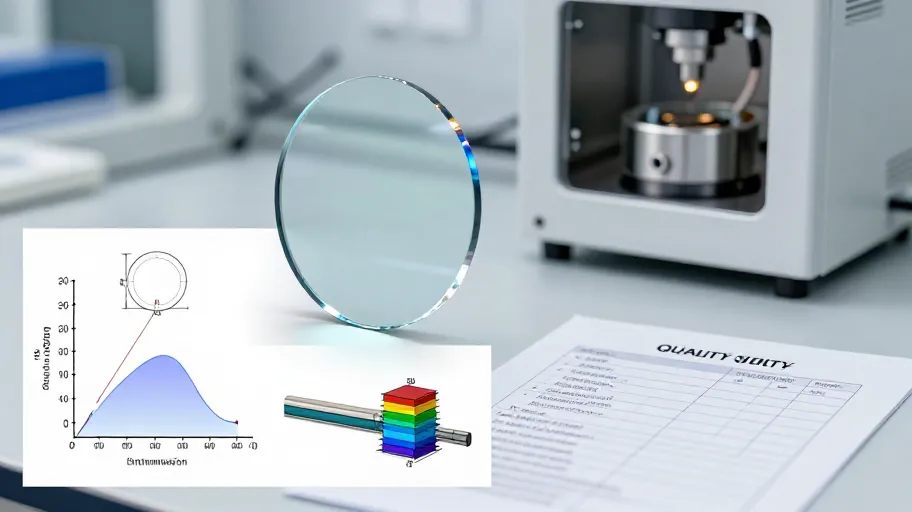
To secure an accurate quote for an anti reflective sapphire crystal coating, you must provide your supplier with exact optical transmission targets, dimensional drawings, coating layer specifications, and defined quality acceptance criteria. Without these inputs, suppliers cannot calculate material usage, determine deposition cycles, or establish testing protocols. Defining these variables upfront ensures your quotation reflects project realities rather than assumptions.
The C.L.E.A.R. Coating Specification Framework
When sourcing custom sapphire components, the quotation process hinges on the completeness of your technical brief. JadeZone Sapphire utilizes a structured approach to help buyers organize their project data. To receive a precise quotation, organize your request using the C.L.E.A.R. framework:
- C - Coating Layers: Specify whether the application requires a single-layer or multi-layer coating. Define whether the coating is applied unilaterally or bilaterally.
- L - Luminous Transmission: State the exact percentage of light transmission required at specific wavelengths.
- E - Environmental Resistance: Document the required environmental tests, such as salt spray, humidity, and thermal cycling.
- A - Adhesion and Abrasion: Outline the specific test methods and acceptance criteria for coating hardness and adhesion.
- R - Reflection Color: Specify the desired residual reflection color (for example, blue or magenta) and the permissible color tolerance.
Coating Application Decision Table
Selecting the right deposition process requires evaluating your project specifications against the capabilities of your supplier. Use the table below to map your project requirements to the correct inquiry path.
| Project parameter | Buyer action required | Supplier inquiry path | Quote impact factor |
|---|---|---|---|
| Unilateral vs. bilateral coating | Define which surfaces require treatment | Request specific masking documentation | Determines fixture complexity and handling time |
| Target transmission percentage | Document exact optical performance targets | Inquire about layer stack design feasibility | Affects material consumption and deposition cycles |
| Color tolerance | Provide visual samples or spectrometer data | Request color consistency validation methods | Influences quality control and rejection rates |
| Adhesion test methods | Cite exact testing standards (e.g., abrasion) | Verify available in-house testing capabilities | Determines inspection duration and documentation |
Concrete Approval Questions
Before finalizing your purchase order, verify the following points with your supplier to ensure alignment:
- What deposition processes do you utilize for anti reflective sapphire crystal coating?
- How do you document and verify the exact transmission percentage?
- What masking techniques are used to prevent coating on specific surfaces?
- Which adhesion and abrasion test standards can you execute and document?
- Confirm the current policy directly regarding sample provision.
- Confirm the current policy directly regarding production lead times.
- Confirm the current policy directly regarding minimum order quantities.
Frequently Asked Questions
What is anti reflective sapphire crystal coating? It is a thin-film deposition applied to sapphire watch crystals to reduce surface glare and improve dial legibility. The coating minimizes light reflection, allowing a higher percentage of light to pass through the sapphire.
How does a single-layer coating differ from a multi-layer coating? A single-layer coating reduces reflection across a narrow band of wavelengths, while a multi-layer coating reduces reflection across a broader spectrum, achieving higher overall light transmission. The choice depends on the visual design goals and optical performance requirements.
What information must I provide for a custom coating quote? You must supply dimensional drawings, target transmission rates, desired reflection color, coating side specifications, and required testing standards. Providing this data prevents quoting delays.
How should I specify quality acceptance criteria? Specify the exact adhesion and abrasion tests required, along with acceptable performance outcomes. State the environmental conditions the coating must withstand, such as humidity or thermal variations.
Can I request a specific reflection color? Yes, suppliers can adjust the layer stack to achieve specific residual reflection colors, such as blue or magenta. Provide a target color parameter to ensure the supplier matches your visual requirements.
Next Steps
Securing an accurate quotation requires precise documentation. Ensure your technical brief is complete before engaging a supplier.
Confirm a coating specification with our technical team to align your project requirements with manufacturing capabilities.
Before submitting your final request, use this low-friction checklist to verify your documentation:
- Dimensional drawings attached
- Coating side (unilateral/bilateral) specified
- Target light transmission percentage documented
- Reflection color and tolerance defined
- Adhesion and abrasion test standards cited
- Environmental resistance requirements listed
- Confirm the current policy directly regarding samples
- Confirm the current policy directly regarding lead times