
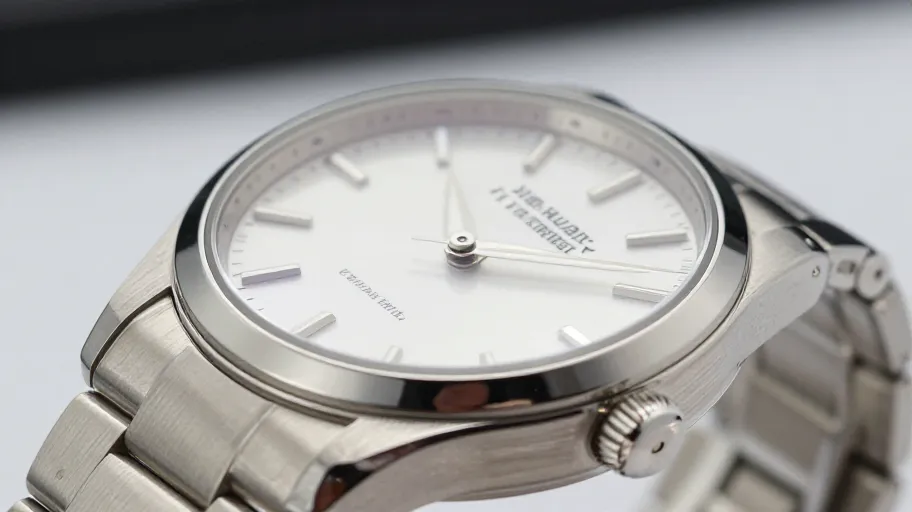
Material grade determines real-world performance
High-grade synthetic sapphire means your timepiece delivers both scratch resistance and optical clarity because it’s made from aluminum oxide (Al₂O₃) grown under tightly controlled conditions. Using lower-grade material might save cents per unit but risks visible striae and micro-bubbles that scatter light—especially under sunlight.
A crystal rated 9 on the Mohs scale can still fail as a luxury component if internal imperfections distort dial legibility. That’s why insisting on ASTM F548 compliance matters: it sets standards for bubble content and optical homogeneity. Suppliers who provide transmitted wavefront error (TWE) data below λ/4 per inch give you proof of minimal distortion across the surface—so your customers see the dial, not a warped reflection.
For engineers, this means fewer post-production adjustments. For brand leaders, it means protecting perceived quality. And for buyers, it avoids last-minute scrambles when first batches don’t pass QC.
AR coating method impacts durability and user experience
The type of anti-reflective coating applied means the difference between crisp readability in bright light and foggy glare because standard magnesium fluoride layers reduce reflectivity only partially—and degrade faster. Multi-layer ion-assisted deposition (IAD) coatings, by contrast, maintain sub-1% reflectivity across viewing angles and resist delamination under thermal stress.
Without specifying the number of layers, adhesion testing (like tape peel tests per ASTM D3359), and environmental cycling validation, you risk receiving crystals that flake after six months or haze during temperature shifts. One European brand discovered their supplier had substituted a cheaper coating—leading to silent returns and forum backlash.
For technical teams, documented AR specs enable compatibility checks with case sealing processes. For decision-makers, it reduces warranty exposure. And for executives, it safeguards brand trust in a market where enthusiasts scrutinize every detail.
Dimensional accuracy ensures fit and function
Precision machining to ISO 2768-mK tolerances means water resistance and bezel alignment are guaranteed because even ±0.05mm deviations can compromise gasket compression or create visual imbalance. A 38mm dress watch is unforgiving—a dome height off by half a millimeter disrupts symmetry and undermines premium perception.
Many sapphire china factory operations lack standardized GD&T callouts, leading to inconsistent edge radii or curvature. Nearly 40% of initial submissions from new vendors require rework due to uncontrolled geometry. That’s why demanding first-article inspection reports (FAIRs) with CMM data isn’t overkill—it’s standard practice among top-tier brands.
When tolerances are contractually enforced, engineering and case design teams can work concurrently, cutting prototyping cycles. For operations leads, this means faster ramp-up. For finance, it eliminates air freight surcharges from delayed reorders.
Certification separates reliable suppliers from hidden risks
ISO 9001 certification means consistent output and traceability because it requires documented processes for growth, annealing, polishing, and corrective actions. Non-certified workshops may offer lower prices but lack audit trails—making root-cause analysis impossible when defects appear mid-run.
Data from the 2024 Global Watch Components Consortium shows defect rates of 17% in unverified batches versus just 2.3% among certified suppliers. That 7x gap directly affects yield, timeline, and customer satisfaction. One U.S. independent maker saved upfront by switching to a low-cost Chinese vendor—only to lose three times that amount in rejected units and communication delays.
For procurement, certification streamlines vendor qualification. For quality managers, it enables proactive risk mitigation. And for leadership, it transforms sourcing from a cost center into a strategic advantage—ensuring reliability at scale.
Clear specs accelerate time to market
Brands that document full technical dossiers mean they reach retail 30% faster on average because there’s no back-and-forth during prototyping, according to the 2025 Horological Innovation Report. With clear material grades, coating specs, dimensional tolerances, and supplier certifications locked in early, engineering teams avoid rework loops and production bottlenecks.
This alignment doesn’t just prevent $380,000+ losses from delayed launches—it builds credibility. In today’s transparent market, one viral post about misaligned crystals or peeling coatings can undo years of branding effort. By treating specification rigor as a competitive lever, you turn procurement into product integrity.
The fastest path to market isn’t the cheapest bid. It’s the clearest spec. See how your current sourcing stack measures up—audit your next supplier quote against these four filters.