
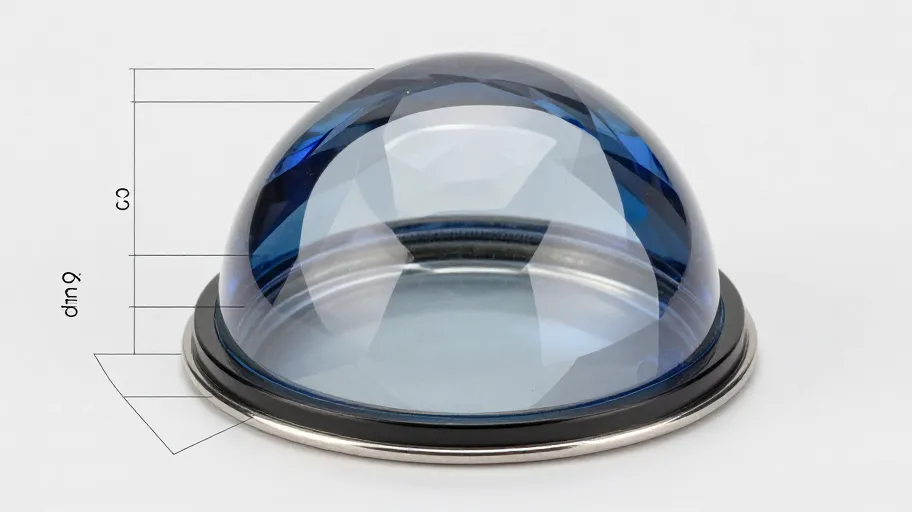
Before committing to a domed sapphire crystal production run, document the curvature profile, edge geometry, gasket interaction, anti-reflective coating placement, and dimensional boundaries. Establishing these specifications prevents unquoted secondary operations and ensures the manufacturer receives a complete, unambiguous technical package.
The C.L.E.A.R. Crystal Sourcing Framework
When sourcing a custom domed sapphire crystal, ambiguity is the primary driver of project delays and unexpected costs. A curved sapphire watch glass requires precise documentation because the three-dimensional geometry introduces complex variables for light reflection, case fitment, and polishing. To prepare your sourcing documentation, apply the C.L.E.A.R. Crystal Sourcing Framework. This structure ensures you present a complete technical package to the manufacturer, facilitating an accurate quotation and production setup.
Curvature profile
The defining characteristic of a domed sapphire crystal is its arc. You must document the intended rise and radius of the dome. Specify whether the curvature is a continuous sphere, a biccone, or an asymmetrical arch. Because the dome distorts the dial view at oblique angles, documenting the optical expectation is critical. Ask the manufacturer how they control optical distortion during the polishing phase and how they verify the curvature radius against your 3D model.
Lip and gasket interaction
The transition from the curved dome to the flat seating plane—the lip—dictates the waterproofing and structural integrity of the watch. Document the lip height and the angle of the bevel. If the crystal sits inside a bezel, specify the exact clearance required for the gasket. You must ask the supplier to confirm their capability to hold the specified lip geometry without micro-fractures along the transition zone.
Edge geometry
The edge of the crystal is a frequent source of unquoted secondary operations. Specify whether the edge requires a polished finish, a brushed finish, or a specific chamfer. A polished edge reduces stress concentrations but requires additional machining time. Document the exact edge profile in your 2D drawing and ask the manufacturer if their quotation includes edge finishing as a standard process or if it represents an additional charge.
Anti-reflective (AR) coating application
An AR coated sapphire crystal reduces glare, but the application method requires strict definition. Document whether the coating is applied to the top surface, the bottom surface, or both. A top-side coating is more susceptible to scratches, while a bottom-side coating preserves the external hardness of the sapphire but may leave residual surface reflection. Ask the supplier to document their coating adhesion testing methodology and to confirm the coating's scratch resistance properties.
Readiness and tooling
Custom curvature requires custom tooling. Document the status of your 3D files and 2D drawings. Before proceeding, ask the manufacturer what tooling is required for your specific dome, how the tooling costs are structured, and who owns the tooling if production moves to another facility.
Decision table: Mapping buyer requirements to supplier verification
When evaluating a potential supplier for a domed sapphire crystal, use this decision table to align your project requirements with the questions you must ask the manufacturer.
| Buyer requirement | Supplier verification question | Documentation needed |
|---|---|---|
| Continuous curvature without distortion | "How do you measure and verify the optical clarity across the dome's apex?" | 3D CAD file with defined radius |
| Specific gasket seating tolerance | "What is your process for verifying the lip height and seating plane flatness?" | 2D drawing with cross-sectional detail |
| Polished edge transition | "Is edge polishing included in the base quotation, and how do you inspect for edge chipping?" | Edge finishing specification sheet |
| Double-sided AR coating | "What equipment do you use to apply and test AR coating adhesion on curved surfaces?" | Optical performance specification |
| Custom dome tooling | "What are the tooling cost structures, and what is the tooling ownership policy?" | Tooling transfer agreement draft |
Concrete approval questions to document
Before you issue a purchase order or finalize an RFQ, ensure the following questions are documented and answered by the supplier. These questions bridge the gap between design intent and manufacturing reality.
- Curvature Verification: "What measurement equipment is used to verify the final produced dome against the provided 3D model?"
- Lip Integrity: "How do you test the structural integrity of the crystal lip during the cutting process?"
- Edge Finishing Inclusion: "Does the provided quotation include all specified edge bevels and polishing, or are these itemized separately?"
- Coating Performance: "What testing methodology do you use to verify the adhesion and hardness of the AR coating on a curved substrate?"
- Tooling and Iteration: "If the initial prototype requires a dimensional adjustment to the dome, how are tooling modification costs handled?"
- Material Verification: "What documentation is provided to verify the raw sapphire boule origin and purity?"
- Policy Confirmation: "What is the current policy regarding sample production, shipping responsibilities for prototypes, and lead times for initial iterations?"
Sourcing checklist: Low-friction preparation
Before sending your technical package to a manufacturer, verify that your internal documentation is complete. Use this quick checklist to ensure readiness:
- 3D CAD file details the exact curvature radius and dome height.
- 2D drawing specifies the lip height, gasket groove dimensions, and edge chamfer angles.
- Optical specifications define the required transparency and AR coating placement (top, bottom, or both).
- Edge finishing requirements (polished, brushed, or raw) are explicitly stated.
- Project timeline accounts for tooling creation, prototype iteration, and mass production.
- A list of current supplier policies regarding samples, shipping, and lead times has been requested.
Frequently asked questions
Why does a domed sapphire crystal require more documentation than a flat crystal? A curved surface introduces variables in optical distortion, polishing complexity, and edge transition geometry. Unlike a flat crystal, the dome's radius must be precisely matched to the watch bezel, and the curvature affects how light interacts with the dial and the anti-reflective coating. Documenting these parameters prevents subjective interpretations of the design.
How should we specify the tolerance for a curved sapphire watch glass? Tolerances must be project-specific and documented in your 2D drawings. Avoid relying on generalized assumptions. Specify the exact dimensional boundaries for the diameter, dome height, and lip thickness. Ask the manufacturer to confirm if they can achieve your specified boundaries before production begins.
What information must we confirm regarding AR coating on a domed crystal? You must document whether the coating is applied to the top, bottom, or both surfaces. Because a dome magnifies the dial, coating imperfections are more visible. Ask the supplier to detail their coating process for curved surfaces and to provide documentation of their adhesion and scratch resistance testing methodologies.
Can we request a prototype before committing to mass production? You must confirm the current sample and prototype policy directly with the supplier. Document your requirements for a single prototype to verify the curvature and fitment before authorizing mass production tooling. Ask the manufacturer to outline the steps required to initiate a prototype run.
Next steps
Preparing your technical documentation is the most critical step in sourcing a custom domed sapphire crystal. A complete package eliminates ambiguity, reduces the risk of unquoted costs, and ensures the manufacturer understands your exact design intent.
下载核对清单 to formalize your preparation process. Ensure your team has documented every curvature, edge, and coating specification before engaging a manufacturer.