
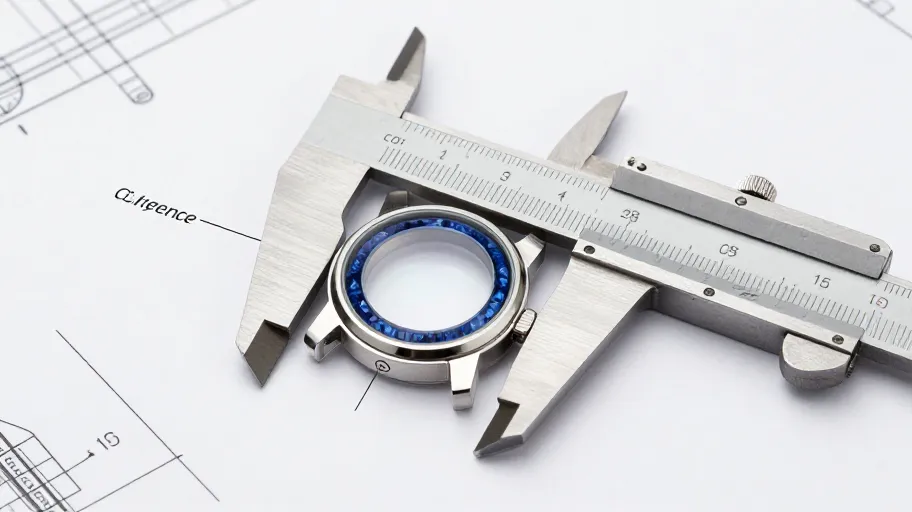
A complete first brief for a custom sapphire watch crystal specifies the case interface, lens geometry, coating scope, reference datum and inspection criteria — not just diameter and thickness. When these are missing, each supplier fills the gaps with its own assumptions, and the quotations you compare describe different parts. The fastest way to a decision-ready quote is a dimension sheet that closes those gaps before it leaves your desk.
Watch brands lose sourcing cycles not on the sapphire itself, but on what the drawing failed to say. A crystal that measures correctly against your drawing can still fail the case: wrong gasket seat, wrong recess depth, an edge profile the bezel cannot accept. Before you send a drawing out for quotation, run it through a structured gate.
The CLARITY Brief Gate
Use this five-point check on every custom sapphire watch crystal drawing before it goes to a supplier:
- C — Case interface. How the crystal locates, seats and seals in the case.
- L — Lens geometry. Flat, domed, step, bevel — with the geometry that defines each transition.
- A — AR coating. Which face or faces, defined by scope and durability expectation, agreed in writing.
- R — Reference datum. Which surface every dimension is measured from.
- I — Inspection criteria. The measurement methods and acceptance criteria you will both use at goods-in.
Each letter is a place where an incomplete brief turns into a delayed project. The sections below break them down.
Decision table: what to do about each measurement gap
| Gap in the first brief | Why it blocks the decision | What to do before quoting |
|---|---|---|
| Diameter stated without datum or tolerance zone | Suppliers may quote to different reference faces; offers are not like-for-like | Define the measurement datum and ask the supplier how it interprets your tolerance zones |
| Thickness given as a single nominal value | Centre thickness, edge thickness and domed-crown height are different dimensions | Specify each separately, and state where thickness is measured |
| Recess or gasket groove dimensions absent | The crystal cannot be validated against the case seat | Attach the case section drawing or the relevant interface dimensions |
| Edge and bevel profile described in words only | Verbal profiles ("soft edge", "polished bevel") allow multiple interpretations | Add a scaled profile detail with angles and radii |
| Coating written as "AR" only | Face count and durability scope change both price and performance | Write the coating scope into the drawing and confirm it in the quotation |
| No inspection method named | Acceptance disputes arise when measurement methods differ | Agree measurement methods and acceptance criteria with the supplier before production |
Details that belong on the drawing — and get missed
The interface dimensions. The crystal is half of a sealing system. Recess depth, gasket cross-section accommodation, seat flatness and the clearance to the bezel inner wall are all inputs to the crystal drawing, not just the case drawing. If they live on a different document, reference it explicitly.
Geometry transitions. For domed or stepped crystals, define the radius, the tangent points and the height of the crown above the seat plane. A single "dome height" figure can be measured from different references by different parties. State yours.
The datum hierarchy. Which face is the primary datum — the seat, the top surface or a machining flat? Every downstream measurement inherits this choice. Write it on the drawing and confirm the supplier reads it the same way.
Edge treatment. Edge finish and bevel geometry affect both fit and how the crystal reads once assembled. Show it as a scaled detail rather than a note.
Marking and packaging. If you need a logo, an inner ring print, or defined packing for assembly-line handling, it belongs on the brief, not in a follow-up email.
Coating scope. An anti-reflective coating specification should state face count and any durability expectation you intend to hold the supplier to. Confirm in writing what the supplier will verify and how — do not assume the scope; document it.
Approval questions before you release the drawing
Ask these of the supplier — and of your own team — before releasing a custom sapphire watch crystal drawing to quote:
- Which surface do you treat as the primary datum, and does it match ours?
- How do you interpret each tolerance zone on this drawing — symmetric, unilateral or fit-for-function?
- What measurement method will you use for flatness, thickness and dome height, and what will you report with each batch?
- What do you need from us to validate the case interface — the case section drawing, a gasket sample, or both?
- What coating scope are you quoting, and what will you confirm in writing before production?
- What is your current sample and production policy, and what should we confirm about cost and logistics before ordering?
That last question matters: sample terms, fees, shipping responsibility and production conditions are commercial policies that change over time. Confirm the current terms directly with the supplier each project rather than relying on any published or remembered figure.
Before you send anything: run the gate
Use this checklist on the drawing before it leaves your desk:
- Case interface dimensions included or referenced
- Lens geometry transitions defined with radii and heights
- Coating scope written, not implied
- Datum hierarchy marked
- Inspection methods and acceptance criteria named
- Edge and bevel profile shown as a scaled detail
- Marking and packaging requirements stated
- Open questions for the supplier listed separately
A drawing that passes this gate produces quotations you can actually compare — and a first article you can actually approve.
Submit your drawing or dimension sheet and have it reviewed against these checkpoints before quotation. Where details are missing, the review will surface them as questions, so you can document decisions once instead of negotiating them twice.
FAQ
What is the minimum information a custom sapphire watch crystal brief should include? At minimum: diameter with datum and tolerance interpretation, centre and edge thickness, dome or step geometry with the defining radii, the case interface dimensions, edge profile detail, coating scope, and the inspection method you intend to apply at goods-in. Anything less invites the supplier to make assumptions you will pay to unwind.
How do I compare quotations for custom crystals fairly? Run every drawing through the CLARITY gate first, then check that each supplier has quoted the same datum, the same coating scope and the same acceptance criteria. Ask each to confirm its interpretation of the tolerance zones in writing. Comparing offers that answer different questions is the most expensive mistake in crystal sourcing.
Should I send the case drawing along with the crystal drawing? If the crystal seals or locates in the case — which covers nearly every watch application — yes, or at minimum the interface dimensions: recess depth, seat geometry and gasket accommodation. This lets the supplier verify fit rather than guess at it, and it surfaces conflicts while they are still cheap to fix on paper.
What should I confirm about samples and production terms? Confirm the supplier's current sample policy, any fees, shipping responsibility, production quantities and delivery terms directly, in writing, for each project. These are commercial policies that may change; do not carry assumptions from a previous project or from any third-party description.
Who should own the drawing review internally? The product developer owns geometry and interface fit; the sourcing manager owns commercial terms and inspection criteria; the watchmaker or assembly lead owns handling and fit validation. Run the gate as a joint review so the drawing that goes out reflects all three perspectives.