
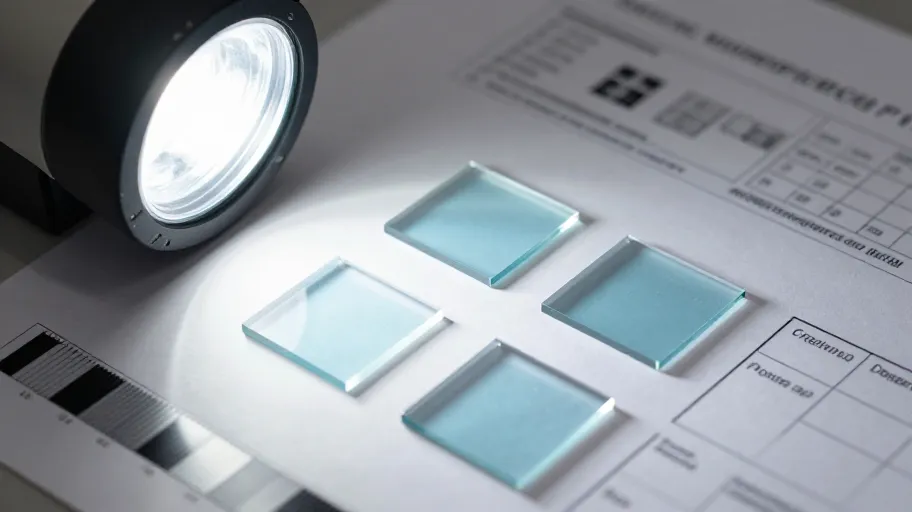
Comparing anti reflective sapphire crystal coating samples requires controlled lighting, defined viewing angles and written acceptance criteria — because photographs cannot capture colour shift, reflection behaviour at oblique angles, or coating build quality. Build your comparison around a structured gate, document what you see, and only then confirm a coating specification with your supplier.
Why photos are not evidence
A photograph of a coated sapphire crystal compresses a three-dimensional optical judgement into a two-dimensional image. Three things disappear in that translation:
- Angular reflection behaviour. Anti-reflective performance changes with viewing angle. A photo fixes one angle and one lighting setup, hiding how the coating behaves when a wrist rotates under daylight, office light or shop-display illumination.
- Colour signature. AR coatings carry a residual reflection tint — a faint blue, green or purple cast depending on the coating design. Cameras auto-correct or exaggerate this tint, so two samples may look identical in an image and visibly differ in hand.
- Surface and edge integrity. Coating defects near the crystal edge, dust inclusions under the coating layer, or inconsistent coverage across a domed surface are only visible under magnification and raking light.
None of this means your supplier's photos are misleading. It means a photo is a communication tool, not an approval instrument. Approval should rest on physical samples evaluated against written criteria.
The C-L-E-A-R Sample Gate: a five-part sample comparison framework
Use this framework to turn a subjective glance into a documented decision.
C — Coating build. Establish what you are comparing at all. Is the anti-reflective coating applied to one side or both sides of the crystal? Which side faces the dial? A single-side and double-side coating are different products and should never be scored against each other on reflection alone. Ask each supplier to state the coating construction in writing before you evaluate the samples.
L — Lighting conditions. Evaluate every sample under at least three lighting environments: diffuse daylight, a single directed point source, and the mixed warm/cool lighting a finished watch will actually encounter at retail. Rotate each sample through oblique angles under the point source. Score reflection suppression and note where residual reflections appear.
E — Edge behaviour. Examine the crystal perimeter under magnification. Coatings applied over curved or beveled edges can show thickness variation, visible transition lines or lifting at the boundary. Consistency at the edge is a strong indicator of process control, and edge photos are the least reliable of all.
A — Acceptance data. Ask the supplier for measurable characteristics of the coating: target transmission or reflection values, coating layer count if disclosed, and any adhesion or abrasion test method applied to the batch your sample came from. You are not asking for a marketing claim — you are asking which test method, if any, the sample has been subjected to, and what the documented result was. If no test evidence exists, record that as "none supplied" in your comparison rather than assuming either quality or its absence.
R — Rejection criteria. Write down, before comparison, what disqualifies a sample: visible colour mismatch against a reference, reflection asymmetry between samples of the same part, edge defects under magnification, or coating marks visible to the unaided eye. Criteria written after viewing samples drift toward justifying a preference already formed.
Decision table: scoring coating samples side by side
| Evaluation dimension | What to check | Pass signal | Flag for discussion | Disqualifier |
|---|---|---|---|---|
| Coating build | Single- or double-sided; stated in writing | Construction matches your brief | Construction undisclosed | Supplier cannot state which side is coated |
| Reflection suppression | Viewing under diffuse and point light at multiple angles | Dial indices readable without glare hotspots | Suppression varies noticeably with angle | Reflection pattern differs between two samples of the same part |
| Colour signature | Residual tint under angled point light | Consistent, acceptable tint across samples | Slight tint difference between suppliers | Tint shifts unpredictably across the surface |
| Edge coverage | Magnified inspection of perimeter and bevel | Clean, uniform transition at edge | Minor visible transition line | Lifting, gaps or visible coating boundary defects |
| Sample-to-sample consistency | Compare at least two crystals of the same part per supplier | Behaviour matches between units | Minor variation between units | One unit passes, another clearly fails |
| Documentation | Test methods, results and coating construction supplied in writing | Evidence provided and legible | Partial evidence, promised later | Refusal to document the coating construction |
Score each supplier per row, attach your lighting notes and photographs taken by your team under your conditions, and keep the sheet as the approval record.
Concrete approval questions to send before you sign off
Send these to every supplier whose samples you are evaluating, and file the written replies:
- Is the anti reflective coating on this sample applied to one side or both sides, and which side faces the dial in the intended assembly?
- Which coating construction and process does this sample represent — and will production parts use the same construction?
- What test method, if any, has been applied to this sample's coating adhesion or abrasion resistance, and what was the documented result?
- Can you supply two or more crystals of the same part so we can verify sample-to-sample consistency?
- What should we inspect at incoming quality control to confirm production parts match this approved sample?
- What is your current policy on samples, associated costs and shipping — and where should we confirm it before ordering?
That last question matters: no assumption about sample arrangements should be carried between suppliers or between projects. Confirm the current policy directly, in writing, each time.
Document the result so production matches approval
Your comparison sheet, lighting notes, retained physical reference sample and the supplier's written answers together form the coating specification baseline. When you place a production order, reference that baseline: the approved sample number, the stated coating build, and the inspection points your IQC will check. This converts a visual preference into a verifiable, repeatable requirement — and gives both parties a shared reference if a later batch raises questions.
For firms sourcing from Shenzhen and Hong Kong supply chains, the geographic advantage is proximity: physical samples, comparison visits and iteration cycles can happen quickly. But speed only helps if each loop produces documentation. A fast cycle with no written acceptance criteria produces the same disputes as a slow one.
Frequently asked questions
Is double-sided anti reflective coating always the better choice? Not automatically. Double-sided coating reduces total reflection further but adds coating surface area that can be exposed to wear and handling; single-side coating applied to the inner surface is protected after assembly. The right choice depends on the case design, the watch's price position and the wear conditions it will face — decide per project, not by default.
How many samples should I request per design before approving? Request at least two crystals of the same part from each supplier so you can check sample-to-sample consistency. A single sample can only demonstrate that one unit's behaviour; it cannot tell you whether the process repeats.
Can I approve a coating from a video call where the supplier shows the sample live? A live demonstration is stronger than a still photo because you can request angles and lighting changes, but it still cannot replace physical evaluation under your own controlled conditions. Treat a live demonstration as an interim step, not the approval event.
What if two suppliers' samples both pass my comparison table? Then decide on the dimensions your table cannot score: documentation quality, responsiveness to the approval questions, willingness to define IQC inspection points, and the clarity of their sample and order policies. A supplier who answers precisely is easier to hold to a specification than one who answers warmly but vaguely.
Should colour difference between two suppliers' coatings decide the choice? Only if the colour signature affects your dial design's legibility or your brand's visual intent. If both coatings perform on reflection and durability, residual tint difference is a design preference, not a defect — document which tint you approved so production is judged against it.
Next step: confirm a coating specification
JadeZone Sapphire manufactures custom sapphire watch crystals and precision sapphire components for watch brands and component buyers. Before approving any coating decision, contact our team to confirm a coating specification — coating build, evaluation conditions, and the documentation you need for your approval file. We will review your project requirements directly with you.
Low-friction option: not ready to talk? Download or copy the C-L-E-A-R sample comparison checklist above — the decision table, the six approval questions and the rejection criteria — and use it on your next sample round. When you are ready, we can walk through the specification line by line.