
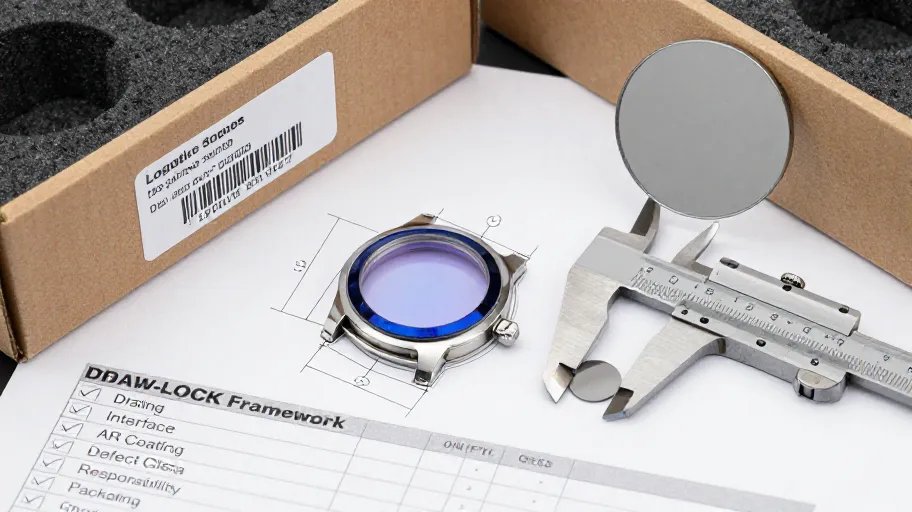
Before you approve bulk production of a custom sapphire watch crystal, resolve eight things in writing: complete drawing data, case-interface fit, AR coating specification, tolerance definitions, defect and inspection criteria, responsibility for out-of-spec output, packaging and logistics expectations, and the approval checkpoints between prototype and bulk run. Anything left verbal becomes a dispute later. Use a framework — DRAW-LOCK — and do not sign off until every gate is documented.
Why approvals fail quietly
Most bulk-production failures in watch crystal sourcing are not dramatic. They are quiet mismatches: a gasket seat measured at the wrong reference point, an AR coating specified as a color word instead of a measurable property, a defect limit nobody wrote down. The buyer approved a drawing; the supplier produced to the drawing; the drawing was incomplete.
The gap is not dishonesty — it is underspecification. A custom sapphire watch crystal is a precision component that must interface with a case, a gasket or bezel, a movement side clearance and an optical expectation. Each interface is a place where assumptions diverge. The job of a sourcing manager is to surface those assumptions before tooling and bulk production begin, when changes are administrative rather than physical.
That is the purpose of DRAW-LOCK: a sequence of eight gates that converts an approval from a signature into a documented engineering decision.
The DRAW-LOCK framework
D — Drawing completeness. The drawing should define geometry, reference datums, chamfers, gasket seats, decorative steps and any applied marking. Confirm which dimensional characteristics are controlled and which are reference-only. Ask the supplier to confirm in writing that the drawing is manufacturable as issued, and to flag any feature that constrains yield or inspection.
R — Ring fit and case interface. The crystal does not exist alone. Confirm how the crystal interfaces with the case: compression fit, gasket, adhesive seat or bezel clamp. Who owns the interface dimensions — the case supplier, the crystal supplier or you? Request that the supplier confirm the measurement method and reference surface used to verify fit, and whether a case or case drawing must be shared for verification.
A — AR coating definition. "AR coated" is not a specification. Document coating type (inner-side or both sides), reflectance target, colour neutrality expectations, and how coating conformity will be inspected. Ask what coating adhesion and abrasion checks the supplier applies, and request the current evidence available for the specific coating proposed for your project. Do not accept a general capability claim as project evidence.
W — Watch-side geometry. Movement-side clearance, underside curvature and any printed or applied features affect assembly. Confirm that underside geometry is dimensioned, and that any logo, index or lume application has agreed artwork, placement tolerance (to be defined numerically by the parties, not assumed) and a documented ink or process specification.
L — Limit criteria (defects and inspection). Define acceptable cosmetic limits under agreed lighting, distance and magnification, and the inspection method and sampling approach for bulk lots. Written limit samples or boundary photos beat adjectives. Confirm who inspects, at which stage, and how results are reported.
O — Options and accountability. Confirm in writing the policy on samples, tooling changes, revisions during production, and responsibility for output that fails the agreed criteria. These terms are project-specific and change over time — confirm the current policy directly with the supplier rather than relying on prior projects or general expectations.
C — Checkpoints (delivery gates). Map the approval sequence: drawing sign-off, first article, pilot lot if applicable, bulk release. Define what document or sample unlocks each gate, and what happens if a gate fails. A supplier that resists defined checkpoints is telling you something; document the conversation either way.
K — Kill points. Decide in advance which failures stop the run — fit interference, coating non-conformity, dimensional rejection — versus which are reworkable. Kill points protect both parties because they make the escalation path boring.
Decision table: approve, hold or revise
| Gate | Approve when | Hold when | Revise when |
|---|---|---|---|
| Drawing | Supplier confirms manufacturability in writing; all critical dimensions defined | Supplier has not reviewed the full drawing | Features are ambiguous or reference-only where control is needed |
| Case interface | Interface ownership and measurement method confirmed | No case or case drawing shared for verification | Gasket seat or fit reference is defined differently by each party |
| Coating | Reflectance, side and inspection method documented | Coating described only as "AR" | Colour or durability expectations not measurable |
| Defect limits | Written limits, lighting, magnification and sampling agreed | Cosmetic criteria still verbal | Limit samples not yet created |
| Accountability | Current sample, revision and rework policy confirmed in writing | Policy taken from memory or old projects | Policy silent on out-of-spec responsibility |
| Checkpoints | Gate sequence and release documents defined | Bulk approval planned without first article | Kill points undefined |
Questions to put in writing before approval
- Can you confirm this drawing is manufacturable as issued, and which features constrain inspection or yield?
- What reference surface and measurement method will you use to verify fit to the case interface?
- For the proposed AR coating, what reflectance and adhesion evidence can you share for this specific project, and how will conformity be checked per lot?
- What are the agreed cosmetic limits, inspection lighting, magnification and sampling approach for bulk lots?
- What is your current policy on samples, drawing revisions during production, and output that fails the agreed criteria?
- What gate sequence do you propose between drawing approval and bulk release, and what document or sample releases each gate?
- What information do you need from us — case drawing, gasket spec, limit samples — to close each gate?
Send these as a numbered document and require numbered answers. Silence on any item is a finding, not a formality.
FAQ
Do I need to supply the case, or just the case drawing? It depends on the interface and verification method the supplier uses. Ask directly what they need — case sample, case drawing, gasket specification — to verify fit, and document the answer in the approval file.
How should I specify AR coating so it cannot drift? Define coating side, reflectance target, colour expectation, and the inspection method per lot. Ask what adhesion or abrasion evidence the supplier can provide for the proposed coating on your part, and confirm current capability rather than accepting a general claim.
What should a first-article approval cover? At minimum: dimensional verification against the released drawing, fit check against the interface, coating conformity evidence, and creation of signed cosmetic limit samples. Define what document formally releases the bulk run.
Who is responsible if a bulk lot fails the agreed criteria? That is a policy question you must confirm in writing before approval. Agree the criteria first, then agree the responsibility and escalation path for non-conforming output.
How do I keep the approval enforceable across a long project? Version-control the drawing, the coating spec, the defect limits and the gate sequence. Re-confirm in writing whenever any element changes, including any change to the supplier's sample, revision or rework policy.
Next step
If you are specifying a custom sapphire watch crystal, submit a drawing or dimension sheet to JadeZone Sapphire for a documented review. The review will surface the open questions above against your actual geometry — which is faster than discovering them after tooling is cut.
Low-friction alternative: not ready to share a drawing? Run the DRAW-LOCK checklist against your current specification and list every gate with no written answer. That list is your pre-approval agenda — bring it to your supplier conversation.