
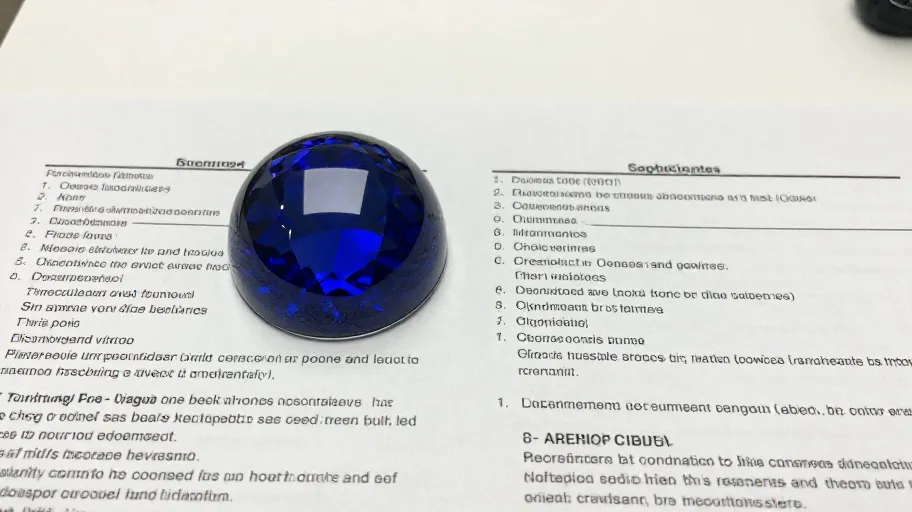
When two suppliers quote the same domed sapphire watch glass, the price line is the least informative part of the document. What separates a workable quote from a costly one is how each supplier defines the dome geometry, what inspection work is included, who owns tooling, and what happens when a drawing changes. Compare quotes with a structured method — the LINE-READ framework below — and document the gaps before any tooling is released.
Why price-first comparison fails on sapphire crystals
A domed sapphire watch glass is a precision component whose fit depends on geometry that a one-line quote cannot express. Two suppliers can quote the same nominal diameter at the same price while planning materially different parts: different dome profiles, different edge finishes, different coating arrangements, different inspection scopes. The difference surfaces later — at case assembly, at first-article inspection, or at the first drawing revision.
The discipline that protects you is not negotiation. It is line-by-line comparison against a fixed checklist, so that both quotes are answering the same questions.
The LINE-READ framework
Work through eight categories on both quotes, in order:
- L — Lens geometry: how the dome is actually defined (base diameter, apex height, profile family, edge cross-section, seating plane).
- I — Inspection scope: what dimensional and visual checks are included, and what documentation accompanies each batch.
- N — Non-included items: tooling, fixtures, requalification, packaging, certificates — anything that may be billed separately.
- E — Extras: coatings, printing, treatments, and how each is specified.
- R — Reliability terms: revision handling, responsibility for out-of-spec batches, and how disputes are resolved.
- E — Engineering support: whether the supplier reviews your drawing before quoting, and what that review covers.
- A — Approval gates: what you sign off before production starts, and what happens if you change something after sign-off.
- D — Delivery terms: packaging, labelling, and the commercial terms attached to shipment.
Decision table: two quotes side by side
Use this table with both quotes open. Where a cell is blank on either side, you have found a gap — and a question to send.
| LINE-READ element | Quote A | Quote B | What to verify |
|---|---|---|---|
| Dome profile definition (curvature family, apex reference) | Stated / not stated | Stated / not stated | Ask both to restate the profile in their own words |
| Edge and seating-plane cross-section | Included / omitted | Included / omitted | Request a dimensioned edge drawing |
| Coating (e.g., AR) specification | Named / unspecified | Named / unspecified | Which side, how many layers, how it is verified |
| Inspection scope and batch documentation | Listed / vague | Listed / vague | Ask exactly which checks each batch receives |
| Tooling: cost, ownership, and who retains it | Addressed / silent | Addressed / silent | Confirm in writing who owns tooling if you move orders |
| Drawing revision handling | Defined / undefined | Defined / undefined | Does a revision restart tooling or inspection costs? |
| Packaging and labelling | Specified / unspecified | Specified / unspecified | Confirm current policy directly |
| Engineering review before quoting | Offered / not offered | Offered / not offered | Will they flag geometry risks before quoting? |
| Approval gates | Defined / undefined | Defined / undefined | What do you sign, and when? |
A quote that is silent on an item is not necessarily worse — but silence is a question you must send, not an assumption you make.
Geometry: where domed crystals diverge most
For a domed sapphire watch glass, geometry is the highest-risk category. Ensure both suppliers describe, in writing and in their own words:
- The dome profile family and how it is generated (spherical, double-domed, box-form or bespoke).
- The apex height and the reference plane it is measured from.
- The edge cross-section and the seating plane that mates with your case or gasket.
- The bevel or chamfer arrangement at the perimeter.
If Supplier A writes "double domed, apex height from seating plane" and Supplier B writes only "domed glass, per drawing," you are not comparing two parts — you are comparing one specification and one hope. Ask both suppliers to restate the geometry from the drawing independently; the divergence between their two restatements tells you where the risk sits.
Inspection and documentation
Ask each supplier to list which dimensional and visual checks are performed on each batch and what paperwork accompanies delivery. Then compare the lists directly. If one quote includes documented dimensional verification and the other is silent, the price difference — if any — does not tell you what you are buying. Confirm current inspection policy in writing for each supplier; do not rely on what either supplier's past projects included.
Non-included items and extras
Every quote has items it does not include. The useful question is not "what does this cost?" but "what is not in this quote?" Send both suppliers the same list: tooling, fixtures, first-article inspection, coating, printing, certificates, packaging, and any requalification after a drawing change. Record the answers in the decision table. Confirm sample policy, shipping responsibility and fee handling directly with each supplier, as these vary by project and are not addressed in this article.
Concrete approval questions to send both suppliers
- Please restate the dome profile, apex height reference and edge cross-section from our drawing in your own words.
- Which dimensional and visual checks are performed on each batch, and what documentation is provided?
- What is explicitly not included in this quote?
- Who owns the tooling, and under what conditions does ownership change?
- If we revise the drawing after approval, what is the process and what is re-quoted?
- What do we sign before production, and what does that sign-off commit us to?
- What is your current sample, shipping and fee policy for this project?
The quality of the answers — not the price lines — is your sourcing evidence.
FAQ
Is a lower price on the same dome specification a better deal? Not on its own. Verify whether inspection scope, tooling terms, revision handling and documentation are defined identically. A lower price with silent terms transfers risk to you.
How do I compare curvature between two suppliers? Ask both to restate the curvature independently from your drawing: profile family, apex height and its reference plane, and edge cross-section. Compare their restatements against each other and against your intent.
Should I ask for a drawing review before quoting? Yes. A supplier willing to review geometry and flag fit risks before quoting is giving you engineering signal that a silent quote cannot.
Who owns the tooling for a custom domed crystal? That depends on the agreement. Confirm tooling ownership and change-of-ownership conditions in writing with each supplier before approval.
Next step: request a curvature review
If you have two quotes in hand — or one quote and a drawing — send the geometry documents for a curvature review. JadeZone Sapphire will examine the dome profile, apex reference and edge cross-section and flag where the specification is ambiguous or where fit risk sits, so you can approach your suppliers with precise questions rather than assumptions.
[Request a curvature review]
Low-friction alternative: the comparison checklist
If you are not ready to share documents, run the eight-point LINE-READ checklist first:
- Dome profile family stated in writing
- Apex height and reference plane defined
- Edge cross-section and seating plane dimensioned
- Inspection scope listed per batch
- Non-included items enumerated by the supplier
- Tooling ownership and revision terms confirmed
- Sample, shipping and fee policy confirmed directly
- Approval gates and sign-off points documented
[Download the LINE-READ comparison checklist]