
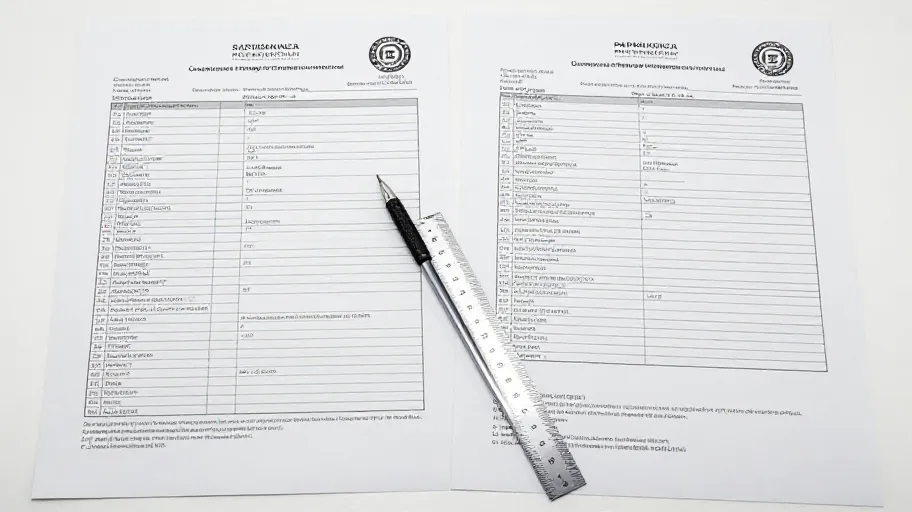
When you hold two quotes for a custom sapphire watch crystal against the same drawing, the useful comparison is rarely the headline price. It is whether each supplier has read the same specification, quoted the same scope, and documented the same process controls. Work through scope, itemised costs, specifications, process control, capabilities, coatings and risk — line by line — and approve only when both documents answer identical questions.
Why two quotes diverge on the same drawing
Two suppliers can read one drawing differently and both believe they are compliant. One may quote the crystal with the coating called out; the other may treat it as an option. One may include inspection reporting; the other may not mention it. One may interpret an edge finish or a domed profile from a note the other supplier overlooked.
None of these differences are visible until you force both quotes into the same structure. That is the purpose of a framework: it gives every gap a name, so nothing stays as "we assumed".
The LINE-COMPARE framework
Use LINE-COMPARE to turn two free-text quotes into a single, comparable document:
- L — Look at scope. What is included, what is excluded, what is silent?
- I — Itemise every cost. Which line items appear in one quote and not the other?
- N — Note specifications. Has each supplier restated the specification, or just repeated your drawing reference?
- E — Evaluate process control. What inspection, measurement and reporting does each quote commit to in writing?
- C — Compare capabilities. Which supplier demonstrates experience with your crystal geometry and finish?
- O — Overlays and coatings. Are coatings quoted as included, optional, or unmentioned?
- M — Map risk. What happens if a part does not conform — and is that written down?
- P — Personalise questions. Which questions does each quote leave unanswered?
- A — Approve or reject. Decide only on documented answers, not impressions.
Decision table: comparing two custom sapphire watch crystal quotes
| # | Quote line | What to check | Supplier A | Supplier B | Decision rule |
|---|---|---|---|---|---|
| 1 | Part identification | Case number, model reference and revision match your drawing | Record | Record | Reject any quote referencing an outdated revision |
| 2 | Geometry | Flat, domed, bevel and edge profile restated in the supplier's own words | Record | Record | Ask both to restate geometry; query any divergence from the drawing |
| 3 | Dimensional interpretation | Which dimensions each supplier treats as critical | Record | Record | Confirm critical dimensions in writing before approval |
| 4 | Coatings and finishes | Coating type, side(s) coated, finish quality stated | Record | Record | A silent coating line is a question, not an inclusion |
| 5 | Included services | Tooling, fixtures, measurement reports, first-article inspection | Record | Record | Approve only what is written into the quote |
| 6 | Exclusions | What each supplier explicitly excludes | Record | Record | Merge both exclusion lists and resolve every item |
| 7 | Cost structure | Every cost line named and unit basis stated | Record | Record | Do not compare totals until line items match one-to-one |
| 8 | Quantities and breaks | Quantity tiers and what changes between them | Record | Record | Ask each supplier for tiers in identical steps |
| 9 | Process control | Inspection stages, measurement methods, reporting format | Record | Record | Prefer the supplier who commits to documented inspection |
| 10 | Non-conformance handling | Written process for parts that do not conform | Record | Record | Absence of a written process is a risk to record, not a reason to guess |
| 11 | Logistics | Packaging, labelling, delivery terms as stated in each quote | Record | Record | Confirm the current policy directly for anything unstated |
| 12 | Communication | Named engineering contact for technical queries | Record | Record | A quote without a technical contact slows every later stage |
Approval questions to put to both suppliers
Ask both suppliers the same questions, in writing, and keep the answers in your decision file:
- Please restate the crystal geometry and all critical dimensions as you interpret them from our drawing. Where is interpretation required?
- Which dimensional callouts do you treat as critical, and what measurement method will you use to verify them?
- Is the coating quoted as included, optional, or not quoted? On which surface(s)?
- What inspection stages are performed, and what documentation will accompany each delivery?
- What is your written process when a delivered part does not conform to the agreed specification?
- What quantity tiers can you quote, and what changes at each tier?
- Who is the named engineering contact for technical questions during the project?
- For sample terms, tooling terms, fees and shipping arrangements: confirm the current policy directly.
- What drawing format and dimension-sheet structure do you prefer, so rework from miscommunication is avoided?
- Are there features of this design that you would flag as difficult to produce as drawn?
The last question matters more than it looks. A supplier who pushes back on a drawing before quoting has read it. Silence is not agreement.
How to run the comparison without bias
Put both quotes into the table, fill every cell, then look at the empty cells. Empty cells are not neutral — they are unpriced, uncommitted or unread items. Send the empty cells back as questions and wait for written answers before scoring.
Resist scoring on a single impression of responsiveness or price. A fast, cheap quote that omits inspection reporting and non-conformance handling transfers risk to you; you will discover the transfer later, at the worst moment. Score on documentation. Approve on documentation.
FAQ
Should both quotes use the same drawing revision? Yes. Lock the revision before quoting, and reject any quote that references an older revision. Revision mismatch is one of the easiest comparison errors to miss and one of the most expensive to discover later.
The quotes list different line items. How do I compare totals? You do not — not yet. Rebuild both quotes into the same line-item structure, send the gaps back as questions, and compare only once every line exists in both documents. A total is meaningless while the scopes differ.
One supplier restated our specification in their own words. Is that significant? Yes. Restatement shows the specification was read, not just received. Where the restatement differs from your drawing, you have found either a drawing ambiguity or a misread — both are worth resolving before approval.
What documentation should accompany a delivery? Make it a contract item, not a hope. Agree in advance what inspection and measurement documentation accompanies each delivery, in what format, and how non-conforming parts are handled in writing.
How do I handle terms that neither quote covers? Confirm the current policy directly, in writing, and attach the answer to your decision file. An unstated term is undecided, whatever a conversation suggested.
Next step: submit a drawing or dimension sheet
If you are comparing quotes for a custom sapphire watch crystal, send JadeZone Sapphire your drawing or dimension sheet. We will review the specification, restate our interpretation in writing, and answer the approval questions above — so your comparison is built on documents, not impressions.
Low-friction alternative: not ready to share a drawing yet? Use the twelve-line decision table above as your internal checklist, and come back when both quotes are filled in.