
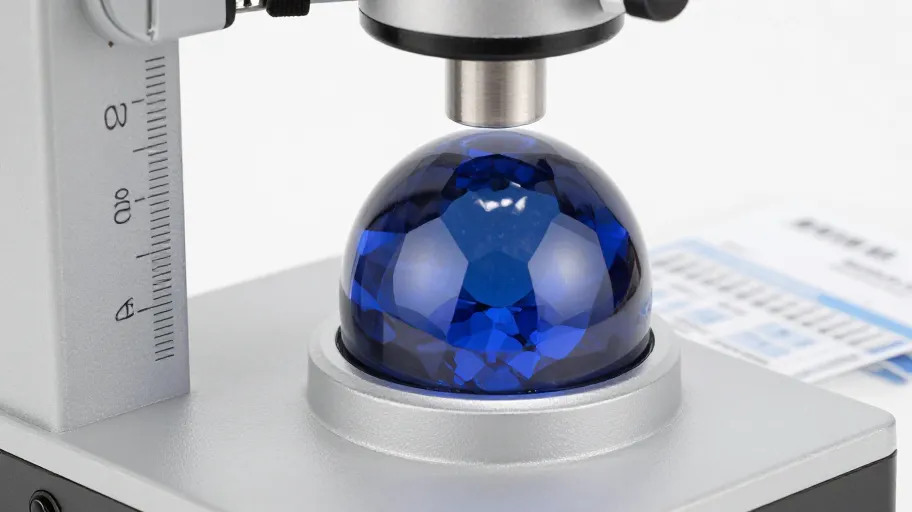
Before you approve bulk production of domed sapphire watch glass, lock four things in writing: the dome's geometric definition, the finish and coating specification, the inspection method that proves conformity, and the evidence pack that travels with the batch. Approving on verbal assurances or an unlabelled sample invites disputes, rework and delayed launches. This article gives you a framework and a question set to close those gaps first.
The CURVE Gate: a five-point approval framework
Use the CURVE Gate to structure every domed sapphire watch glass approval decision:
- C — Curvature spec. Define the dome profile in dimensional terms: apex height relative to the edge, profile shape, edge transition, and how the profile is measured. Confirm which drawing convention your supplier works to.
- U — Use-case load. Document the watch's intended environment and the loads the crystal must withstand, then ask the supplier how they verify against that use case.
- R — Refinement and coating. Specify surface finish, any anti-reflective or decorative treatment, and where coatings are applied. Ask how coating conformity is checked per batch.
- V — Verification method. Agree the inspection instruments, sampling approach and acceptance criteria before production. A spec without a measurement method is an opinion.
- E — Evidence pack. Require documentation to accompany delivery: dimensional reports, inspection records and any test data relevant to your specification.
The gate exists to move decisions from "the sample looked fine" to "the batch conforms to a defined, measured and documented specification."
Approval decision table
| Decision area | Not ready to approve | Approve with conditions | Ready to approve |
|---|---|---|---|
| Dome geometry | "Match the sample" with no drawing | Drawing exists, measurement method not yet agreed | Profile fully dimensioned; measurement method and instrument agreed in writing |
| Coating/finish | Coating described verbally only | Coating named but per-batch check undefined | Coating specified; verification method and acceptance criteria documented |
| Use-case fit | No load or environment documented | Use case described, supplier response pending | Supplier confirms in writing how the design addresses your documented use case |
| Inspection plan | No sampling or acceptance criteria | Criteria drafted, instrument TBD | Sampling plan, instruments and criteria locked before production |
| Documentation | Nothing promised in writing | Evidence pack listed but format unconfirmed | Evidence pack contents and format agreed before release |
Work each row left to right. Any row sitting in "not ready" should block bulk approval.
Concrete approval questions to send your supplier
Send these before tooling or production commitment, and require written answers:
- What dimensional definition do you need from us to define the dome profile — and what will you issue back as the controlling document?
- How will the dome profile be measured on production parts, and with what equipment?
- What coatings or surface treatments can you apply to this domed sapphire watch glass, and how is coating conformity verified per batch?
- What inspection plan applies to this part: sampling method, instruments, and acceptance criteria?
- What documentation accompanies each delivery — dimensional reports, inspection records, or other evidence of conformity?
- What is your process for handling parts that fall outside the agreed criteria, and at what stage am I consulted?
- What information do you need from us about the watch's intended use and assembly to confirm the design is fit for purpose?
- What is your current policy on samples, costs, lead times and minimum order quantities for this specification? Confirm the current policy directly.
Question 8 deserves emphasis: commercial terms, sample arrangements and timelines vary by project and change over time. Confirm the current policy directly rather than relying on prior projects, catalogue statements or third-party summaries.
Comparing options: what to compare, not what to assume
When comparing suppliers or configurations of domed sapphire watch glass, compare documented answers, not impressions:
- Flat vs domed. Ask each supplier to state the geometric and processing implications of the dome you want, and how those implications are controlled in production. Do not assume one is simpler for every supplier.
- Coating choices. Ask which coating options are available for your geometry, where they are applied, and how each is verified. Compare the verification methods, not the marketing names.
- Verification approach. Compare which suppliers will commit to a written inspection plan with named methods versus those who offer only visual assurances.
- Documentation. Compare what each supplier will put in writing about conformity evidence. The willingness to document is itself a signal.
Avoid anchoring on what other projects received or what a forum suggests. Each supplier, part and batch is project-specific.
Pre-approval checklist
Run this checklist before releasing bulk production:
- Dome profile fully dimensioned on a controlled drawing.
- Measurement method and instruments for curvature agreed in writing.
- Coating or finish specified, with per-batch verification defined.
- Intended use case and load environment documented and shared.
- Inspection plan (sampling, criteria) agreed before production starts.
- Evidence pack contents and format confirmed.
- Out-of-criteria handling process documented.
- Current sample, cost, timeline and order-quantity policy confirmed directly with the supplier.
FAQ
How is a dome profile specified for custom sapphire watch glass? Through a controlled dimensional drawing that defines apex height relative to the edge, the profile curve and the edge transition. Ask your supplier which conventions they use and what document will control the part, then verify the returned drawing matches before approval.
What verification should I require for coating conformity? Require a written statement of the verification method, the sampling approach per batch, and the acceptance criteria. Ask the supplier to name the instruments used and to include the results in the delivery documentation.
Can I approve production from a sample alone? A sample without a controlling drawing and agreed measurement method creates ambiguity: the batch may differ from the sample in ways nobody defined. Approve against a documented specification and verification plan instead, and use the sample as a reference artifact alongside them.
What should I ask about use-case fit? Document the watch's intended environment, assembly method and expected loads, share it with the supplier, and ask them to confirm in writing how the design addresses it. Keep that confirmation in your project file as part of the approval evidence.
How do I compare two suppliers offering domed sapphire watch glass? Put the same question set to both and compare the written answers: geometry control, measurement methods, coating verification, inspection plan and documentation. The supplier whose answers are specific, measurable and documented is the safer approval.
Request a curvature review
The highest-risk unknown in any domed sapphire watch glass project is the curvature itself. Request a curvature review with JadeZone Sapphire before you approve bulk production: share your dome intent and drawings, and get the geometric questions resolved first.
If you are not ready for that conversation yet, start with the pre-approval checklist above — copy it into your RFQ and use it to structure your supplier comparison.