
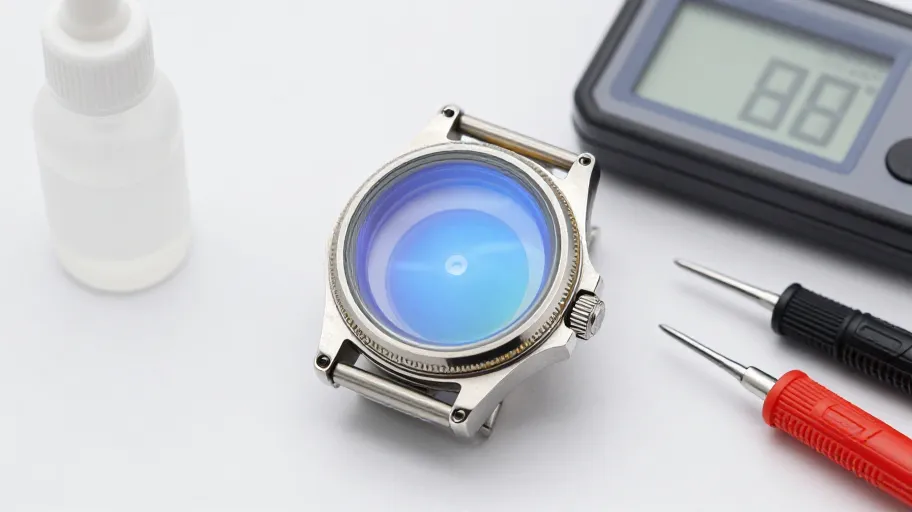
When you evaluate an anti reflective sapphire crystal coating for an OEM watch build, record three things in writing: how the crystal fits the case (Fit), how the coating behaves at every interface it touches — gaskets, adhesives, seals, cleaning agents (Interface), and what functional checks you ran and their outcomes (Test). A structured record converts a subjective "it looks fine" into a defensible approval decision you can hand to your assembly partner and repeat across batches.
That structure is what we call the FIT-3 record. It exists because most coating failures in watch programmes are not discovered at the coater's bench. They surface later: a tint mismatch against a dial, haze after UV-cured adhesive curing, or a gasket that interacts with the coated surface over time. By then, the information you need — which coating stack, which side coated, which bonding route, which check you ran — has evaporated. FIT-3 keeps it on paper.
The FIT-3 framework: three passes, one record
F — Fit. How the crystal seats in the case or bezel under your actual assembly conditions. Record the seating method, the reference surfaces used, whether the crystal sits flush and centred, and any interference observed. Do not assume a numeric tolerance from a catalogue or prior project; log the tolerance the supplier has confirmed for this project and verify the delivered parts against that written figure.
I — Interface. Every material that contacts the coated surface: gaskets, adhesives, UV-cure compounds, solvents, cleaning fluids, sealants, and gloved handling during assembly. For each, record the material name, application method, cure or dwell conditions relevant to your process, and any visible change to the coating — haze, tint shift, delamination, or streaking — observed after exposure. If a crystal is coated on one side only, record which side faces the dial and which faces outward, because interface risks differ.
T — Test. The functional checks you actually performed: visual inspection under your defined lighting, contrast assessment against the intended dial, any environmental or wear exposure you chose to run, and the pass/fail outcome. Record the conditions, not just the result, so the check can be repeated when a second batch arrives.
Decision table: outcome → action
| Check | Outcome observed | Recorded action |
|---|---|---|
| Fit | Crystal seats flush, centred, no interference | Log reference surfaces and confirm tolerance as verified for this project |
| Fit | Rocking, gap or seating interference | Quarantine part; request the supplier's confirmed dimensional record for the lot |
| Interface | No coating change after adhesive/gasket exposure | Log material, exposure conditions and observation date |
| Interface | Haze, tint shift or edge lifting after exposure | Halt; test alternative adhesive/gasket pairing; raise with supplier before approval |
| Coating appearance | Consistent tint and reflectance across sample set | Log observation conditions; request batch/coating identifiers from supplier |
| Coating appearance | Variation between parts | Request coating lot traceability and re-run comparison under identical lighting |
| Test | All checks pass under documented conditions | Approve with dated record; attach to specification sheet |
| Test | Any failure | Do not approve; document conditions and open a supplier query |
What to log per crystal
Every crystal you evaluate should carry a small identity card in your records:
- Crystal reference / drawing number and revision
- Supplier lot or batch identifier, as provided by the supplier
- Coating configuration: one-side or two-side coating, and which face is coated
- Supplier-confirmed dimensional specification for this project (figures confirmed per order — never carried over from a previous programme)
- Interface materials tested and observed results
- Test conditions, date, and the person who ran the check
None of these items require you to assume what a supplier's policy is. They require you to write down what was confirmed and what was observed. That distinction is what makes the record usable in a dispute or a design revision.
Concrete approval questions to send your supplier
Before approving an anti reflective sapphire crystal coating, send these questions in writing and keep the answers with your FIT-3 record:
- What coating configuration do you recommend for this crystal — single-side or double-side — and on which face, given our dial and assembly method?
- What dimensional specification will you confirm in writing for this project, and how will conformance be documented per lot?
- Which coating lot or batch identifiers will accompany each delivery so we can trace appearance variation?
- Which adhesives, gasket materials and cleaning agents have you evaluated for compatibility with this coating, and what evidence can you share from those evaluations?
- What inspection or verification steps do you perform before shipment, and what record of them can we receive?
- What is your current policy on samples, pricing, lead time and re-ordering for this specification — and where is it documented?
That final question matters. Sample policy, cost responsibility, shipping arrangements, lead time and whether any fee is applied or credited are all supplier-policy items that change over time and differ by programme. Do not rely on assumptions, prior projects or third-party summaries. Ask, in writing, and attach the answer to the specification.
Boundaries: what not to assume during approval
A careful sourcing record also notes what is not yet verified. Treat the following as open items until the supplier confirms them directly: minimum order quantities, unit pricing, sample availability and terms, shipping cost responsibility, production lead times, certifications applicable to your market, and any warranty position on coating performance. Logging these as "pending confirmation" is not a weakness in your record — it is the record working as intended. An approval that lists its open items is far more defensible than one that silently assumed them.
Frequently asked questions
Why document fit checks separately from coating checks? Because the failure modes differ and the responsible party can differ. A seating problem may trace to case machining; haze may trace to coating or adhesive interaction. Separate records let you route the query correctly and avoid blaming the wrong process.
Which side of the crystal should carry the anti reflective coating? That depends on the dial colour, the intended visual effect and the exposure risk of each face — the outward face encounters wear and cleaning, the inward face encounters adhesives and outgassing. It is a project-specific decision to make with your supplier, and your choice should be recorded in the specification, not inferred later.
How many sample parts should we run through FIT-3 before approving? There is no universal number we can responsibly state. Define your own sample plan based on programme risk, then record how many parts were checked, from which lot, and under what conditions. A documented small plan beats an undocumented large one.
Can we reuse a FIT-3 record for the next project? Reuse the structure, never the contents. Tolerances, coating configurations and interface results are tied to a specific drawing, supplier confirmation and material set. Carry the template forward; re-run the checks and re-confirm the specification each time.
Confirm your coating specification
The fastest way to de-risk an anti reflective sapphire crystal coating decision is to put the specification in writing before parts move. JadeZone Sapphire works with watch brands, component buyers and product developers in Shenzhen and Hong Kong on custom sapphire watch crystals and precision sapphire components. Send us your drawing, target coating configuration and interface materials, and confirm a coating specification with our team — including current policy on samples, pricing and lead times, which we will state directly rather than have you assume.
Checklist CTA: Download or copy the FIT-3 record card above — Fit, Interface, Test — and run it on the next sample set you receive. If any row comes back "pending confirmation," you have found exactly the questions to ask first.