
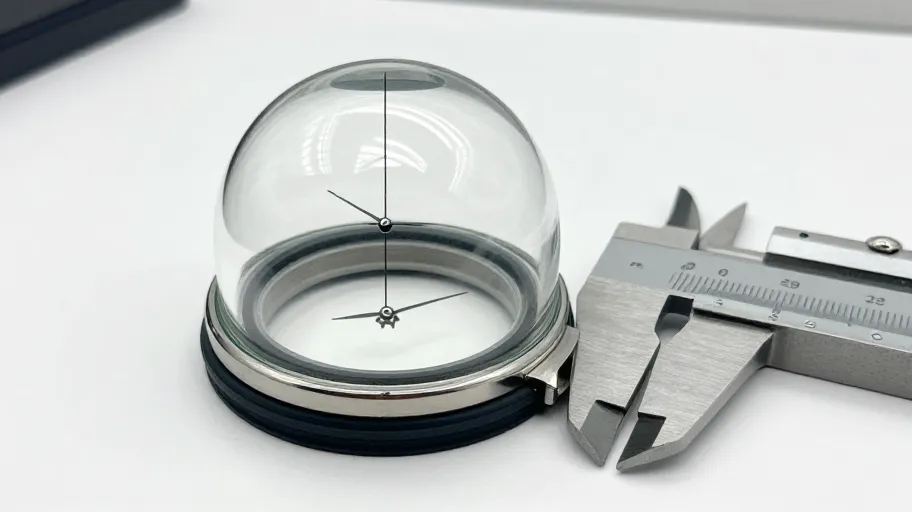
A domed sapphire watch glass introduces curvature that a flat crystal does not, and that curvature is where most fit failures occur: poor seating, hand interference, gasket mismatch and hard-to-reproduce profiles. Before you approve any supplier, run a structured fit check and record four things — the reference geometry, the critical dimensions, the alignment behaviour, and the agreed resolution of every discrepancy. This article gives you a reusable framework, a comparison table and an approval question set to do exactly that.
Why domed sapphire watch glass needs its own fit-check record
When you source flat sapphire watch glass, the fit conversation is anchored to a small set of measurable interfaces: diameter, thickness and gasket seat. Add a dome, and three new variables enter the approval decision:
- Curvature profile. A dome can be a single arc, a compound curve, or a box-style profile with steep sides and a flatter top. Each behaves differently in a gasket and a bezel.
- Height and clearance. The dome raises the highest point of the crystal above the case, changing clearance to hands, dial furniture and, on some designs, the bezel edge.
- Optical behaviour. A curved surface distorts the dial view at the edges. This is a design feature, but it must be reviewed on a real part, not a drawing, because distortion depends on the exact profile your supplier cuts.
None of these can be judged from a 2D drawing alone. That is why a documented fit and compatibility check — not just a visual inspection — should sit at the centre of your approval process for domed sapphire watch glass.
The C-D-A-R fit-check framework
Use four passes, in order, and record the result of each. The framework works whether you are checking a first sample, a pre-production part, or comparing two suppliers' interpretations of the same drawing.
C — Capture the reference geometry
Before measuring anything, capture what the part is meant to be and what it actually is.
- Photograph the sample against the drawing, from above and in profile, with a scale reference in frame.
- Record which drawing revision the sample was made to. A mismatch here explains many "bad fits" that are really documentation errors.
- Record whether the dome profile is defined in your drawing by radius, by height, by a cross-section curve, or only by a verbal description. If it is only verbal, that is the first thing to fix.
D — Dimension the critical interfaces
Measure and log each interface that controls fit. At minimum:
- Overall diameter, measured at multiple points around the rim — doming can introduce slight out-of-roundness in finishing, and you want to know the range, not a single reading.
- Dome height from the seating surface to the apex.
- Thickness at the edge and at the apex.
- The gasket contact zone: where the curve transitions into the side wall, and how consistent that transition is around the circumference.
- Inside clearance: the vertical gap between the inner apex of the dome and the highest hand or dial element, including at full hand sweep positions.
Record every measurement with the measuring method noted (caliper, height gauge, optical projector). When you later compare suppliers or production batches, identical methods make the comparison meaningful.
A — Align the part in the real case
Dimensions on paper do not confirm fit. Assemble, or dry-fit, the crystal with the production-intent case, gasket and movement:
- Seat the crystal with the intended gasket and record whether it sits flush and even, or shows lift, tilt or a visible gap at any point.
- Rotate the crystal a quarter turn and re-check. Uneven seating that rotates with the part points to the crystal; uneven seating that stays fixed points to the case or gasket channel.
- Run the hands through a full sweep and log minimum clearance to the dome's inner surface at every hour position.
- Close the bezel (if the design uses one) and check for stress marks, uneven gaps or resistance that suggests profile interference.
R — Resolve and record every discrepancy
Every deviation found in passes one to three should be written down with three fields: what was observed, what the agreed cause is, and what the agreed correction is. Unresolved observations should not silently become approvals. This record becomes your acceptance baseline — the document you compare future production against and the evidence you bring if a dispute arises.
Comparing dome profile options for approval
| Dome profile | Fit considerations to record | Approval questions to settle | Risk to document |
|---|---|---|---|
| Low single-arc dome | Minimal height change; gasket behaviour close to flat glass | Is the arc radius locked to the drawing revision? What clearance remains at full hand sweep? | Edge distortion of dial numerals may be subtle and easy to miss without side-by-side review |
| High single-arc dome | Significant added height; hand clearance becomes a primary check | What is the minimum inner clearance across all hand positions? Is the bezel opening affected? | Interference with hand tips under shock or at sweep extremes |
| Box crystal (steep sides, flatter top) | Side walls interact with the gasket channel differently than a curve | Where exactly does the wall begin relative to the gasket seat? Is the wall consistent around the circumference? | Uneven seating if the wall-to-top transition varies; harder visual QC of the transition |
| Double-domed (inner and outer curve) | Both outer fit and inner clearance change | How is the inner curve specified and verified? What is the optical distortion at dial edges? | Distortion and reflection at edges; clearance calculations based on outer dome alone will be wrong |
This table is not a ranking. It is a record template: whichever profile your design uses, the middle column tells you what to measure, and the right column tells you what must be answered in writing before approval.
Concrete approval questions for your supplier
Put these to any supplier you are comparing — including JadeZone Sapphire — and file the written answers alongside your fit record.
- Which drawing revision will the production parts be cut to, and how will revisions be controlled?
- How do you verify dome profile conformity — and what measurement output can you provide with each batch?
- What is your current policy on pre-production fit samples for a new dome profile, including any fees, quantities and shipping arrangements? Confirm current terms directly.
- If a fit discrepancy is found at our end, what is your agreed correction process, and what documentation do you require from us?
- What information do you need from us to propose a dome profile — case drawing, gasket specification, movement and hand heights, or target optical behaviour?
- How should we specify the gasket interface for our chosen profile, and will you review our gasket drawing against the crystal geometry?
Notice what these questions deliberately do not assume: no pricing, no lead times, no tolerance figures and no sample terms are stated here, because none were supplied for this article. Every one of those is project-specific and must be confirmed directly with the supplier before it enters your approval record.
Fit-record checklist
Use this checklist for every domed sapphire watch glass approval, one copy per supplier per sample round:
- Drawing revision recorded and matched to the sample
- Dome profile type confirmed in writing (single arc, box, double-domed)
- Diameter measured at minimum four points; range recorded
- Dome height and edge thickness recorded with method noted
- Gasket contact zone inspected around full circumference
- Dry-fit in production-intent case completed and photographed
- Seating evenness checked with quarter-turn rotation
- Hand clearance logged at every hour position, full sweep
- Optical edge distortion reviewed on the wrist mock-up or case
- All discrepancies logged with cause and agreed correction
- Supplier written answers to the six approval questions filed
- Sample approved or rejected against the record, not against impressions
FAQ
How is a domed sapphire watch glass specified so suppliers quote the same thing? Specify the dome by an explicit cross-section or by a locked combination of arc radius and apex height, tied to a drawing revision. A verbal description such as "gently domed" invites each supplier to interpret differently, which makes comparison impossible. Provide the gasket interface and maximum hand height alongside the dome definition.
What clearance should I leave under a domed crystal? No universal figure applies — it depends on hand height, dome profile, movement specification and shock requirements, and this article asserts no standard. Instead, measure the minimum inner clearance at every hand position on a real part and record it. Make your acceptance figure a project decision documented in the fit record.
Can I judge hand clearance from the outer dome shape alone? Not reliably. On a double-domed crystal the inner surface follows its own curve, so clearance calculated from the outer profile will overstate the real gap. Measure the inner apex position directly on the sample.
What should I do if the same drawing produces different fits from two suppliers? Run both samples through the identical C-D-A-R record. Differences in seating or clearance traced to profile interpretation tell you the drawing is under-specified; differences traced to finishing tell you something about process control. Either way, the record identifies the cause before you commit.
What documentation should I hold after approving a domed crystal? Keep the drawing revision, the measurement record with methods, the assembly photographs, the supplier's written answers to your approval questions, and the discrepancy log with resolutions. That file is your acceptance baseline for production checks and any future re-order.
Request a curvature review
Before tooling a domed sapphire watch glass profile, have the geometry reviewed against your case and gasket drawings. Request a curvature review from JadeZone Sapphire and compare the feedback against your own C-D-A-R record — then approve on evidence, not impressions. Sample terms, costs and lead times are project-specific: confirm current policies directly with the supplier.
Lower-commitment option: take the fit-record checklist above into your next sample evaluation. If you want it as a reusable one-page form, ask for it when you request your review.