
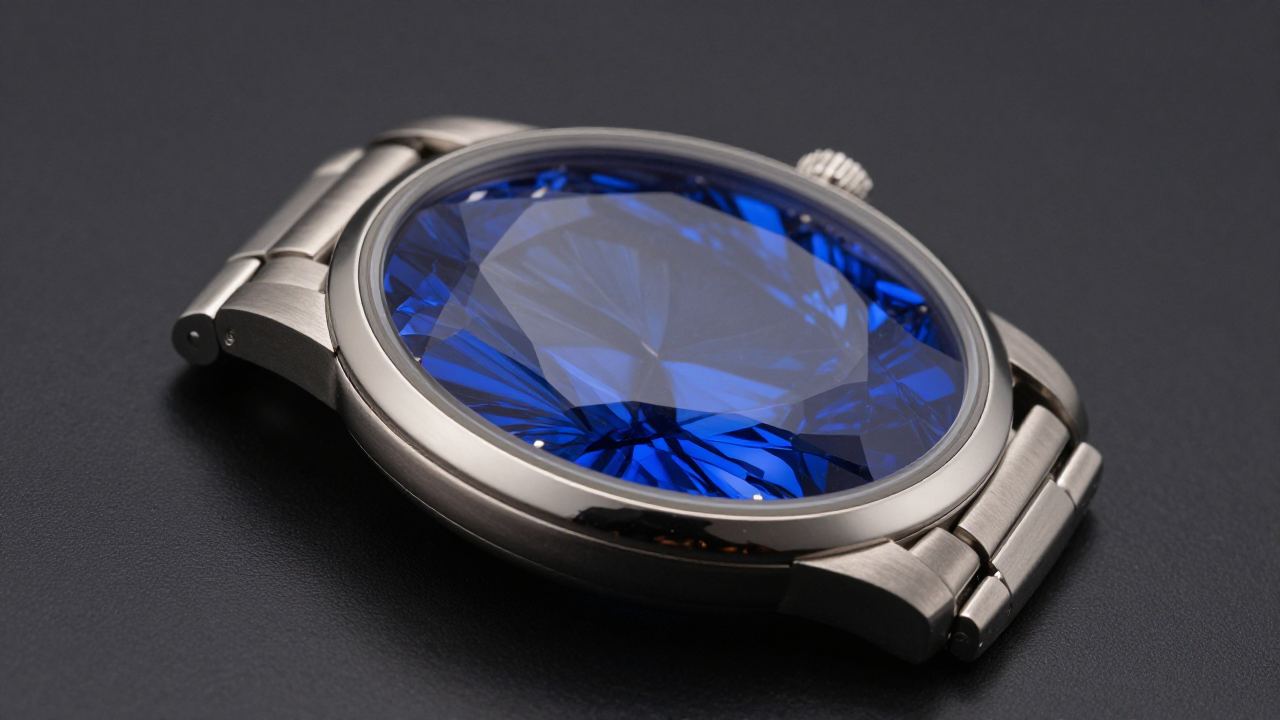
For daily-wear field and pilot watches, buy flat sapphire at 1.0–1.2 mm with inner-only AR coating. For vintage-styled dress pieces and GMTs, buy double-domed box sapphire with double-sided AR.…
For sub-$150 retail, sapphire-coated mineral is the honest answer. For anything water-rated past 200 meters, buy 2.2–3.0 mm domed sapphire with inner AR only.
Pick the Crystal Before You Pick the Watch
Those four pairings cover roughly 95% of the orders we watch move through our Shenzhen line each year. What follows is where each one breaks down, and which number on the spec sheet actually predicts the failure.
Why Sapphire Still Beats Mineral and Acrylic
Sapphire is single-crystal aluminum oxide at Mohs 9, and the National Institute of Standards and Technology's hardness references put corundum behind diamond alone. That single number explains why a sapphire watch crystal survives a decade of door frames and beach sand while mineral glass at Mohs 5.5 picks up visible scratches within months.
On the Vickers scale the gap is wider still. Synthetic sapphire sits near 2,000 HV; hardened mineral glass lands between 500 and 600 HV; acrylic barely registers at Mohs 3. Hardness is not the same as toughness, and we'll get to that, but for surface wear there is no contest.
Optics matter too, and this is where buyers get surprised. Uncoated sapphire transmits about 85–92% of visible light depending on thickness and polish quality. A proper anti-reflective stack pushes that to 98–99% and kills the gray cast that makes cheap crystals look hazy under store lighting. Two surfaces, two coating decisions, and a $12 swing in unit cost.
The price floor has collapsed. Sapphire used to signal a four-figure watch. In 2025 Timex shipped a compact GMT with a sapphire crystal at a retail price that would have been absurd in 2015, and Casio answered in the same bracket. Once sapphire shows up at $250, the question stops being whether you want it and becomes which configuration of it.
Which Sapphire Watch Crystal Configuration Should You Buy?
The four configurations below cover the vast majority of what US buyers order in 2026, and the variable that decides cost and performance is thickness plus coating stack. Sapphire versus sapphire barely matters compared to geometry.
Flat sapphire with inner AR is the workhorse, and its boundary is the case. Below 1.2 mm, the crystal becomes a wear item under lateral impact. Above 1.4 mm you start eating into dial clearance and hand height on slim movements.
Double-domed box sapphire buys you the distortion-free dial and the vintage profile that sells at retail, but the outer coating is a sacrificial layer. Anyone who tells you a double-AR crystal is a lifetime part is selling you a replacement cycle.
Sapphire-coated mineral exists because $2.50 beats $9 on a $120 watch. It is not fraud, and it is not sapphire either. Treat it as a two-year consumable.
Thick domed sapphire past 2.2 mm is the only option that survives real dive duty. It also costs three to four times a flat crystal, forces a taller case, and needs water-resistance re-testing every time you swap one.
Scratch Resistance and Impact Resistance Rarely Arrive Together
Hardness and impact toughness diverge once geometry is fixed. A 1.0 mm flat sapphire watch crystal scratches identically to a 3.0 mm domed one, but it chips at the edge under loads the thick crystal absorbs without complaint. Buyers optimize for the scratch they can see and get burned by the crack they didn't plan for.
In March 2022, a microbrand out of Portland, Oregon pressed 1.0 mm flat sapphire into 4,000 titanium cases and came back with a 12% breakage rate at assembly. The material spec was fine. The bevel was not. We re-cut the edge to a 0.15 mm chamfer and moved the next run to 1.4 mm stock; breakage fell to 1.8%.
Coating is the other half nobody compares. The AR layer sits around Mohs 6–6.5. Quartz sand is Mohs 7. A day at the beach will scratch the coating while leaving the sapphire beneath it flawless, and the owner will blame the crystal. In September 2024, a San Diego dive watch brand shipped 2,400 units with double-sided AR. About 300 came back within six months, all coating scratches, zero sapphire damage. They moved to inner-only AR on the tool line and kept double AR on the dress models.
There is also a fitment tolerance almost no spec sheet lists: gasket compression. Domed crystals need the gasket to compress within about ±0.05 mm of nominal or you get a slow leak that shows up in a humidity test, not a pressure test. We've rejected whole batches for 0.08 mm of variance.
Mistakes That Cost Real Money
The single most expensive mistake is treating "sapphire" as a finished specification. It names the material, not the part. Four things get skipped constantly:
Sourcing is the quieter trap. European blank suppliers run 8–12 weeks on custom geometry; Shenzhen runs 10–15 days on the same tolerance band, which is why lead time, not unit price, decides most microbrand launch calendars. Ask for the actual transmitted wavefront distortion figure rather than a marketing claim, and always request a first-article inspection with dimensional report before committing to a 5,000-piece run. Jadezone Optical has cut sapphire watch crystal in Shenzhen since 2010 with a staff north of 300, and the batches that go wrong are almost never the ones that were inspected.
Match the Crystal to the Wearer
If the watch lives on a wrist that meets desks, car doors and gravel, and it retails between $200 and $600, choose flat sapphire at 1.2 mm with inner-only AR. You get Mohs 9 scratch resistance, a $9–12 unit cost, and a replacement that any independent watchmaker can handle in twenty minutes.
If the watch is a dress piece, a GMT, or anything where the dial has to look wet and deep under a jewelry counter light, choose double-domed box sapphire at 1.5–1.8 mm with double AR. Accept the coating as a wear item and budget for it. The clarity is the product.
If the retail ceiling is $150 and the crystal has to survive a teenager, choose sapphire-coated mineral and say so plainly on the spec sheet. Overpromising here generates more returns than the $6 you saved.
If the watch is rated to 300 m and someone will actually take it there, choose 2.2–3.0 mm domed sapphire, inner AR only, and pay for the pressure test. Outer coatings on a dive watch are a liability with a marketing budget.
Frequently Asked Questions
What is a sapphire watch crystal made of?
A sapphire watch crystal is synthetic single-crystal aluminum oxide (Al2O3), grown in a furnace rather than mined. It measures Mohs 9 on the hardness scale, transmits roughly 92% of visible light when uncoated, and shares the same chemistry as natural corundum. It is not glass in any traditional sense.
How much does it cost to replace a sapphire watch crystal?
Independent US watchmakers typically charge $75–$200 for parts and labor on a flat sapphire crystal, with domed or branded replacements running higher. OEM pricing at 100–500 units sits near $8–14 for flat sapphire and $22–45 for double-domed box sapphire. Water-resistance testing adds another $20–$40.
Is sapphire-coated mineral glass the same as sapphire?
No. Sapphire-coated mineral is hardened glass with a thin aluminum oxide layer bonded to the surface. It starts out nearly as scratch-resistant, but the coating runs only 2–4 microns thick and wears through in roughly 18–30 months of daily wear, after which scratches appear in the mineral beneath.
How long should a sapphire watch crystal last?
A properly seated sapphire watch crystal at 1.2 mm or thicker commonly outlasts the movement inside it. Documented failures cluster around assembly errors and edge impacts rather than surface wear. The AR coating stack, not the sapphire, is usually the first component to show age.
How do I choose between flat and domed sapphire?
Choose flat sapphire under 1.2 mm when case height, cost and repairability matter most. Choose domed or box sapphire when dial clarity and vintage proportions matter more than the extra $15–30 per unit and the tighter gasket tolerances that domed crystals demand.