
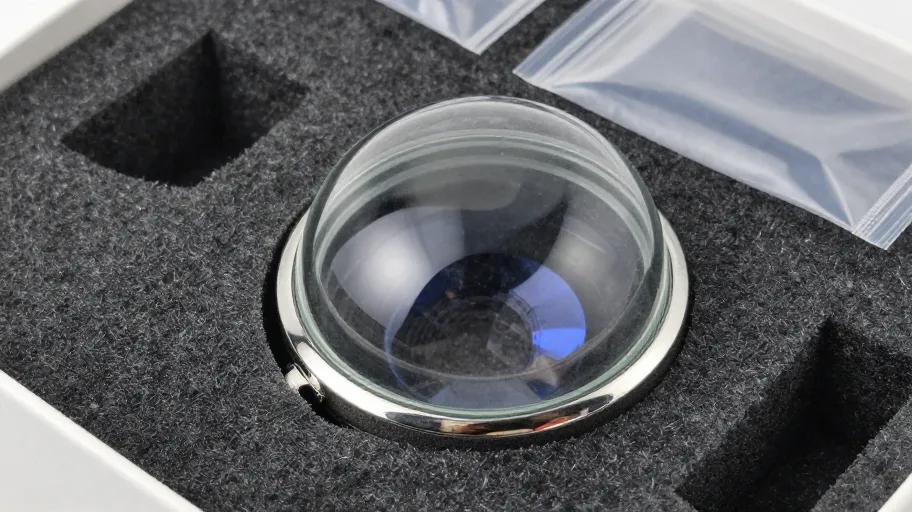
Domed sapphire watch glass should be compared on three controllable variables before price: curvature control, surface finish, and packaging that protects the part through delivery. The Curvature–Finish–Protection (CFP) framework turns a vague supplier search into a documented comparison, so quotes arrive on your specification rather than the supplier's defaults. Every tolerance, finish grade and packing detail should be confirmed in writing for your specific project.
Why domed sapphire watch glass resists simple comparison
A domed crystal is not a commodity part. Two suppliers offering "domed sapphire" can deliver parts that differ in dome height relative to diameter, edge transition profile, polish quality at the apex, and how the part survives freight. When a buyer compares only price, the comparison collapses the moment fitment fails or a batch arrives damaged.
The root problem is missing documentation. Many supplier conversations never specify:
- The dome profile (spherical radius, high-domed versus low-domed geometry, or a supplier-defined approximation)
- The measurable boundaries of the part — how the supplier defines the acceptable range of height, diameter and thickness variation for your drawing
- How the finish is inspected and against what written acceptance criteria
- How each part is packed, separated and protected in transit
The CFP framework exists to fix that. It does not ask "who is cheapest?" It asks "who can document what they will deliver?"
The CFP framework: Curvature, Finish, Protection
Curvature. Confirm that the supplier works from your drawing or can produce one for approval. Ask how dome height is measured relative to diameter, how the edge transition from dome to seat is defined, and which of these dimensions are controlled versus reference-only. Whether tolerances are expressed as numerical ranges on a datasheet or agreed per project, they must exist in writing — never as a verbal assurance.
Finish. Sapphire polish quality is visible but hard to specify verbally. Ask what finish grades the supplier offers, how each is inspected (visual, magnification, instrument), and what the acceptance criterion is for apex distortion, edge chipping and inclusions. If any coating such as anti-reflective treatment is involved, ask for the coating specification and how its adhesion and appearance are verified — and confirm current policy on coating performance claims directly.
Protection. A finished crystal that arrives scratched is a rejected crystal. Confirm how parts are individually separated, what container each part sits in, how batch-level and piece-level inspection are documented, and what the procedure is if freight damage occurs. Do not assume responsibility splits — confirm the current shipping and claims policy in writing before ordering.
Decision table: comparing domed sapphire watch glass suppliers
| Comparison factor | Weak supplier signal | Strong supplier signal | What to request in writing |
|---|---|---|---|
| Dome geometry | "We can do any dome" with no drawing | Works from your drawing or produces one for your approval | Dome profile definition and measurement method |
| Dimensional control | Verbal assurances | Documented project-specific dimensional agreement | Which dimensions are controlled, which are reference |
| Surface finish | Single unnamed polish option | Named finish grades with inspection method | Written acceptance criteria per grade |
| Coating | "AR available" with no spec | Coating specification offered for review | Coating spec and verification method |
| Packaging | Parts loose or generic bags | Individual separation and protective containers described | Packing method and per-part protection |
| Delivery issues | No stated procedure | Documented claims process | Current shipping and claims policy |
| Sample policy | Unstated | Clearly stated when asked | Confirm current sample, cost and shipping policy directly |
| Order terms | MOQ mentioned verbally | Written project-specific quotation | Confirm MOQ, lead time and capacity for your project directly |
No row in this table can be filled from assumptions. Each cell marked "confirm" is a question for the supplier, because none of these terms are universal — they change per project, per specification and over time.
Curvature and tolerance questions to approve before ordering
Put these to every supplier on your shortlist, including JadeZone Sapphire:
- Can you machine to our supplied drawing, and will you flag any feature of the dome you cannot hold as drawn?
- How is dome height measured, and at how many points?
- How is the edge — where the dome meets the seat — transitioned, and how is that transition verified?
- Which dimensions on our drawing will be treated as controlled, and which as reference only?
- What is your inspection and re-inspection procedure for out-of-spec parts, and how is it documented?
The supplier's willingness to answer in writing, with numbers relevant to your drawing, tells you more than any brochure.
Finish and coating approval questions
- What finish grades do you offer, and what distinguishes them in inspection terms?
- What is your acceptance criterion for apex distortion and edge condition?
- How do you inspect for surface defects, and at what magnification?
- If we specify an anti-reflective or other coating, what specification governs it, and how is performance verified on our parts?
- What is your policy on finish disputes after delivery, and what evidence (inspection records, retained samples) supports resolution?
Packaging and the delivery gate
Packaging is where a good batch becomes a bad delivery. Before releasing a purchase order, document:
- Individual part separation and container type
- Interior cushioning and orientation
- Outer carton marking and handling instructions
- Inspection records accompanying the batch
- The named procedure and responsible party if damage occurs in transit
This documentation becomes your delivery gate: parts are accepted only when the batch matches the agreed packing and inspection record. Confirm freight terms, insurance and claims responsibility for your specific order directly with the supplier, as these vary by project and are not stated here.
Pre-order delivery checklist
- Drawing approved, with dome profile defined and signed off
- Controlled dimensions versus reference dimensions listed in writing
- Finish grade selected and acceptance criterion documented
- Coating specification confirmed, if applicable
- Packing method described and agreed
- Batch inspection documentation agreed
- Sample policy, costs and shipping terms confirmed directly with the supplier
- MOQ, lead time and capacity confirmed for this specific project
- Claims procedure for transit damage documented
Frequently asked questions
Is a higher dome harder to control than a lower dome? Geometry affects both machining and inspection, but difficulty is project-specific. Ask each supplier which dome profiles they can hold to your drawing and how they verify height at the apex. Confirm rather than assume.
How do I compare finish quality between suppliers without visiting? Ask each supplier to state their finish grades, inspection method and written acceptance criteria, then compare those documents side by side. A supplier who cannot describe finish in inspection terms cannot be compared fairly.
What should a domed sapphire watch glass quotation include to be comparable? At minimum: dome profile definition, controlled dimensions, finish grade and criteria, packing method, and the sample, shipping and claims policies applicable to your project — all confirmed in writing.
Who bears responsibility if crystals are damaged in transit? That depends on the freight and claims terms for your specific order. Confirm the current policy directly with the supplier before ordering, and document it in the purchase order.
Can JadeZone Sapphire review our dome design before we commit to an order? Yes — a curvature review is the recommended first step. Share your drawing or target geometry and the team will discuss curvature control, finish options and packaging as they apply to your project.
Request a curvature review
Send your drawing or target dome geometry to JadeZone Sapphire and request a curvature review. The discussion will cover how the dome profile would be defined and measured, which dimensions can be controlled for your project, and what finish and packaging documentation would accompany delivery — all specific to your design, confirmed directly.
Prefer to start smaller? Use the pre-order delivery checklist above to prepare your enquiry, then request your curvature review with the documentation gaps already identified.