
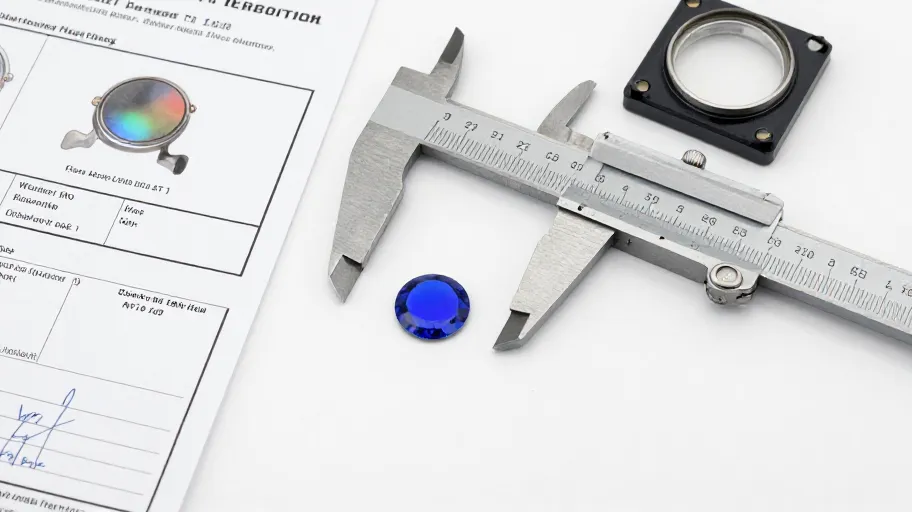
Handing an approved custom sapphire watch crystal sample to production means freezing the specification in writing, agreeing the measurement authority, verifying material and coating properties against defined criteria, qualifying the production line with first articles, and pre-agreeing how deviations are escalated. Visual approval of one part is not a production control. A disciplined handoff protects both buyer and manufacturer, and gives sourcing managers an audit trail.
Why approving a sample is not the same as approving production
A sample answers one question: can this supplier make this part once, to this appearance, under engineering attention. Production asks a different question: can the supplier repeat that result across a run, with inspection data, when the engineering team is not standing at the machine.
The gap between those two questions is where sourcing programmes lose time and margin. The parts arrive, they differ from the approved reference in some measurable way, and nobody can prove which document governs. Was it the drawing? The sample? An email with a photo? Without a freeze point, every dispute becomes a negotiation.
The purpose of a handoff protocol is not distrust. It is clarity. A manufacturer that welcomes a documented specification freeze is easier to work with across a full programme lifecycle, because expectations are written down before volume commitments are made.
The SAMPLE-Freeze Gate framework
Use five gates between sample approval and serial production. Each gate produces a document, and each document answers a question that will otherwise surface as a dispute.
S — Specification lock. The dimension sheet, drawing revision, material definition, coating callout and finish references are frozen. Both parties sign the same revision. Any change after this point triggers a re-approval, not a quiet adjustment.
A — Measurement authority. Agree which instruments, gauges and measurement methods decide pass or fail. If your inspection uses a different method than the supplier's, borderline parts will generate disagreement. Record the method alongside the tolerance.
M — Material and property verification. Define how sapphire material properties and any coating characteristics will be evidenced for the run, and what documentation accompanies each batch. Ask the supplier what verification they can support, and confirm it in writing before the purchase order.
P — Production line qualification. The approved sample proves capability; first articles from the production run prove repeatability. Agree in advance how many first articles will be inspected, against which criteria, and who holds the reference sample during the run.
L — Escalation path. Name a contact on each side, agree how deviations are reported, and define what triggers a stop-ship versus a concession review. Confirm the current policy directly for replacement, rework or containment terms — do not assume.
Decision table: choosing your handoff model
| Programme profile | Recommended handoff model | Key documents | Risk if skipped |
|---|---|---|---|
| New design, first production run | Full SAMPLE-Freeze Gate with first article inspection | Signed drawing revision, measurement plan, property evidence, FAI report | Silent specification drift from the approved sample |
| Repeat model, new crystal variant | Specification lock plus targeted first articles | Delta dimension sheet, coating callout, inspection criteria | Legacy assumptions applied to a changed geometry |
| Transferring from another supplier | Full gate with independent incoming inspection baseline | Golden sample register, comparative measurement report | Reference part and drawing disagree; no authority named |
| Low-complexity replacement part | Abbreviated gate: lock and measurement authority only | Signed dimension sheet, gauge agreement | Fit disputes with no agreed measurement method |
Approval questions to close before the purchase order
Work through these with the supplier and record the answers:
- Which drawing revision and dimension sheet revision governs this production order, and who signs the freeze?
- Which measurement instruments and methods define dimensional acceptance, and where are they recorded?
- How will crystal geometry, flatness and coating characteristics be evidenced for each batch, and what documentation ships with the parts?
- How many first articles from the production setup will be inspected, against which criteria, and by whom?
- Who holds the approved reference sample during the run, and how are disputes against it resolved?
- What deviation triggers a stop-ship, and what is the named escalation contact on each side?
- What are the current terms for order quantity, pricing, scheduling and shipment? Confirm the current policy directly — these are project-specific and change over time.
Deviation handling: agree the rules while everyone is aligned
The best time to negotiate a deviation protocol is before any deviation exists. Write down three things:
- Detection: how you will inspect incoming parts, and which criteria are hard stops versus reviewable.
- Reporting: the channel and timeframe for flagging a suspect batch, on both sides.
- Resolution: whether a deviation requires re-approval against the frozen spec, or a documented concession with your engineering sign-off.
A written protocol converts a potential conflict into a process step. It also protects the supplier, because it tells them exactly what your acceptance criteria are rather than leaving them to infer it.
FAQ
Should I keep the approved sample or send it to the manufacturer? Discuss and document custody before the run. Some programmes split references — one retained by the buyer, one held at the production site — so both parties compare against the same physical artefact. Agree it in writing either way.
How detailed does a dimension sheet need to be for a sapphire crystal? Detailed enough that a third-party inspector could accept or reject a part using only the sheet. Include geometry, mounting features, finish references, coating callouts and the measurement method for each critical dimension. If your sheet is thin, request the supplier's input on what they need to control the part.
What is first article inspection, and is it necessary for every order? First article inspection means measuring parts from the actual production setup against the frozen specification before the run continues. Whether it applies to every order depends on programme risk, part novelty and batch strategy — decide it per programme and record the decision in the handoff documents.
Can I approve a crystal by appearance alone? You can, but you are accepting appearance, not production control. Coating behaviour, fit and durability are governed by measurable properties. Document what you verified, so the approval means what you intend it to mean.
What if my supplier and my inspectors measure differently? Resolve it during the measurement-authority gate. Agree the instruments, fixtures and methods, and if needed exchange parts or cross-check measurements before the run. A borderline dimension measured two ways is a dispute waiting for a schedule.
Primary CTA: Ready to move from approved sample to controlled production? Submit a drawing or dimension sheet to JadeZone Sapphire, and our engineering team will review it against the SAMPLE-Freeze Gate before any production commitment.
Checklist CTA: Download or copy the seven approval questions above into your next supplier review, and confirm every answer in writing before issuing the purchase order.