
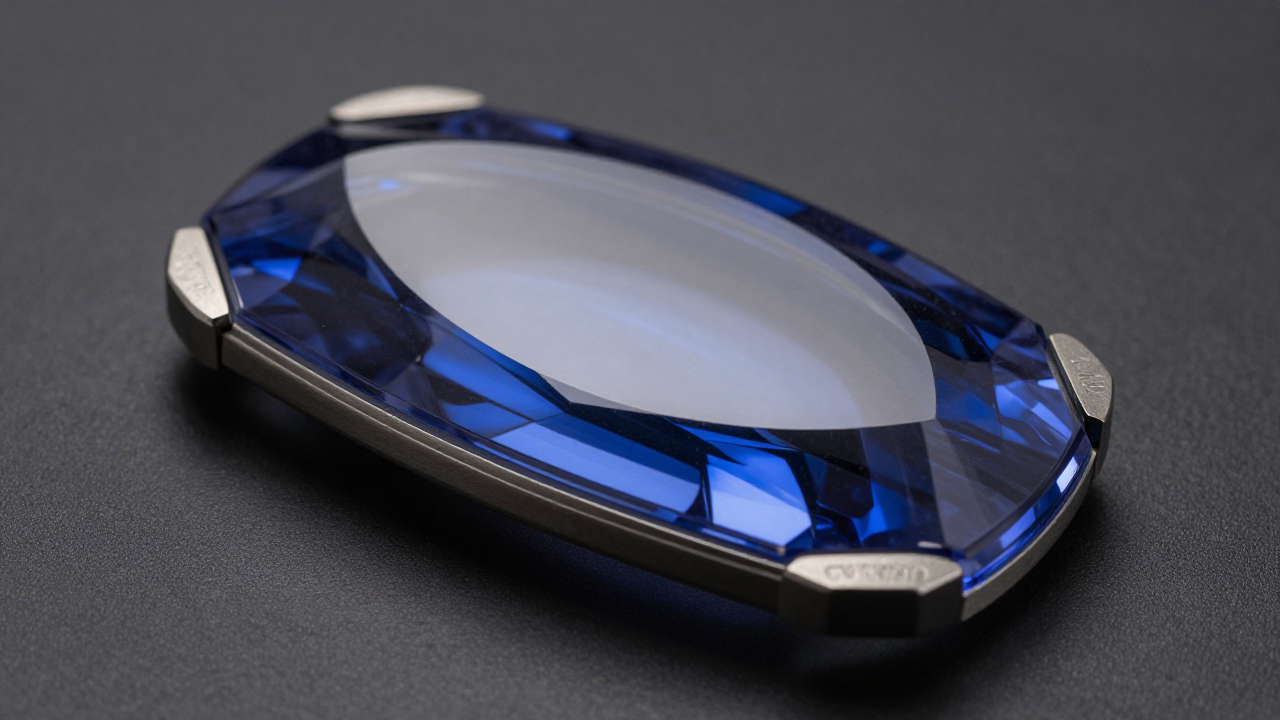
The single biggest change in 2026 is that sapphire buyers stopped asking about hardness and started asking for kilowatt-hours.…
After two decades of selling on Mohs 9 scratch resistance, the buying conversation has moved to energy per finished part and scrap recovery numbers a procurement team can actually audit.
What Changed in Sapphire Watch Crystal Sourcing This Year
Two forces pushed it there. The SEC adopted its climate disclosure rule on March 6, 2024, then the Eighth Circuit stayed it that April — the legal pressure vanished, the customer pressure did not, and large brands kept building supplier emissions inventories anyway. At the same time, the smartwatch accessory tier now consumes more flat sapphire covers than the traditional watch case business, and that tier is run by supply chain managers with spreadsheets rather than watchmakers with loupes.
What follows comes from inside a plant. We cut and coat sapphire in Shenzhen — Jadezone Optical has been at this since 2010 — so the figures below are from our own furnaces, our own yield reports, and a few arguments with customers that I'd rather not repeat.
Three of these shifts are already in purchase orders. One is a prediction I'm willing to be judged on. I flag which is which.
Eco Claims Now Get Audited, Not Applause
Watch sapphire was never mined, so "ethical sourcing" is a non-issue. The only ESG number that matters is electricity per crystal, and a Kyropoulos furnace burns roughly 10 to 14 kWh of grid power for every finished 40 mm crystal it produces.
Auguste Verneuil worked out flame-fusion sapphire in 1902. Every watch crystal sold in the United States since then has been lab-grown. When a brand markets "conflict-free sapphire," the honest reaction is confusion — there is no mine, no chain of origin, no certificate to file. What there is, is a crucible pulling 40 to 60 kW for two to three weeks per boule.
We learned this the hard way. In February 2025 a sourcing manager at a smartwatch band company in Carlsbad, California asked us for a per-boule energy figure and we didn't have one. It took eleven weeks to instrument the furnace and reconcile the meter data. Result: 15,000 to 30,000 kWh per boule depending on pull rate, which lands at that 10 to 14 kWh per finished crystal before grinding, and closer to double that once you count polishing compound and coating oven time.
So stop asking suppliers whether their sapphire is "sustainable." Ask for two numbers: kWh per finished part, and scrap recovery percentage. Anyone who can't produce both inside a week is buying boules from a trader, not running a furnace.
Already in purchase orders. Large brands are adding an energy line item to supplier scorecards right now. The 2026 RFQs crossing our desk contain a data clause that didn't exist in 2023. Predicted, verifiable by Q2 2027. Recycled alumina feedstock — regrinding our own offcuts back into the melt — becomes a standard line item instead of a novelty. We currently recover about 60% of grinding scrap by mass. Getting to 85% is a feedstock sorting problem, not a physics problem, so the date is realistic.Nano-Coating Is Beating Nano-Material to the Punch
The nano story in 2026 is not a new crystal. It's the stack on top of it. Anti-reflective and oleophobic coatings now move perceived quality more than any change to the sapphire substrate, and they generate most of the warranty claims too.
Uncoated single-crystal sapphire transmits 85 to 86% of visible light. A good dual-side AR stack pushes that past 98%. Customers don't measure it, but they see it — a crystal that reads black next to one that reads grey.
Here's the part that never makes a press release. In August 2024 a smartwatch accessory brand in Portland, Oregon ran a 90-day wear test on 240 coated sapphire covers across five cities. Nine units came back with haze along one edge. Root cause: the laser-cut edge reached the coating chamber with a sharp corner, and the stack thinned exactly there. We now chamfer inside the same fixture before coating. It added 40 cents per unit and removed the failure. It also cost us two weeks of rework on an open order, which I mention because the fix sounds obvious in hindsight and wasn't.
Predicted, verifiable by Q3 2026. "Nano" stops being a selling word and becomes a spec sheet with three numbers: Taber abrasion cycles, water contact angle in degrees, and a transmission curve with wavelength range. Buyers who accept a material name instead of those numbers will keep eating returns.Customization Turned Into a Supply Chain Problem
Personalization demand is real, but the bottleneck is tooling and MOQ, not design. Brands that cracked custom sapphire in 2025 did it with shared cavity tooling and standard outer diameters. The ones who chased unlimited SKUs are still sitting on inventory.
In March 2025 a micro-brand in Brooklyn asked us for 600 pieces at 39.4 mm with a laser-etched logo. Our dome tooling runs 38.5 mm and 40.0 mm. Custom tooling quoted at $4,800, which amortizes to $8.00 per unit on a 600-piece run — more than the crystal itself. They shipped at 40.0 mm and put the savings into packaging.
The rule that falls out: customization is cheap in the cosmetic layer and expensive in the geometric layer. Laser etching, printed indices, coating tint, and bevel finish are low-cost variables. Diameter, dome radius, edge profile, and material thickness are high-cost variables.
Already in purchase orders. We're seeing more mixed-SKU orders where geometry is fixed and only cosmetics vary. That's the correct structure, and it took the industry about three years to land on it.Is Sapphire Watch Crystal Still Worth the Premium?
Yes for watches and wearables above roughly $600 where scratch resistance drives the purchase. No for the high-volume accessory tier, where chemically strengthened glass has closed enough of the performance gap that price decides the order.
Use the failure-mode row when you argue internally. Sapphire wins scratch tests and loses drop tests, and on a wearable the second one generates the RMA.
Why I Think Sapphire Loses the Volume Tier Through 2027
The mainstream read is that smartwatches pulled sapphire into the mainstream and unit volume keeps climbing. I'll take the other side: sapphire revenue grows while sapphire unit share in flat covers under 45 mm shrinks, because the fastest-growing tier is the one sapphire cannot serve profitably.
The number that convinced me landed in October 2025. A US accessory brand quoted 250,000 flat sapphire covers against chemically strengthened glass and went with glass at roughly one-ninth the price. Their device retails for $34 and gets replaced every 14 months. Mohs 9 only pays off if the customer keeps the thing long enough for glass to scratch badly, and at that replacement cycle most don't.
Apple's lineup makes the same point from another angle. The Ultra models carry a sapphire front crystal; the standard Series models mostly don't. Every shift in that mix moves flat-crystal demand by tens of thousands of units per quarter, and it moves in whichever direction Apple chooses, not whichever direction the sapphire supply chain hopes.
There's a materials argument underneath it. On wearables, the actual failure is edge impact — a doorframe, a dumbbell, a tile floor. Sapphire's brittleness makes it worse at that than glass. The industry keeps selling the spec it can measure and ignoring the failure it keeps paying for.
Where I could be wrong: if blank pricing keeps falling, the cost gap narrows and my call breaks. Watch quarterly import volumes on synthetic sapphire optical blanks. If the sub-$60 tier is absorbing more than 15% sapphire by unit in 2027, I'll buy the coffee.
Action Timeline for the Next 3, 6, and 12 Months
Next 3 months. Put two questions in writing to every crystal supplier: kWh per finished part, and scrap recovery percentage. Keep the chamfer spec in the same document as the coating spec, because splitting them across two vendors is how the Portland haze problem happens. Buying under 5,000 pieces a year? Accept the standard 38.5, 40.0, and 42.0 mm diameters and spend your customization budget on etching and coating. Months 3 to 6. Run your own wear test — 200 to 500 units, minimum 90 days, tracking edge haze and impact failures as separate categories. Use aggregated RMA data, not anecdote. Re-bid anything under $60 retail against glass with the coated-glass column tabled next to sapphire. Lock lead times contractually: 6 to 10 weeks is normal, but polishing capacity tightens every August through October ahead of holiday builds. Months 6 to 12. Move to dual sourcing with shared tooling — one domestic finisher, one overseas grower. Negotiate energy terms instead of unit price. Off-peak furnace scheduling is worth more to your supplier than a 3% price cut is to you, and it shows up in your Scope 3 reporting. If you're a brand rather than a manufacturer, get the energy figure into your supplier scorecard before your first 2027 audit cycle opens.Frequently Asked Questions
What is a sapphire watch crystal made of?
Synthetic single-crystal aluminum oxide (Al₂O₃), grown from alumina feedstock in a high-temperature furnace. It is chemically identical to natural sapphire but contains no mineral inclusions. Commercial watch crystals have been lab-grown since the Verneuil flame-fusion process arrived in 1902, so no mined material is involved.
How much does a sapphire watch crystal cost?
Flat crystals at 100,000 units typically run around nine times the cost of chemically strengthened glass of the same size. Domed and coated versions cost more because yield loss on domed parts runs 18 to 22%. Runs under 1,000 pieces cost far more per unit once tooling is amortized.
Why does sapphire watch crystal take so long to produce?
Growing a boule takes two to three weeks in the furnace, then several more for slicing, CNC shaping, edge chamfering, polishing, and coating. Total lead time from purchase order runs six to ten weeks. Polishing capacity tightens every August through October, which can add two weeks.
How do I choose between sapphire and glass?
Pick sapphire when the device retails above roughly $600 or the customer keeps it more than three years, since scratch resistance is the benefit being paid for. Pick chemically strengthened glass below that threshold. Sapphire resists scratching better but fractures more easily on edge impact, which is the dominant wearable failure mode.