
Why 99 percent light transmission can still fail in the field
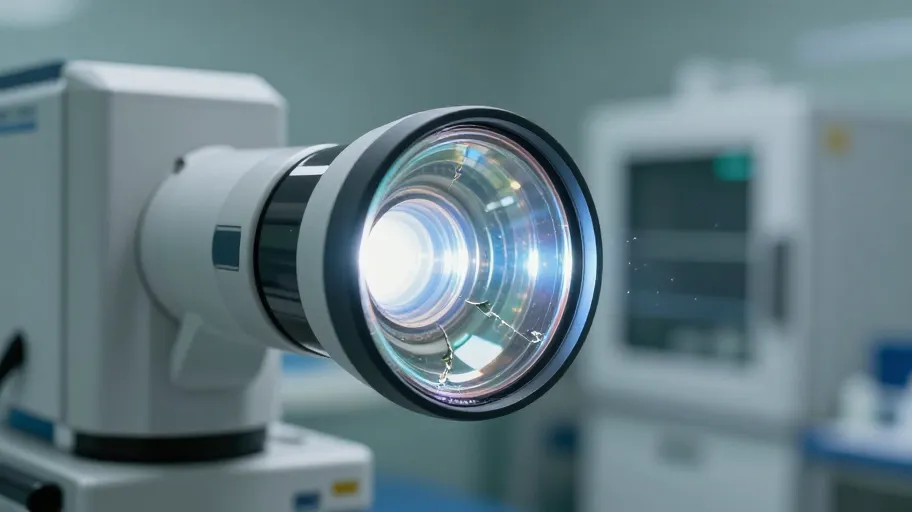
99% light transmission sounds perfect—until your endoscope starts fogging after sterilization. That extra 11% transmission from an anti-reflective coating means clearer medical images and earlier disease detection because more usable light reaches the sensor. But this benefit only holds if the coating survives real-world stress. In high-moisture, high-heat environments like hospital autoclaves, many AR coatings delaminate or micro-crack, causing optical distortion and glare. One medtech firm saw a 35% increase in image noise after just 50 cleaning cycles—not because the sapphire failed, but because the coating wasn’t designed for durability. So while the factory’s spectrophotometer readout looked flawless, the actual diagnostic performance degraded fast.
How generic coatings hide behind perfect lab numbers
Many sapphire crystal China factories use off-the-shelf AR formulas optimized for peak transmittance in stable conditions, not clinical reuse. This means they deliver excellent initial performance but fail under thermal cycling or chemical exposure because the coating wasn’t modeled for long-term adhesion. A study by an independent optics lab found that 40% of coated sapphire samples failed ASTM F1980 aging tests due to moisture ingress at the substrate interface. For device makers, this translates to unexpected field failures, requalification delays, and regulatory scrutiny. The problem isn’t capability—it’s misalignment. These factories have ion-assisted e-beam tools and ISO certification, but without clear input on environmental profiles, they optimize for yield, not longevity.
The real cost of skipping application-specific validation
Assuming all AR-coated sapphire performs the same can lead to six-figure losses. One U.S. OEM avoided $620,000 in requalification costs by requiring side-by-side testing of three AR formulations under accelerated aging. All showed >99% initial transmittance, but only one maintained signal-to-noise ratio after 300 autoclave cycles. This means engineering teams save months in time-to-market and avoid late-stage redesigns because they validate performance upfront. Without this step, failure often appears suddenly—after hundreds of units are already deployed. The cost isn’t just financial; it includes patient risk, brand damage, and lost trust in what should be a reliability upgrade.
Four questions that separate reliable suppliers from paper tigers
When a supplier proposes an AR coating change, asking the right questions protects your ROI. First: Over what wavelength range and angles does the 99% transmission apply? This matters because endoscopic imaging uses oblique lighting paths—off-angle performance is critical. Second: What do post-thermal cycling transmittance measurements show after -40°C to +85°C exposure? This means the coating won’t crack during shipping or use because it’s tested for expansion stress. Third: Is adhesion verified via ASTM D3359 tape testing or ISO 20502 scratch testing? That proves resistance to peeling during cleaning. Fourth: Was the design modeled using your system’s optical tolerances? If not, the coating may cancel the wrong wavelengths. These aren’t checkboxes—they’re safeguards against hidden failure modes.
How disciplined collaboration beats cheaper bids every time
Vertical integration in a sapphire crystal China factory means faster turnaround and tighter process control because everything from boule growth to coating happens in-house. But this advantage becomes a liability if communication breaks down. One manufacturer cut costs by switching suppliers, only to face recalls when their new vendor used a broadband AR formula unsuited for near-infrared imaging. The fix? Treating coating selection as a co-engineering effort, not a procurement decision. By sharing full environmental profiles—including steam exposure, pH levels, and cycle counts—they enabled the factory to tailor the stack design. The result: a 40% longer service life, fewer replacements, and stronger IP around their optical system. In mission-critical devices, the cheapest component often becomes the most expensive one.