
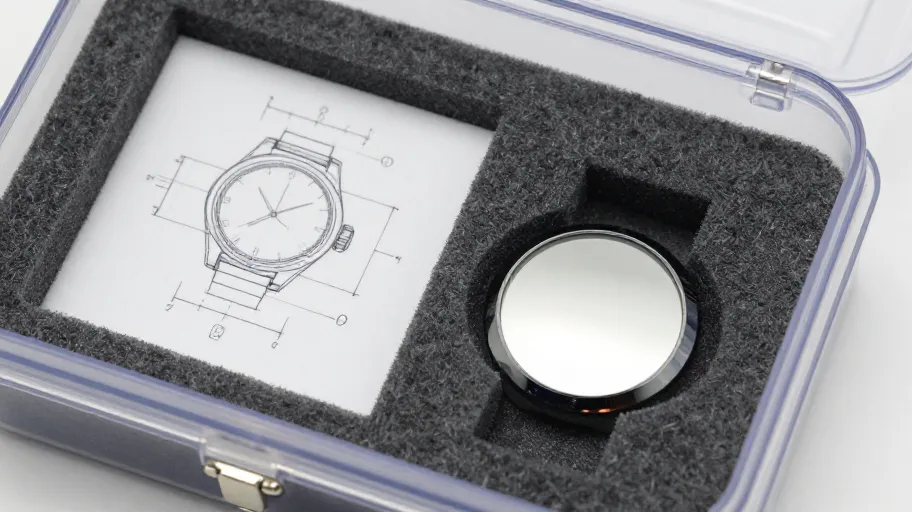
When you source a custom sapphire watch crystal, your leverage sits in three documents: the dimensional drawing, the finish specification, and the packaging instruction. Approve a supplier against the D.F.P. framework — Drawings, Finish, Packaging — and you convert an opaque quotation into a verifiable engineering agreement. Every tolerance, coating option and transit-protection requirement should be written, questioned and signed off before production begins.
The D.F.P. framework: three gates before approval
Most sourcing disputes about custom sapphire watch crystals trace back to something that was never written down. The D.F.P. framework forces three explicit gates:
- Drawings — geometry, dimensions, tolerances, edge treatment and datum references, communicated as a dimension sheet or technical drawing.
- Finish — surface polish, flatness, coating type and coating coverage, defined in words the supplier must acknowledge.
- Packaging — how each crystal is separated, protected, labelled and shipped, specified before the first order, not after the first damaged shipment.
A supplier who answers all three gates in writing is one you can audit. A supplier who answers only in price is one you can only hope about.
Gate one: tolerances and the drawing package
A custom sapphire watch crystal is machined and polished from synthetic sapphire, and every geometric feature — thickness, diameter, chamfer, bevel angle, dome profile, step or date-window cut-out — carries a tolerance. What matters commercially is not whether tolerances exist, but whether both parties have agreed on them in writing.
When you prepare your drawing or dimension sheet, make sure it covers:
- Every dimension with a stated tolerance band, including thickness at the centre and edge.
- Edge and bevel definition, including which surface the bevel angle is measured from.
- Coating callouts, if any, marked separately from polish.
- Datum references, so inspection measurements mean the same thing at both parties.
- Critical-to-quality features, flagged so the supplier knows where to focus inspection.
Because achievable tolerance bands depend on crystal shape, size, feature mix and each manufacturer's process capability, never accept a verbal figure. Ask the supplier directly: "What tolerance band can you hold for this geometry, and what is your measurement method?" Document the answer on the drawing. Do the same for anything you read here — no specific tolerance figure is claimed in this article, and none should be assumed.
Gate two: finish, polish and coating
Finish is where visual quality lives, and where disagreements get expensive. Before approving a finish specification for your custom sapphire watch crystal, ask:
- What surface polish specification does the supplier quote against, and how is it inspected?
- Is anti-reflective coating available, on which faces, and how is coating presence verified at incoming inspection?
- How are coating defects — if any are permitted — defined, counted and dispositioned?
- What does the supplier consider a rejected versus accepted surface, in measurable terms?
- Can you get first-article or pre-production parts to approve finish before the balance runs?
Do not rely on marketing language such as "flawless" or "premium." Translate every finish expectation into an inspection question and get it answered in the quotation document. Coating performance claims in particular should be verified with the supplier's own current test evidence, specific to your part — never assumed from general descriptions.
Gate three: packaging and delivery protection
Sapphire is hard but brittle, and a crystal that survives machining can still be lost to poor packing, edge chipping from crystal-to-crystal contact, or unlabelled mixing of near-identical variants. Packaging is a specification, not a courtesy.
Put in writing:
- How each crystal is separated and cushioned.
- How different variants (sizes, coatings, thicknesses) are labelled and segregated.
- What inspection or count verification happens at dispatch.
- What the buyer should do, and whom to contact, if damage or shortage is found on arrival.
Sample policy, shipping cost responsibility, fee treatment and any replacement terms are commercial policies that change over time and differ between suppliers. Confirm the current policy directly with the supplier in writing before ordering, and treat the written confirmation as part of your approval record.
Decision table: comparing supplier responses
| Evaluation item | Strong response | Weak response | Action if weak |
|---|---|---|---|
| Tolerance confirmation | Written tolerance band per feature, with measurement method | "Standard tolerance" with no definition | Request feature-level written confirmation |
| Drawing review | Supplier marks up your drawing with questions | Quote given with no drawing query | Ask for a documented drawing review |
| Finish specification | Inspectable polish and coating criteria stated | Adjectives only | Convert to inspection questions |
| First-article approval | Pre-production parts offered for approval | No interim inspection point | Negotiate an approval step |
| Packaging spec | Written separation, labelling and dispatch checks | Unspecified | Attach a packaging instruction |
| Commercial terms | Current MOQ, pricing, lead time and sample policy stated in writing | Deferred or vague | Confirm current policy directly before ordering |
Pre-approval checklist
Before you release an order for a custom sapphire watch crystal, confirm each item:
- Dimension sheet or drawing issued, with tolerances and datums.
- Supplier's written tolerance confirmation per critical feature.
- Finish and coating specification in inspection language.
- First-article or pre-production approval step agreed.
- Packaging and labelling instruction attached to the PO.
- Current MOQ, price, lead time and sample policy confirmed in writing.
- Damage/shortage handling route named.
- Named contact for engineering questions during production.
Frequently asked questions
What should I send to start a custom sapphire watch crystal quotation? A dimension sheet or technical drawing with tolerances, material expectation, coating requirement, target quantities and the case or movement interface the crystal must fit. The more complete the drawing, the fewer rounds of clarification.
How do I know the tolerance a supplier can actually hold? You ask, in writing, for this geometry. Machining and polishing capability depends on the part's shape, size and features, and varies between manufacturers. Document the supplier's stated band and hold them to it at inspection.
Is anti-reflective coating something I should specify per face? Yes — put coating on the drawing: which faces, and how presence is verified. Coating coverage and performance claims should be confirmed against the supplier's current evidence for your specific part.
What packing detail matters most for crystals? Individual separation to prevent edge-to-edge contact, clear labelling of variants, and a documented arrival-check procedure so any damage is reported through the agreed route.
How do I compare two suppliers quoting the same crystal? Compare their responses on the decision table above: tolerance confirmation, drawing review quality, finish inspectability, approval steps, packaging spec and written commercial terms. The supplier who documents more is the lower-risk choice.
Send your drawing
Submit a drawing or dimension sheet to JadeZone Sapphire — a Shenzhen and Hong Kong B2B manufacturer of custom sapphire watch crystals and precision sapphire components — and open the first gate of the D.F.P. process.
Not ready yet? Run the pre-approval checklist above against your current specification before you send anything. It is the fastest way to find the gaps your supplier would otherwise find for you.