
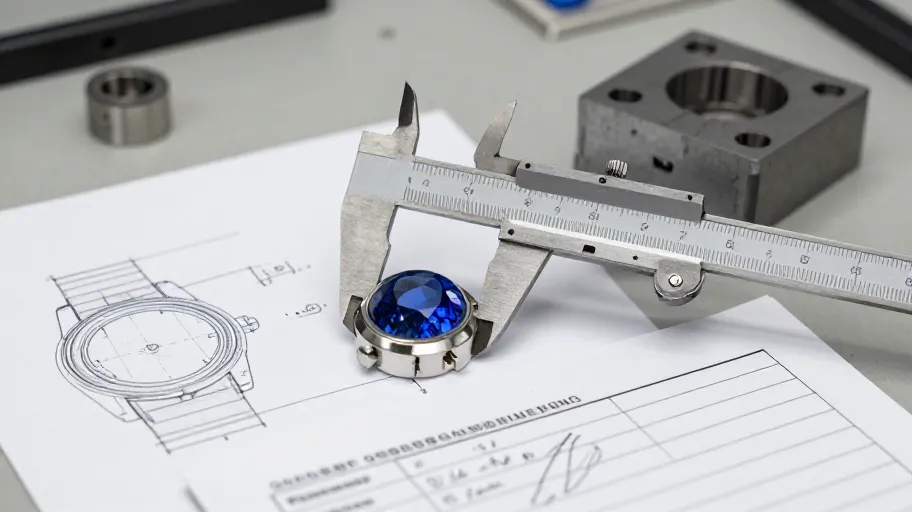
Getting a domed sapphire watch glass from approved sample to volume production requires four documented gates: approve the physical geometry against a frozen drawing, freeze every specification that defines the dome, verify that production tooling and process match the approved sample, and agree in writing how any deviation is raised, reviewed and approved. Buyers who skip documentation end up arguing about intent; buyers who document compare suppliers on evidence.
The hand-off is where supplier comparisons are actually decided
This is why product comparison for custom sapphire crystals should focus on process behaviour, not brochure claims. Terms such as MOQ, price, sample fees, lead time, tolerances and shipping arrangements are all project-specific and subject to change; confirm each one directly in writing before comparing quotations. No article — including this one — can state those facts for you.
The Sample-to-Production Gate (SPG) framework
Use four gates. Do not advance to the next gate until the previous one is documented.
Gate 1 — Approve geometry. Physically inspect the domed sapphire watch glass sample with calipers, a profile projector or optical measurement, and compare it against the drawing you submitted. The dome is defined by measurable parameters — put each one on the drawing:
- Diameter (or length and width for shaped crystals)
- Apex height (the height of the dome at its centre)
- Base thickness (thickness at the edge)
- Radius of curvature, or the equivalent arc definition
- Edge profile: bevel angle, bevel width, or step/flange geometry
- Surface finish on both faces, and any coating specified by name, not description
Gate 2 — Freeze the specification. Convert every parameter above into a controlled document: revision number, date, approval signatures from both parties. "Domed, like the sample" is not a specification. A frozen drawing with named parameters and agreed measurement methods is. If a coating is involved, name the coating type and the inspection method used to verify it — and ask the supplier to state in writing how coating consistency is checked between sample and production.
Gate 3 — Verify process transfer. Before the production batch, ask the supplier to confirm in writing which tooling, fixtures and measurement references production will use relative to the sample. Ask how first-article parts from production tooling will be compared to the approved sample, and who signs that comparison. This is where vague suppliers reveal themselves: those who cannot describe the transfer step are asking you to trust memory rather than documentation.
Gate 4 — Document deviations. Agree the deviation loop before production starts: what the supplier must do when a production part falls outside the frozen spec, how quickly they raise it, what evidence they provide, and whether re-approval from your side is required. A supplier who proposes this loop unprompted is demonstrating a process; a supplier who resists it is demonstrating a risk.
Decision table: comparing suppliers at the hand-off
| Hand-off behaviour | Weaker signal | Stronger signal | What to verify |
|---|---|---|---|
| Geometry definition | "We'll match the sample" | Frozen drawing with apex height and radius, revision-controlled | Ask to see the document template they use |
| Sample approval | Verbal or email approval only | Signed approval record referencing the drawing revision | Confirm who signs on each side |
| Process transfer | No stated link between sample and production tooling | Written first-article comparison against the approved sample | Ask how first articles are measured and reported |
| Deviations | Raised after delivery, informally | Deviation raised before shipment with evidence and approval loop | Ask for the escalation path and expected evidence |
| Measurement method | Unstated | Named instruments and methods per parameter | Confirm which parameters they can measure in-house |
| Commercial terms | Stated verbally | Quoted in writing per project | Confirm MOQ, price, lead time, sample and shipping policy directly |
Approval questions to put in writing
Copy these into your RFQ or hand-off record:
- Which drawing revision are you producing against, and who approved it?
- How will you measure apex height and curvature on production parts, and with what equipment?
- What is your first-article procedure relative to the approved sample, and will we receive the measurement report?
- If a production part deviates from the frozen spec, what is your escalation process and what evidence will you provide?
- How is coating type named and verified across sample and production, if a coating is specified?
- What are the current MOQ, price, lead time, sample policy and shipping arrangements for this project — confirmed in writing?
- Who is our named contact for production-stage engineering questions?
None of these have universal answers, and any supplier's current policy may change — which is exactly why they belong in writing per project.
The deviation loop in practice
A deviation is not automatically a failure. Machining hard materials at production scale can produce parts that differ from a sample; the question is whether the difference is surfaced, evidenced and approved rather than discovered at incoming inspection. When a supplier proposes a deviation:
- Request the measured values against the frozen drawing.
- Ask what changed in the process, and whether the change is permanent.
- Decide explicitly: approve the deviation, request rework, or reject.
- Record the decision against the drawing revision.
This loop protects both parties. It converts disagreements about memory into comparisons against a document.
Frequently asked questions
How is a domed sapphire watch glass specified so two suppliers quote the same part? By naming the geometry parameters — diameter, apex height, base thickness, radius of curvature and edge profile — on a revision-controlled drawing, plus surface finish and any named coating. Suppliers quoting against the same drawing can be compared; suppliers quoting against descriptions cannot.
What should I check on the sample before approving it? Measure the sample against your drawing with your own instruments or an agreed third-party method. Verify dimensional parameters, inspect both surfaces under magnification, and confirm the coating matches what was specified by name. Document the results in the approval record.
What is a first-article comparison? A check where initial parts from production tooling are measured against the approved sample and the frozen drawing, with the results reported to you before the batch continues. Ask each supplier to describe their first-article process in writing as part of your comparison.
How do I handle a production batch that differs from the approved sample? Return to the frozen drawing. Compare measured values, request the supplier's process explanation, and route the decision through the agreed deviation loop. If no loop was agreed beforehand, negotiate one for future orders and document it against the drawing revision.
Should pricing and MOQ be part of the hand-off record? Yes. Confirm current MOQ, price, lead time, sample policy and shipping arrangements in writing per project, because these terms are project-specific and may change. Treat any figure not confirmed in writing as unverified.
Next step: request a curvature review
The fastest way to test a supplier's process discipline is to ask them to review your dome geometry before anything is frozen. Request a curvature review from JadeZone Sapphire: submit your drawing or sample intent, and use the review to see how precisely curvature, apex height and edge profile are questioned, documented and confirmed — the same behaviours you will rely on at every gate afterwards.
Low-friction alternative: the hand-off checklist
Not ready for a review? Run this checklist internally first:
- Dome geometry fully parameterised on a drawing (diameter, apex height, base thickness, radius, edge profile)
- Surface finish and any coating specified by name and verification method
- Sample approval recorded against a drawing revision, signed by both parties
- First-article comparison procedure requested in writing
- Deviation escalation loop agreed
- MOQ, price, lead time, sample and shipping policy confirmed directly in writing
- Named engineering contact for production questions agreed
Every box you tick moves risk out of memory and into documentation — and makes your next supplier comparison an evidence-based one.